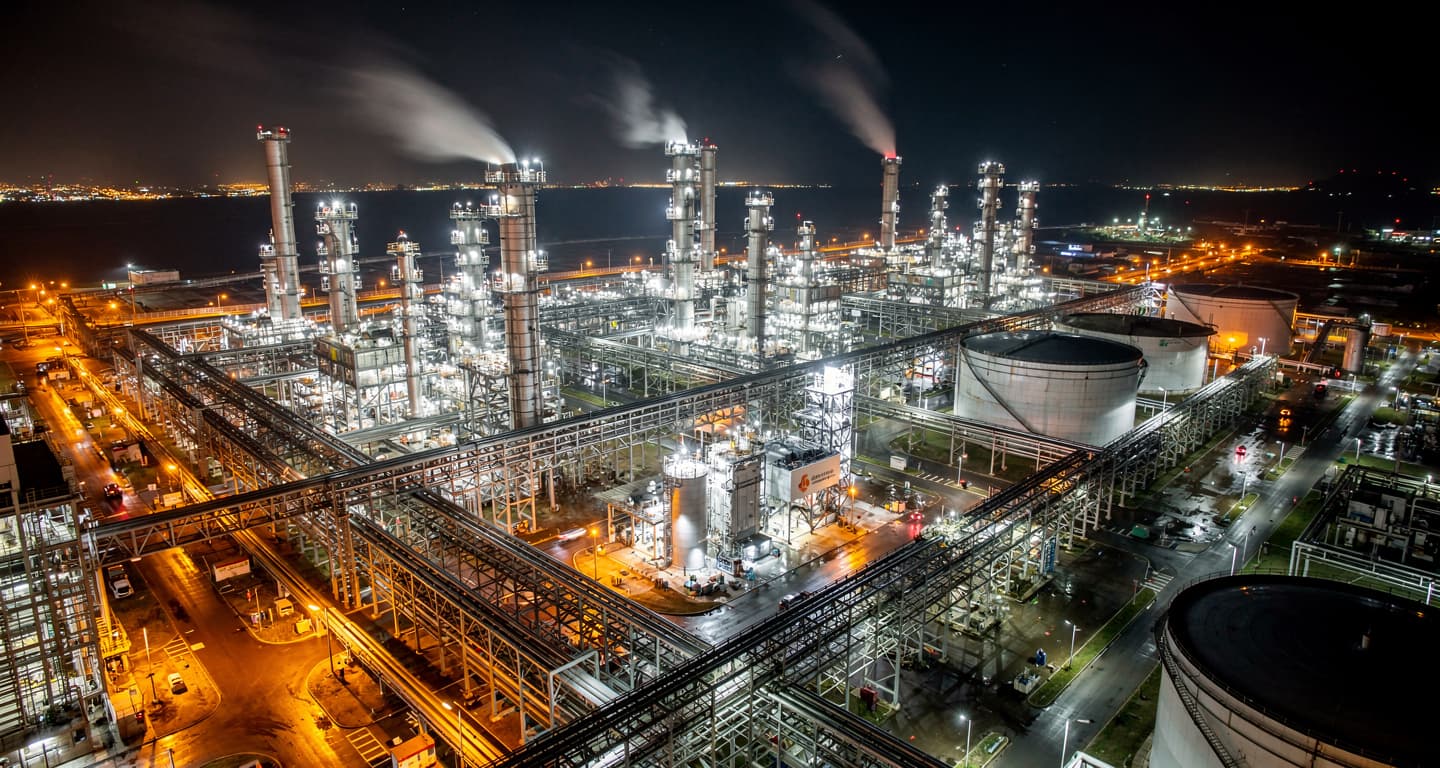
Petronas Chemicals Group Bhd lost roughly 34% of its share value in the two weeks to mid-June 2026, closing at RM3.83 and trimming the group’s market value to RM30.64 billion. The slide followed a US-Iran memorandum of understanding signed in June 2026 that commits Washington to lift the naval blockade of the Strait of Hormuz. TA Research and Maybank Investment Bank both cut the stock to “sell”.
Maybank lowered its FY2026 core net profit forecast by 31%, to RM2.07 billion. The downgrades signal that the conflict-driven premium in petrochemical prices is being priced out.
Strip out the war and look at the business. Petronas Chemicals Group Bhd trades today at RM3.83 a share — and almost none of the move that got it there was about chemicals.
The stock surged as much as 107% to RM6.13 after the Strait of Hormuz closed in early 2026. Feedstock from Malaysia, not the Gulf, made the company look insulated while rivals scrambled. Traders priced that scarcity in fast.
Now they are pricing it out just as fast. A US-Iran memorandum signed in June 2026 promises to reopen the strait within 30 days, and the rally has reversed. TA Research and Maybank Investment Bank have both moved the stock to “sell”.
The question is not why the shares fell. It is what was holding them up in the first place.
The rally was rented, not owned
The clearest read sits in one figure. On May 31, 2026, Petronas Chemicals closed at RM5.68. By mid-June it was at RM3.83 — a fall of roughly 32% from that late-May level, with no change in the company’s plants, its 54 production lines, or its demand book.
Mohd Nazri Khan, head of research at TA Securities, argues the reopening of the strait acts as a de-rating catalyst. It removes the geopolitical premium that lifted petrochemical prices, he says, and spreads should drift back to pre-conflict levels. His firm cut its target price to RM4.32 from RM6.56.
Maybank’s Wong Chew Hann frames it as the end of an event-driven super cycle. She cites weaker demand, lower plant utilisation and falling urea prices, and points to Chinese capacity still climbing. Maybank’s revised core net profit forecast for FY2026 is RM2.07 billion, down 31% from RM3 billion.
The commodity tape backs the analysts. Asian polyethylene prices fell about 12% between early May and mid-June 2026 as Gulf supply routes reopened, on ICIS benchmark assessments. These are fast-moving spot figures, and the spread normalisation is still unfolding rather than settled.
So the downgrades are documented. What they do not yet explain is why a domestically supplied producer was ever this exposed to a strait it does not ship through.
A premium priced on a chokepoint
The mechanism is simpler than the story. The Strait of Hormuz carries a large share of Gulf petrochemical exports, and when it closed, Asian buyers lost a supply line overnight. Prices for polyethylene and aromatics jumped on scarcity, not demand.
Petronas Chemicals never shipped through that strait. It draws on Malaysian feedstock. But its products are priced against a regional benchmark set partly by Gulf flows — so when those flows stopped, its margins rose on a shortage it had no part in. The premium was geography’s, not the company’s.
Brent crude tells the same story in reverse. Futures fell to around USD 72 a barrel by June 21, 2026, from peaks above USD 95 during the conflict, on US Energy Information Administration spot data. The risk premium is unwinding across the whole energy complex.
For a Western fund holding the MSCI Emerging Markets Energy & Materials segment, the lesson is direct: a position that looked like a chemicals bet was a Hormuz bet wearing a Malaysian label. When the strait reopens, the trade and the company part ways — and the question from the opening answers itself.
Beyond the headline
The money trail
The surge and slide show how fast geopolitical risk can drown out fundamentals in commodity-linked stocks. Short-term traders and funds positioned for supply shocks captured the upside. Long-horizon holders now face a reset to earnings driven by ordinary capacity, utilisation and demand cycles rather than wartime scarcity.
The timing
The downgrades land just as markets pivot from pricing disruption to pricing a settlement and renewed Iranian exports. That inflection coincides with a broader rotation out of energy and materials into high-growth sectors like AI hardware. The effect is sharpest on names whose gains sat inside the conflict window rather than across multiple cycles.
The bigger picture
The episode exposes a structural weakness: Asian petrochemical champions stay exposed to chokepoints like Hormuz even when they source feedstock at home. As capacity expands in China and the Gulf, the advantage shifts to low-cost, scale producers. Firms like Petronas Chemicals must compete on efficiency and integration, not location windfalls.
Your exposure to a strait you may not have noticed
With the US-Iran MoU due to take effect within 30 days and Q2 results landing in August 2026, anyone with capital in the sector faces a near-term call.
- Emerging-market fund holders
Review the sector weights in any ETF or fund you hold that tracks emerging-market energy and materials, including those benchmarked to the MSCI Emerging Markets Energy & Materials segments, through your brokerage or the fund’s official site. Decide whether petrochemical concentration still matches your risk tolerance now the Middle East premium is fading.
- Global chemicals investors
Track the International Energy Agency’s monthly Oil Market Report on iea.org through the September 2026 quarter to see how US-Iran de-escalation feeds into oil and petrochemical prices. Use those trends before adding to or trimming exposure to producers like Petronas Chemicals, SABIC or Sinopec.
- Income-focused shareholders
Watch PetChem’s Q2 FY2026 results and dividend guidance in August 2026. Confirmation of weaker spreads and lower utilisation would point to softer payouts; resilient margins and a stable dividend would offer the share price some floor.
Explainer
- Strait of Hormuz
- A narrow sea passage between Iran and Oman linking the Persian Gulf to the open ocean. It carries a large share of the world’s seaborne crude oil and Gulf petrochemical exports, making it one of the most-watched chokepoints in energy markets. Its closure in early 2026 cut Asian buyers off from Gulf chemical supply, which is what lifted regional prices and, with them, Petronas Chemicals’ margins.
- De-rating
- A fall in the valuation multiple investors are willing to pay for a company’s earnings. It often happens when the reason for a premium — a supply shock, a growth phase — disappears, even if profits have not yet dropped. Analysts flagged PetChem as a de-rating risk because its premium rested on conflict-driven scarcity rather than durable demand.
- Memorandum of understanding (MoU)
- A signed statement of intent between parties that sets out commitments without the full binding force of a treaty. The leaked 14-point US-Iran version reportedly commits Washington to lift the Hormuz naval blockade and end oil sanctions within 30 days, while Iran pledges never to build nuclear weapons. Its non-binding nature is why analysts still price in the chance talks stall.
- Urea
- A nitrogen-rich compound used mainly as fertiliser and as a chemical feedstock. Its price tracks natural gas costs and farm demand, and it is a meaningful earnings line for integrated producers like Petronas Chemicals. Spot urea in Southeast Asia fell from around USD 420 a tonne in April 2026 to near USD 330 by mid-June, squeezing nitrogen-related margins.
RELATED STORIES