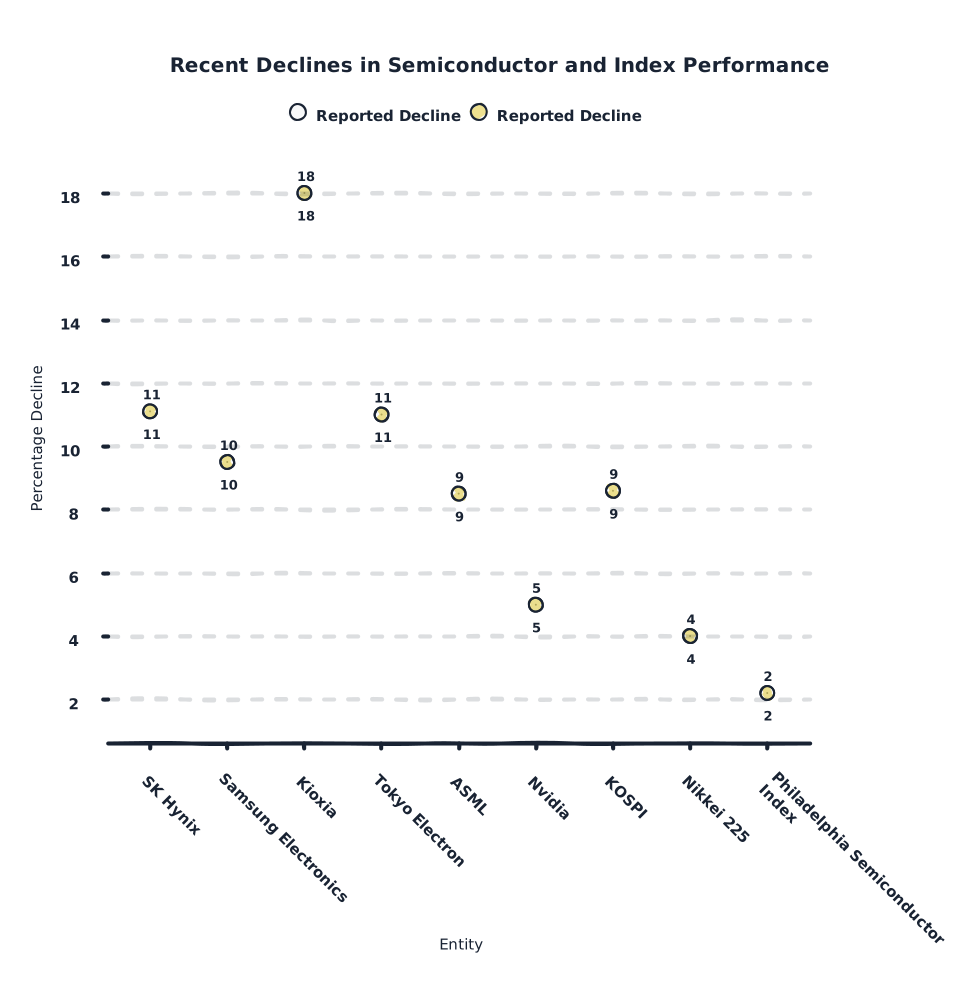
South Korea’s KOSPI index plunged 8.59% on July 28, triggering a 20-minute circuit breaker as Asian chipmakers led a region-wide rout. SK Hynix tumbled nearly 11%, Samsung Electronics shed more than 9%, and Japan’s Kioxia slid 18%, while the Nikkei 225 dropped 4%.
The selloff followed a 2.2% decline in the Philadelphia Semiconductor Index and reports that Nvidia had fallen 4.99% on July 27 after a Wall Street Journal report on roughly US$250 billion in financing guarantees for OpenAI. But oil’s nearly 9% drop on US-Iran de-escalation and the Federal Reserve’s rate decision due Wednesday are reshaping more than just chip valuations.
Two forces landed on Asian markets on July 28, neither of them the one that dominated the headlines. Oil prices collapsed nearly 9% after Washington suspended airstrikes on Iran and signalled productive talks with Tehran. China disclosed that it had begun producing domestically designed immersion deep ultraviolet lithography machines, the toolset that until now belonged entirely to ASML. The chip sector rout that followed looks like an AI bubble moment. It is more accurately read as a geopolitical repricing—one that changes the supply-and-demand assumptions beneath the world’s most valuable semiconductor companies.
The geopolitical forces the selloff masks
The numbers are severe. South Korea’s KOSPI fell 8.59% to 6,175.71 by 11:20 a.m. on July 28, after opening 5.26% lower. The exchange paused trading with a 20-minute circuit breaker—the first triggered in three months. But the single data point that sharpens the debate about AI infrastructure is the one that landed a day earlier: Nvidia shares fell 4.99% on July 27 after a Wall Street Journal report that the company is negotiating roughly US$250 billion in financing guarantees for OpenAI’s data-centre buildout. That decline preceded the broader Asia selloff on July 28.
Market participants read that as a signal that hyperscaler capex is shifting from chip orders to financial backstops, a far less certain foundation for valuations. Stephen Innes, a market strategist at SPI Asset Management, frames the repositioning bluntly. AI demand has not collapsed, he says, but investors are no longer willing to price those promises at any cost. The distinction matters: the question is not whether the buildout continues, but who funds it and on what terms.
Beneath the AI-anxiety narrative, two other forces are doing more structural work. Thierry Wizman, a currency and rates strategist at Macquarie Group, identifies the US-Iran dynamic and its effect on oil as the crucial determinant of the global macro backdrop this week. Brent crude slid to US$87.55 a barrel after a nearly 9% drop, pushing 10-year US Treasury yields down about four basis points to 4.64%. That is a cross-asset transmission mechanism—energy costs, inflation expectations, and central bank posture—that reshapes equity valuations more durably than a single earnings revision would.
The second force is China’s lithography disclosure. Han Ji-young, an analyst at Kiwoom Securities, says the domestic DUV equipment reports were enough to cool sentiment and raise fears of future memory-chip competition. Lee Gyeong-min, an analyst at Daishin Securities, goes further: a Chinese company’s immersion DUV equipment development could ease capacity bottlenecks in China and erode the supplier-friendly memory market structure that Korean and Japanese producers have depended on. According to Lee, wariness has grown that an expansion of Chinese memory supply could erode the current market structure.
The competitive landscape is shifting faster than most supply-chain models account for. The breakdown below shows the scale of the rout, but the geopolitical repositioning behind it is what will still matter when the circuit breaker memory fades.
The repricing is only partly about chips
The cross-asset read-through is what separates this selloff from a standard sector rotation. The Japanese yen traded at 163.78 per dollar, near a four-decade low, while the euro held around US$1.1370 and the Australian dollar sat just under 70 US cents. Markets are pricing a 38% probability that the Federal Reserve will raise rates by 25 basis points at its Wednesday meeting. If the Fed signals a tightening bias, dollar strength compounds pressure on Asian tech valuations. If it holds with softer guidance, the immediate shock should ease.
The Bank of Japan’s decision, expected by August 1, adds a second layer of currency risk. According to Wizman, if the BoJ’s messaging lacks sufficient hawkishness and the dollar strengthens further against the yen, traders should prepare for official Japanese action—verbal warnings, rate checks, or direct FX intervention—potentially as soon as Friday. That would turn a chip-sector correction into a broader Asia-Pacific financial event.
What is being repriced, then, is not just AI enthusiasm. It is the assumption that the geopolitical floor under chip supply chains—cheap energy, stable currencies, and a comfortable gap between Western tooling and Chinese alternatives—would hold through the next phase of the buildout. The evidence from July 28 suggests markets are no longer confident that it will.
Beyond the headline
The Bigger Picture
The AI buildout model is being re-evaluated, not abandoned. What changed on July 28 is that the market began pricing capital discipline alongside capacity expansion. When investors ask whether hyperscalers can fund the next phase, the names that command premium valuations are no longer the ones promising the most growth—they are the ones that can prove they are not overpaying for it.
The Money Trail
Pressure is shifting to the financing layer behind AI infrastructure. If Nvidia is backstopping US$250 billion in OpenAI data-centre commitments, the question is no longer whether chips sell. It is who underwrites the buildout when equity investors stop treating those commitments as scalable and start treating them as circular. The next phase depends on credit markets, not just order books.
The Timing
This week compresses three stress tests at once. US policy guidance lands on July 30. Japan’s currency risk crystallises by August 1. And AI enthusiasm, already fragile, must survive a higher-rate backdrop that makes infrastructure financing more expensive. The same trade can look durable in isolation. When all three land on the same calendar, positioning that looked solid a week ago gets exposed fast.
Three decisions before the week ends
With the Federal Reserve decision due July 30 and the Bank of Japan’s announcement expected by August 1, Western investors and companies with APAC semiconductor exposure face choices that cannot wait for the volatility to subside.
- US-based investor with APAC semiconductor exposure
Re-evaluate your weighting in Korean and Japanese memory names before the Fed decision. A tightening signal will strengthen the dollar and compress Asian tech multiples further—the 38% probability of a hike is low enough to leave positioning fragile if it materialises. Check the Federal Reserve statement on July 30 for the rate decision and wording, and monitor the Bank of Japan’s policy announcement for yen-intervention signals.
- Western semiconductor procurement manager
China’s domestically produced immersion DUV lithography disclosure changes supplier diversification timelines. The competitive gap in memory supply is narrowing faster than most sourcing models assumed. Map your exposure to Korean and Japanese memory producers, and begin scenario-planning for a market where Chinese capacity erodes the current supplier-friendly structure within 12 to 18 months.
- AI infrastructure investment analyst
Scrutinise the financing structures behind data-centre buildouts, not just the chip demand forecasts. Nvidia’s reported US$250 billion in guarantees for OpenAI signals a shift from product revenue to financial engineering. The sustainability question is not whether the buildout continues—it is who carries the capital cost when equity investors stop treating those commitments as assets and start pricing them as contingent liabilities.
Explainer
- KOSPI
- The Korea Composite Stock Price Index, the benchmark equity index of the Korea Exchange, tracking all common stocks listed. It is capitalisation-weighted and heavily influenced by the performance of Samsung Electronics, which alone accounts for roughly 20% of its value. A circuit breaker on the KOSPI halts trading for 20 minutes when the index drops more than 8% from the previous session’s close, a safeguard triggered only during extreme market stress.
- Immersion DUV lithography
- A chip-manufacturing technique that uses deep ultraviolet light passing through water to project circuit patterns onto silicon wafers with nanometre-scale precision. ASML of the Netherlands has dominated the immersion DUV market for two decades, making it a critical chokepoint in global semiconductor supply chains. China’s disclosure that it has produced a domestically designed version signals a narrowing of that bottleneck, even if the tool’s performance at the most advanced nodes remains unverified.
- High-bandwidth memory
- A type of stacked DRAM that processes data faster and more efficiently than conventional memory, making it essential for AI training and inference workloads. South Korean firms SK Hynix and Samsung Electronics supply the vast majority of the global market. The technology’s concentration in two suppliers makes it both a strategic asset and a vulnerability—any shift in competitive dynamics, including Chinese capacity growth, has disproportionate market impact.
- Yen intervention
- Official action by Japan’s Ministry of Finance and the Bank of Japan to buy yen and sell foreign currencies when the exchange rate moves too sharply. It typically escalates through verbal warnings, rate checks with commercial banks, and, as a last resort, direct large-scale currency purchases. With the yen trading near a four-decade low of 163.78 per dollar, traders are pricing in rising odds of intervention if the BoJ’s messaging this week fails to strengthen the currency.
RELATED STORIES