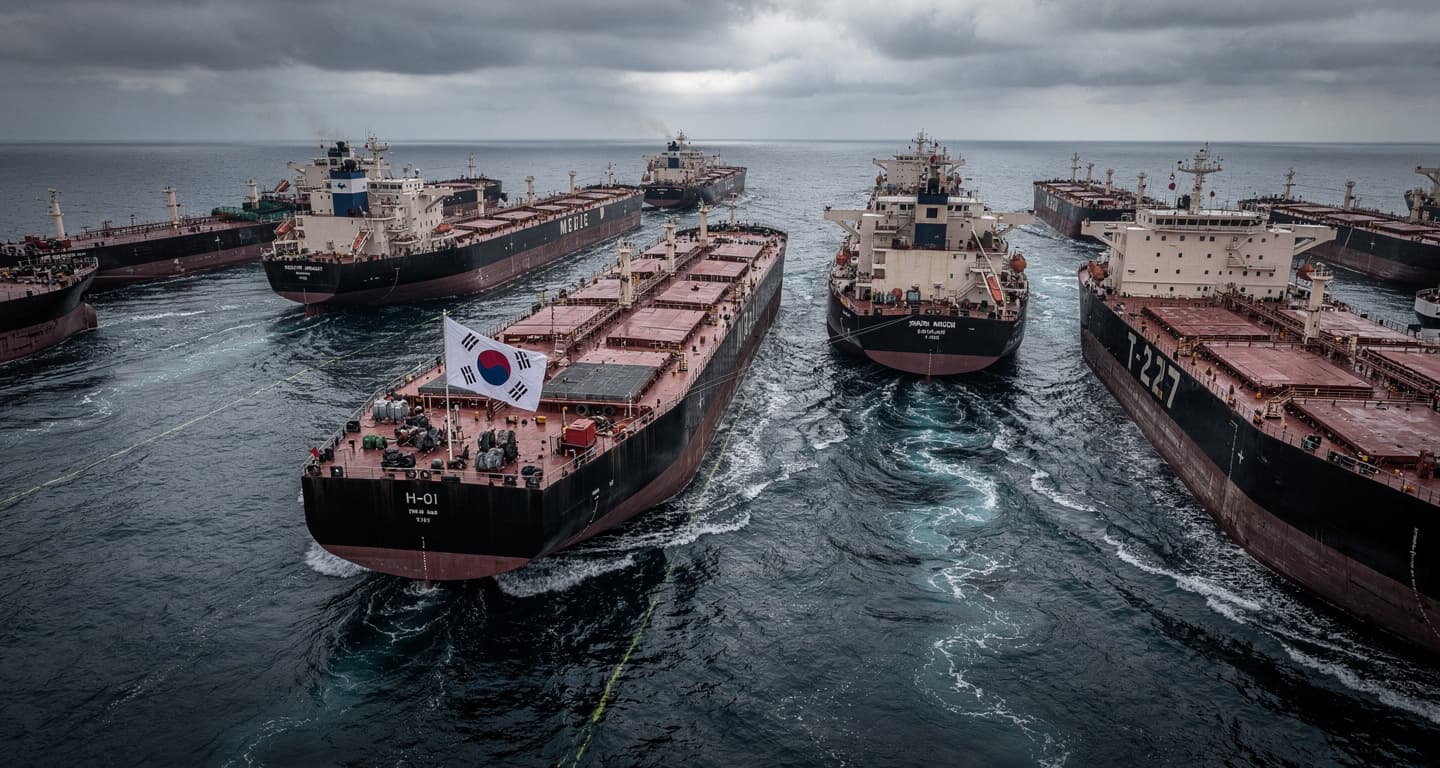
South Korea has built a foreign-ministry team to win Korean companies a place in Middle East reconstruction, formed weeks after the post-ceasefire diplomacy began. Foreign Minister Cho Hyun said on June 20, 2026 that Seoul rejects any toll for passage through the Strait of Hormuz, calling free navigation a core trade interest. Seoul has reportedly been weighed for a place in a $300 billion private investment fund tied to Iran.
Seoul and Kyiv have also reached a basic agreement in principle on transferring two North Korean prisoners of war held in Ukraine. A meeting set for June 30 is expected to test whether principle becomes practice.
Trading nations rarely wait for the shooting to stop before they start counting contracts. South Korea is no exception, and its foreign ministry has moved early. Weeks before any U.S.–Iran memorandum was signed, Seoul stood up an internal team aimed at one thing: getting Korean firms into the rebuilding of a Middle East that has just stopped fighting.
That is the real story here, not the headline about Hormuz tolls. The toll question is a matter of principle Seoul was always going to defend. The reconstruction push is a bet — that a country with shipyards, engineering depth, and embassies across the Gulf Cooperation Council can position itself as a post-conflict broker before the field is defined.
The pattern is familiar. After every regional war of the past three decades, the contracts went to whoever showed up with capacity and a plan, not to whoever arrived once the frameworks were written. Seoul has read that history. It is trying to arrive first.
Seoul is buying a seat before the table is set
The structure came before the opportunity, which is the tell. South Korea’s foreign ministry formed an internal Middle East economic task force on June 5, 2026, according to ministry statements, with the stated aim of securing supply-chain stability and pushing cooperation into higher-value industries. The team was built to map opportunities with the six GCC states and Iran before any formal request for help arrives.
That sequencing is deliberate. A senior ministry official has indicated that joining any reconstruction fund would be weighed as part of a broader strategy linking all six Gulf states and Iran — while stressing that no formal request has yet been made. One figure has circulated in connection with that effort: Seoul’s reported consideration for a $300 billion private fund for investment in Iran. That number should be read with caution, as it has not been independently confirmed.
On the maritime side, the position is firmer because it costs nothing to hold. A senior official has asserted that South Korea has never paid a toll for Hormuz passage and will not begin, framing freedom of navigation as essential to global trade and maritime order. As of June 20, by ministry accounts, roughly 22 Korea-linked vessels were still in the strait. For European refiners and shippers, that stance matters: while Hormuz stays politically contested, route risk stays priced into energy imports and freight contracts.
The harder question is the one the ministry cannot answer on its own. Whether early administrative positioning translates into actual project access depends on actors Seoul does not control.
The real leverage is bureaucratic, not naval
Seoul’s strength in this story is administrative. It can coordinate embassies, mobilize companies, and insert itself into reconstruction networks before rivals define the field. In post-conflict settings, that first-mover capacity often decides which governments and firms become hard to replace once contracts and security arrangements take shape.
The maritime piece works differently. South Korea holds no toll authority of its own, so its Hormuz position is diplomatic and commercial rather than regulatory. It is coordinating with the United Kingdom and France on navigation security, leaning on coalitions that keep lanes open rather than on any power to set rules. The briefed U.S.–Iran deal to extend the ceasefire and reopen the strait remains the external signal that governs the rest.
Then there is the human file that sits oddly beside the contracts. South Korea’s constitution treats North Koreans as citizens of the Republic of Korea — the legal basis Seoul cites in seeking two North Korean POWs held in Ukraine. The transfer is being handled as a consent-based move, not a forced handover, which limits what Seoul and Kyiv can do without the prisoners’ agreement.
Strip away the three tracks and one logic runs through them. Seoul is trying to convert a moment of regional instability into durable position — in the Gulf, in the shipping lanes, and over its own claimed citizens. Whether the early arrival pays off is the part history leaves open, because it usually has.
Beyond the headline
The timing
The clock that matters is the post-ceasefire window, not the reconstruction headline. If Hormuz stays open while regional governments start talking money, the bargaining shifts from crisis management to who gets invited first. That makes this week a transition point, because early diplomatic positioning can harden into project access, shipping influence, and coalition roles before formal frameworks are written.
The power behind it
Seoul’s real leverage is administrative, not military. It can coordinate embassies, mobilize companies, and insert itself into reconstruction networks before others define the field. In post-conflict settings, first-mover bureaucratic capacity often determines which governments and firms become indispensable once contracts and security arrangements begin.
The reach
For European refiners and shippers, the mechanism is straightforward: if the strait stays politically contested, route risk stays priced into energy imports and freight contracts. The less obvious implication is that even a South Korean diplomatic stance can affect how much uncertainty European buyers pay for in the next pricing cycle.
Three tracks worth watching this week
With the June 30 talks days away and Hormuz traffic still unsettled, three groups have decisions to weigh.
- Energy and shipping risk managers
Review your government’s maritime-security and energy-risk advisories for the Strait of Hormuz and Gulf lanes this week, especially if you are exposed to shipping, insurance, or fuel costs. Seoul’s refusal to accept a toll signals that route uncertainty, not a new fixed charge, is the variable to price in.
- Western firms eyeing reconstruction
If Seoul helps shape post-conflict contracting across Iran and the Gulf, it can influence who later gets access to projects and financing. Track which sectors the GCC and Iran prioritize, and treat South Korea’s industrial partnerships as an early indicator of where the doors open.
- Human-rights and policy observers
Check the South Korean Ministry of Foreign Affairs press releases for any formal update within 48 hours of the June 30 meeting. A transfer announcement would mark the moment Seoul moves from principle to practice on its claim over North Koreans abroad.
FAQ
Why does consent matter so much in the POW transfer?
South Korea says any transfer of the two North Korean prisoners must rest on their free will. That makes a consent check central before anyone can move. The June 30 talks matter procedurally as well as diplomatically, because a transfer without consent would undercut Seoul’s stated legal basis — its constitutional claim that North Koreans are its citizens.
Is there actually a toll being charged in the Strait of Hormuz?
Nothing in the available record shows a formal toll regime operating in the strait. Seoul’s statement is a rejection of a proposed or hypothetical charge, not an admission fee to an existing system. Any practical effect on shipping would depend on whether outside actors could enforce or normalize such a toll, which has not happened.
Does South Korea already have a signed role in Iran reconstruction?
No. The ministry official has said no formal request has been made, and Seoul is not described as holding a signed role in any Iran fund. The immediate question is whether South Korea becomes an early participant through informal coordination, or waits for a formal invitation with defined sectoral terms.
Explainer
- Gulf Cooperation Council
- A regional bloc of six Gulf states: Saudi Arabia, the United Arab Emirates, Qatar, Kuwait, Bahrain, and Oman. Formed in 1981, it coordinates economic and security policy among members holding a large share of the world’s oil reserves. South Korea’s reconstruction strategy treats the GCC and Iran as a single field of opportunity, which is unusual given the long rivalry between several Gulf states and Tehran.
- Strait of Hormuz
- A narrow sea passage linking the Persian Gulf to the open ocean, bordered by Iran and Oman. Roughly a fifth of the world’s traded oil moves through it, making any disruption a direct input into global energy and freight prices. South Korea’s refusal to accept a passage toll is rooted in the fact that no such charge has ever applied there, and accepting one would set a precedent for the chokepoint’s other users.
- Cho Hyun
- South Korea’s foreign minister, who set out Seoul’s twin position on Hormuz tolls and Middle East reconstruction on June 20, 2026. He confirmed the ministry began preparing for a post-war economy before any U.S.–Iran agreement was finalized. Seoul is also arranging a direct call between him and Iranian Foreign Minister Abbas Araghchi, a sign the reconstruction track runs through Tehran as well as the Gulf capitals.
RELATED STORIES