Kmart’s A$89 Anko camera glasses sold out within days of release, prompting Attorney-General Michelle Rowland to request an urgent privacy review from the Australian Privacy Commissioner. The review will examine whether existing laws can address risks of covert recording, harassment, and data misuse by mass-market smart glasses.
The core problem is structural: Australia’s federal privacy law binds organizations, not individuals, leaving state recording laws to govern what a wearer does in public. The commissioner’s assessment, expected in weeks, will determine whether the government treats cheap wearables as a new category of privacy threat.
Australia’s privacy regime draws a sharp line: it regulates what companies can do with personal data. It barely touches what a person wearing a pair of glasses can record on a train. That gap is now under emergency review. Attorney-General Michelle Rowland recently directed the Australian Privacy Commissioner to conduct an urgent assessment of smart glasses technology. The product that forced the question is a A$89 pair of Anko camera glasses from Kmart—a device that makes covert recording cheap enough to become ambient.
The glasses capture photos, video, and audio, then transfer the footage to a phone app for editing and sharing. The wearer does not need to raise a phone; a glance is enough. The law, built for visible cameras and explicit consent, never anticipated this. The commissioner’s review will decide whether the patchwork of state and federal rules can be stitched together fast enough—or whether the gap will widen as the devices get cheaper and more discreet.
The gap no one mapped until a pair of A$89 glasses sold out
The Kmart glasses became available in stores recently, pricing discreet recording within reach of any consumer. A comparable pair from Meta and Ray-Ban starts at $337. The price difference is not a footnote; it turns a novelty into a mass-market capability. The glasses run on HeyCyan software, and recorded content stays on the device until a user transfers it to a smartphone app—at which point it can be edited, shared, or published.
The regulatory problem is not just recording. It is who the law regulates. The Privacy Act and its Australian Privacy Principles set rules for how organizations handle personal information, but they do not apply to what a private citizen captures with a wearable camera. An individual wearing smart glasses in a café is not covered. “The framework never anticipated wearables that can quietly record people,” said Avinash Singh, principal lawyer at Astor Legal.
The chain of harm from covert capture to online harassment is not a single point but a sequence. The risks stack from the moment of recording to the point of distribution.
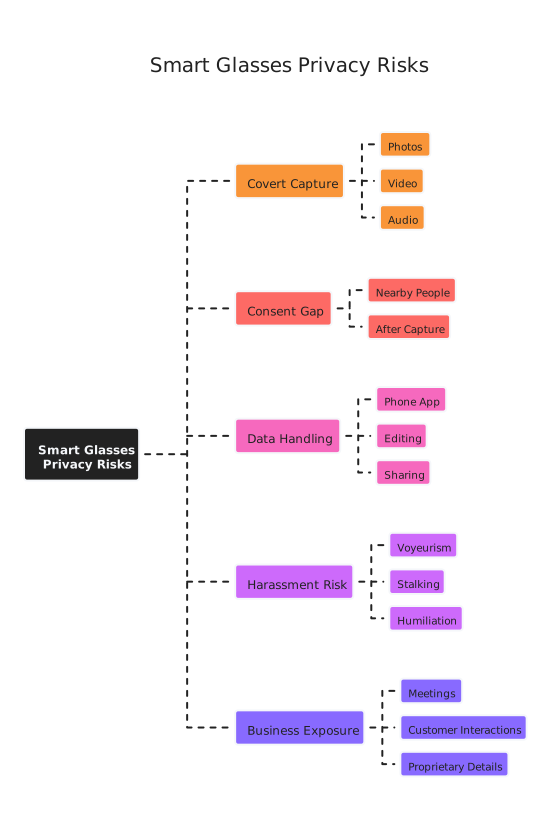
Fareed Kaviani of Monash University found that owners saw smart glasses as useful and fashionable, while non-owners were far more concerned about privacy. “Owners tended to regard smart glasses as useful, fashionable and consistent with their identity,” he said. That divide makes consent harder to manage. Milica Stilinovic of the University of Sydney said the core question is how the data is handled, by whom, and at what cost. Michelle Rowland herself flagged the detection problem: the glasses make it “harder to know when you are being recorded.”
| Entity | Current rule | New rule | Effective date |
|---|---|---|---|
| Privacy Act (Cth) | Applies to organizations with turnover >$3M; regulates collection, use, disclosure of personal information | Does not regulate an individual’s recording of others | Enacted 1988; amended 2014 |
| State surveillance devices laws (e.g., NSW) | Criminalizes recording private conversations without consent | No harmonized national standard; rules vary across states | Varies (e.g., NSW Surveillance Devices Act 2007) |
| Anti-doxxing laws (Criminal Code Act 1995) | Criminalizes online publication of personal information to menace or harass | Only applies after publication; does not prevent covert recording | 2024 amendments |
| eSafety Commissioner powers | Can compel removal of cyberbullying or cyberharassment material | Reactive, not preventive; no pre‑recording powers | 2015 (eSafety Commissioner established) |
| Source: OAIC, state legislation, federal Criminal Code | |||
The closest Western parallel is Meta Ray-Ban smart glasses, which have mainstreamed the category. The critical difference is scale and price. Kmart’s A$89 Anko model takes discreet recording from a premium accessory to a mass-market item, raising the regulatory stakes for ordinary public spaces. For Western companies, the issue is less novelty than cheap mass adoption of an already familiar surveillance capability.
The privacy commissioner’s review, if it leads to reform, will not just rewrite Australia’s rules. It will shape the design of wearables sold in Western markets within eighteen months. That is the timeframe manufacturers need to retool consent mechanisms and data-handling protocols—and the window regulators rarely seize before a product category hardens.
The patchwork that was stitched before recording became invisible
Individual wearers of smart glasses operate in a legal vacuum that organizational data handlers do not. When a person records with a wearable camera in public, the federal Privacy Act and Australian Privacy Principles—which govern organizational conduct—do not apply. Instead, state and territory surveillance laws take over, creating uneven treatment across jurisdictions. Unlike the EU‘s centralized approach under the GDPR, Australia’s framework fragments liability for wearers and companies, with no unified smart-glasses rulebook.
Fareed Kaviani pointed to consent as the core issue: smart glasses make recording faster, more continuous, and less visible. Milica Stilinovic said the central question is data handling—by whom, and at what cost. Avinash Singh emphasized that the law never anticipated wearables that can quietly record people. Together, their positions outline a problem that is simpler to name than to fix.
The commissioner’s review, due in weeks, is the first moment the pattern could break. Or confirm Australia’s reliance on a patchwork that was stitched together before recording became invisible.
Beyond the headline
The bigger picture
This is not a product story. It is a consent story moving from exceptional to ordinary. The baseline built around visible cameras and explicit permission no longer matches a world where recording is ambient. When the legal default assumes a person is not recording, and the device makes recording the default, the law is no longer aligned with the behaviour it is supposed to regulate.
What isn’t being said
The official discussion focuses on privacy harms. It downplays the difficulty of enforcing rules against a wearer in the moment. The most realistic intervention may be product design, store policies, and app-level controls. The enforcement target is often the person with the glasses, but the most effective lever may be the manufacturer and the platform.
The timing
This week matters because the trigger is not a hypothetical device. It is a cheap product already in customers’ hands. Once a mass-market price point appears, the review is no longer about fringe tech adoption. It becomes a test of whether regulators can react before the behaviour becomes normalised.
What the review means for anyone who wears, encounters, or builds these devices
With the privacy commissioner’s review now underway, the stakes spread across anyone who wears, encounters, or builds these devices.
- Australian consumer considering smart glasses
You need to understand that the legal landscape is shifting. Before buying, check the OAIC‘s guidance on surveillance devices and review your state’s recording laws. What is legal in Queensland—where a participant may record a conversation—may be an offence in New South Wales. The real risk rises when you share footage online; anti-doxxing laws and eSafety Commissioner powers can apply after publication.
- Australian business owner with public-facing operations
Your premises are now a potential recording zone. Update your privacy policies to include a no-recording rule, post visible signs, and train staff to identify and address smart glasses. Legal advice should cover state-specific consent requirements for audio recording. The eSafety Commissioner can help remove harassing content afterwards, but the best protection is preventing capture in the first place.
- Western tech company developing wearable devices
Australia’s response could set a precedent. Monitor the OAIC‘s findings and any federal reform bill. If Canberra mandates privacy-by-design for wearables—such as mandatory recording indicators or app-level consent checks—it will influence product roadmaps globally. Start mapping your device’s data flow and consent mechanisms now; the window for voluntary standards is closing.
- Australian legal professional specializing in privacy law
The commissioner’s assessment will clarify the gaps. Prepare to advise clients on compliance, potential tort liability under the Privacy Act for serious invasions of privacy, and the interaction between federal anti-doxxing laws and state surveillance statutes. The case law from this moment will define the next decade of wearable privacy litigation.
FAQ
Can I record in public with smart glasses in Australia?
The answer depends on the state or territory. Australia has no single national rule for individual wearable recording. In most jurisdictions, recording private conversations without consent can be an offence, but Queensland is different because a participant may record a conversation. The legal risk rises further when footage is shared online.
What happens if someone films in a changing room or bathroom?
Filming a person in a private or intimate circumstance—such as a bathroom or change room—without consent is a criminal offence. These locations are the clearest high-risk zones for smart-glasses misuse, and it is one reason the story is drawing attention from privacy and safety officials rather than only consumer-tech writers.
What legal tools exist after footage is posted online?
Several layers apply: anti-doxxing laws can apply if personal information is posted to menace or harass, and the eSafety Commissioner can seek removal of cyberbullying or cyberharassment material. Those remedies are post-publication tools, though, so they do not prevent the initial covert recording or stop the first upload.
Explainer
- Australian Privacy Principles
- The Australian Privacy Principles (APPs) are 13 rules in the Privacy Act that govern how most Australian government agencies and private sector organizations collect, use, disclose, and store personal information. They set standards for transparency, data quality, and security, and give individuals rights to access and correct their data. The APPs are technology-neutral, but they apply only to organizations, not to private individuals recording others with a wearable camera.
- Office of the Australian Information Commissioner
- The Office of the Australian Information Commissioner (OAIC) is the independent national regulator for privacy and freedom of information. It investigates complaints, conducts assessments, and advises the government on privacy law reform. The Australian Privacy Commissioner leads the OAIC, and the current commissioner was asked by Attorney-General Michelle Rowland to urgently assess smart glasses technology.
- eSafety Commissioner
- The eSafety Commissioner is Australia’s online safety regulator, established in 2015. It has the power to investigate and act on complaints about cyberbullying, cyberharassment, and image-based abuse. The commissioner can compel social media platforms and websites to remove harmful content, but its powers are reactive—they kick in after material is posted, not before a recording is made.
- State surveillance laws
- Each Australian state and territory has its own laws governing the use of surveillance devices, including listening devices and optical cameras. These laws typically make it an offence to record a private conversation without the consent of all parties, though exceptions exist—for example, Queensland allows a participant to record a conversation. The patchwork means a smart-glasses wearer crossing a state border could face different legal risks.
RELATED STORIES