
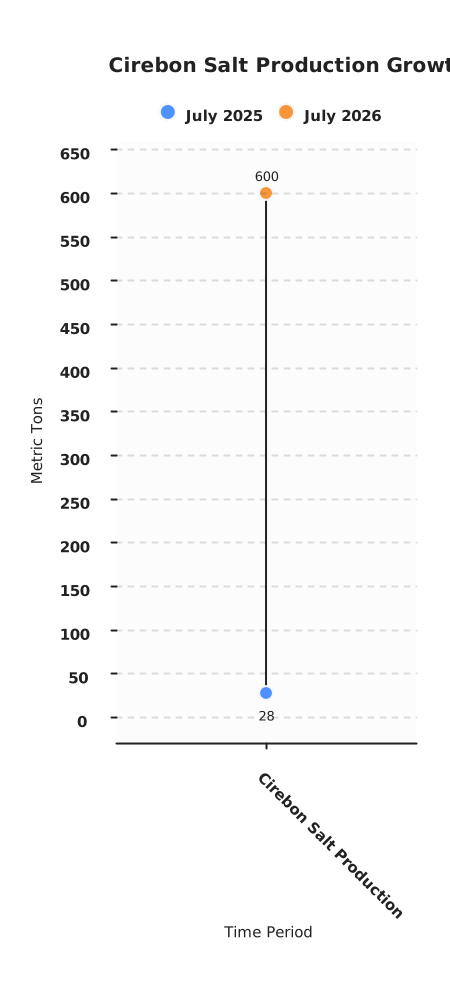
Salt farmers in Cirebon, West Java, harvested nearly 600 metric tons in July 2026, a more than twenty-fold increase from the 25–30 tons collected the same month a year earlier. The spike, driven by an intensifying El Niño drought, has turned a normally marginal dry-season window into an extended production bonanza.
The same weather pattern, however, has pushed wildfire hotspots nationwide past 5,000, exceeding counts from prior El Niño cycles. The government has launched emergency weather modification across six fire-prone provinces to protect water supplies and peatlands, while crop farmers are being forced to rewrite planting calendars.
On July 28, President Prabowo Subianto chaired a limited cabinet meeting to brace for what the Meteorology, Climatology, and Geophysics Agency (BMKG) warns will be a strong El Niño through the second half of 2026, with effects lingering into early 2027. Emergency weather modification operations — essentially cloud-seeding to replenish reservoirs and moisten fire-prone peatlands — have been ordered for six provinces, from Riau to South Kalimantan. The government’s response reflects the scale of the challenge: by July, more than 5,000 hotspots had been detected across the country, a sharp increase compared to previous El Niño years, while the extended dry weather is delivering the best harvest in years for salt farmers on Java’s north coast.
The drought that has seized Indonesia is not a single disaster — it is two stories running in opposite directions. In the coastal salt flats of Cirebon regency, the extended dry weather is delivering exceptional yields. Across the archipelago, the same conditions are turning peatlands to ash and pushing fire hotspots above 5,000 by July. For the thousands of crop farmers who must now adjust their calendars or risk failed harvests, the drought is a command. For the salt farmers on Java’s north coast, it is something else entirely.
A harvest built on heat
Cirebon’s salt fields cover 1,400 hectares. The production method is elemental: shallow coastal ponds are flooded with seawater, and the sun does the rest. Even one passing rain shower can thin the brine and stall crystallisation. This year, the region has recorded only a single light drizzle in the past month. The forecast from BMKG points to dry conditions persisting through October, giving the ponds an almost uninterrupted evaporation window.
“For us, El Niño is a blessing and a grace,” said Dadang Darmawan, head of a local salt farmers’ group. The sentiment is shared by the Cirebon Regency Food Security and Fisheries Agency, which confirmed the July harvest figures. The jump in output is large enough that one farmer, Darminto, told reporters he hoped the dry season would stretch longer so he could store more salt and earn the income that a normal rainy interlude would deny.
The national picture shows how powerfully the oscillation between El Niño and La Niña swings Indonesia’s salt output. In 2025, a La Niña-shortened dry season suppressed production to around 1 million tons. The previous El Niño, in 2023, yielded 2.5 million tons. Cucu Sutara, head of the Indonesian Salt Users Industry Association, said the prolonged dry period will “definitely” lift national production in 2026, though he declined to give a target. Whether gains outside Cirebon will match the regency’s surge remains an open question until the Ministry of Marine Affairs and Fisheries issues its post-harvest assessment later in the year.
The scale of the jump is easier seen than described.
| Entity | Current status | Action taken | Effective date |
|---|---|---|---|
| BMKG | Strong El Niño forecast for H2 2026 | Prioritising water replenishment and fire prevention via weather modification | July 28, 2026 |
| Presidential Secretariat | Limited cabinet meeting on drought and fire risk | Ordered cross-agency weather modification operations | July 28, 2026 |
| BNPB, Ministry of Forestry, private partners | Coordinating with BMKG | Conducting cloud-seeding in six priority provinces: Riau, Jambi, South Sumatra, West Kalimantan, Central Kalimantan, South Kalimantan | Ongoing since late July 2026 |
| Ministry of National Development Planning | Four-cluster policy brief prepared | Cross-sector risk management for food, natural resources, health, and energy | 2026 |
| Salt producers — Cirebon | Minimal rainfall, extended dry window | Expanding harvests; no direct government intervention needed | July–October 2026 |
| Source: Sekretariat Kabinet Republik Indonesia; BMKG; Reuters | |||
The uneven geography of a drought
The mechanism driving the salt windfall is the same one that is draining reservoirs and drying out fire-prone peatlands. Weather modification — the government’s main tool — is being routed entirely toward hydropower, irrigation, clean water, and wildfire suppression. The six priority provinces named on July 28 lie on Sumatra and Kalimantan, hundreds of kilometres from Cirebon’s coast. No cloud-seeding sortie is being flown to protect salt crystals; they simply do not need it.
BMKG has said that July 2026 was the driest July since 1991, and June was the eighth driest since records began. By early August, satellite monitoring had detected 5,690 hotspots. The same dry spell that is suppressing rain over Kalimantan’s peatlands is sustaining Cirebon’s evaporation ponds. The salt boom is a side effect of a policy apparatus aimed at preventing disaster elsewhere — an unintended redistribution of fortune rather than a managed outcome.
The next few months will test whether the salt harvest’s scale can be replicated nationally, or whether it remains a localized spike. BMKG updates through October and the Ministry of Marine Affairs and Fisheries’ post-season assessment will show whether the Cirebon windfall is an outlier or a sign of a wider supply shift. What is already clear is that the same climate signal is tightening water competition across the archipelago, and the cost is not being distributed evenly. The salt ponds are the rare place where the ledger shows a surplus.
Beyond the headline
The Bigger Picture
Indonesia’s El Niño story is really about climate winners and losers moving inside the same country at the same time. The same dry pattern that lifts salt evaporation also squeezes irrigation, reservoirs, and fire control, which means one weather system is redistributing income rather than just damaging output.
The Human Cost
For crop farmers, the drought is not abstract: planting calendars, irrigation schedules, and seed choices have to change fast or yields collapse. In places where water is already tight, households are also facing practical strain as competition rises between farm use, drinking water, and firefighting demand.
The Regional Split
Java’s north coast benefits from the dry spell in ways that Sumatra, Kalimantan, and drought-hit farming districts do not. That divergence matters because it can make the national picture look healthier on commodity data than it is on the ground, masking fire risk and food stress in other provinces.
Risks and openings as the dry season deepens
With the dry season forecast to persist through October and El Niño effects extending into early 2027, businesses and organisations with Indonesian exposure face a landscape of uneven risk. The tools to navigate it are specific and near-term.
- Western food commodity importer with Indonesian exposure
Assess your salt supply chains now. The surge in Cirebon’s output could foreshadow a national production increase — but that remains unconfirmed until the Ministry of Marine Affairs and Fisheries publishes its post-harvest assessment. Monitor BMKG’s dry-season bulletins for early signals of supply strength, and prepare contracting strategies for potential price softening in the fourth quarter of 2026.
- ESG investor with Indonesian agricultural holdings
The same El Niño that gifts salt producers is stressing crop-dependent assets. Review the climate resilience of holdings in rice, palm oil, and coffee against the four-cluster risk brief the government is using. Diversification toward salt or other solar-dependent production may be worth modelling, but be cautious: the Cirebon windfall is highly localised, and the broader drought could degrade asset values across water-stressed regions.
- Indonesian government affairs consultant for Western businesses
Advise clients that the policy centre of gravity has shifted from post-disaster response to preventive weather modification — a model that may become standard in El Niño years. The six priority provinces offer early entry points for public-private partnerships in cloud-seeding and reservoir management. Regulatory risks lie in possible water-use restrictions that could complicate industrial permits in drought-affected districts.
- Western aid organization focused on Southeast Asian food security
Direct resources toward farming communities in Riau, Jambi, South Sumatra, and the Kalimantan provinces, where drought stress is compounding fire risk. BMKG’s seasonal outlooks can guide programme timing; support for fast-track planting-calendar adjustments and emergency irrigation may mitigate crop losses before the October dry peak. The salt boom is a non-factor for food security; the humanitarian case is in the fire and crop belt.
Explainer
- El Niño
- A climate pattern driven by warmer-than-average sea surface temperatures in the central and eastern Pacific Ocean. It disrupts global weather, often bringing hotter, drier conditions to Southeast Asia and raising the risk of drought and wildfire. In Indonesia, El Niño tends to extend the dry season, which can suppress crop yields but also boost solar-dependent activities like salt production.
- BMKG
- The Meteorology, Climatology, and Geophysics Agency of Indonesia, responsible for monitoring weather, climate, and seismic activity. Headed by Teuku Faisal Fathani, BMKG issues seasonal outlooks and coordinates early warning systems. The agency is the government’s lead body for deciding when and where to conduct weather modification operations during drought.
- Weather modification
- The practice of using aircraft to disperse salt or other particles into clouds to encourage rainfall. Indonesia has used cloud-seeding since at least the early 2000s, primarily to fight forest fires and fill reservoirs. During the 2026 El Niño, the technique is being deployed proactively, not just after fires break out, with six provinces prioritised for regular operations to keep peatlands moist.
RELATED STORIES


