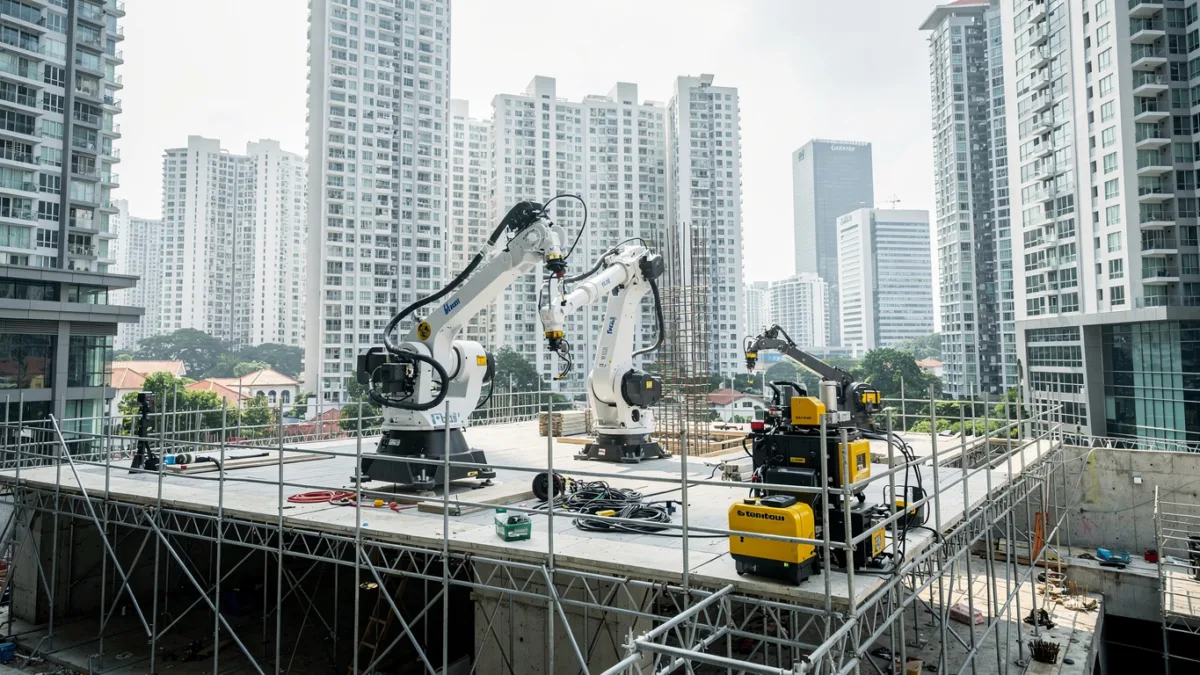
Singapore’s public agencies have begun mandating construction robots in government tenders, with JTC Corporation requiring them in all bids since late 2025 and the Housing Board piloting an autonomous tower crane at Tengah. The push comes as non‑residents make up nearly 80% of the sector’s 566,800 workers and construction labourer remains the top unfilled job.
The mandates are forcing a technological leap many contractors cannot yet afford. Painting robots cost up to S$180,000 and grants can take years to arrive, leaving a gap between what the state demands and what the market can profitably deliver.
Since late 2025, every construction tender issued by JTC Corporation has carried a new condition: robots must be part of the bid. The Housing Board followed, writing robotics into 16 of the 31 Build‑To‑Order projects tendered since last year. An autonomous tower crane is now being trialled at Tengah, with results expected by Q4 2026.
The mandates are not a response to contractor demand. They are a bet that the state can force a productivity leap the market has been unable to make on its own. The numbers behind that bet reveal the strain. Construction labourers were the top non‑PMET job vacancy in 2025. The sector’s 566,800 workers are roughly 80% non‑resident, and the foreign labour pipeline is tightening under rising levies and accommodation costs.
Edmund Ng, founder of Seng Soon Huat Construction, has been building in Singapore for years. He puts the problem simply: “Frankly speaking, whose son wants to go into a construction site?”
The mandates arrive before the business case
More than 25 robot types have now been used across about 60 projects, up from virtually zero in 2022, according to the Building and Construction Authority. Yet robots are present in only roughly 5% of larger projects. The gap between policy ambition and on‑site reality is wide, and it is not closing quickly.
The government’s Construction Industry Transformation Map targets 80% of firms adopting advanced technologies including robotics by 2030, up from around 30% in 2023. A S$1 billion BuildSG Transformation Fund launched in 2024 backs the push. But painting robots cost between S$80,000 and S$180,000, and grants can take two to three years to disburse. For small and medium contractors, that timeline makes the investment a balance‑sheet risk, not a productivity gain.
Andy Lu, assistant secretary‑general of the Singapore Contractors Association Limited and CEO of Wee Hur Construction, notes that many firms view robots as expensive experiments. They hesitate to purchase without a proven track record. The caution is not resistance to technology; it is arithmetic.
The real story is not that robots are arriving. It is that the state has decided to make them non‑negotiable before the business case has closed. The Land Transport Authority used robotic shotcrete and demolition machines on past MRT lines, and the Defence Science and Technology Agency deployed a robot to grade the NS Square stage — a 10,000 sq m surface where precision drainage slope was critical. Those deployments proved the technology works in controlled, well‑funded settings. Scaling across the industry is a different problem.
| Agency | Previous practice | New requirement | Effective date |
|---|---|---|---|
| JTC Corporation | No robotics requirement | Robotics mandated in all construction tenders | Late 2025 |
| Housing Board (HDB) | No robotics requirement | Robotics included in 16 of 31 BTO projects tendered since 2025; autonomous tower crane trial at Tengah | 2025, trial results Q4 2026 |
| Land Transport Authority (LTA) | Ad‑hoc use on past MRT lines | Robotic shotcrete and demolition machines used on recent projects; no blanket mandate yet | Ongoing |
At Japan’s Naruse Dam in 2023, Kajima Corporation operated 14 automated machines from a control room 400 kilometres away, running 70 hours without interruption. That benchmark is what Singapore’s agencies are watching. The autonomous tower crane at Tengah is the closest local equivalent, and its performance will shape the next round of mandates.
A procurement‑driven testbed, not a market evolution
Singapore’s approach is unusual. In Western markets, construction robotics appears through individual contractor initiatives — Boston Dynamics’ Spot for inspection, Hilti’s Jaibot for ceiling drilling. The US and EU rely on OSHA standards and state‑level codes, not procurement mandates. Singapore, by contrast, uses the Building Control Act and agency tender specifications to require automation and set performance thresholds. There is no standalone robotics statute; the law works through the purchasing power of the state.
That makes Singapore a policy‑driven testbed. For Western robotics vendors, meeting its safety and integration standards can signal readiness for less prescriptive markets. But the approach also concentrates risk: if the mandates outpace the technology’s reliability, contractors bear the cost of failed experiments. Singapore’s broader workforce is already facing faster AI disruption than most economies, and the construction sector’s robot push is the physical twin of that digital transformation.
The global robotics landscape is fragmented. Komatsu and Caterpillar advance autonomous earthmoving; Trimble integrates robots with digital models. Chinese firms like Sany and XCMG experiment on mega‑projects. Singapore imports most solutions, relying on vendors from Japan, Europe and the US, and on local integrators to adapt machines to dense urban sites. The after‑sales support and repair ecosystem that would lower lifecycle costs does not yet exist locally.
The Tengah tower crane trial, due to report by Q4 2026, is the first real test of whether the mandates can move from aspiration to operational standard. If the crane proves itself, the mandates get teeth. If it stumbles, the gap between what the state demands and what the technology can deliver will widen — and the next round of tenders will show it.
Beyond the headline
The Response Gap
Singapore’s public agencies are using tender mandates and grants to force a technological leap that many contractors are not yet economically ready to make. The state’s willingness to underwrite risk through funds and pilot projects contrasts with hesitant private balance sheets, leaving a gap where policy demands faster automation than current business models or site practices can profitably absorb.
The Money Trail
The economics of construction robotics hinge less on headline hardware prices than on lifecycle costs and who pays for integration, maintenance and retraining. Large developers and government bodies can spread these expenses across big project pipelines, while smaller firms face concentrated financial risk. This dynamic shapes which vendors gain a foothold: systems optimised for capital‑rich, policy‑driven clients may not translate easily to cost‑sensitive contractors elsewhere in Asia.
The Timing
Singapore’s push on robotics coincides with converging pressures: tight foreign labour quotas, rising accommodation and levy costs, and a multi‑year pipeline of complex public works. Moving now allows policymakers to lock in new practices before the next construction upcycle, but it also comes at a moment when many technologies are still maturing. The bet is that early discomfort will pay off as robot capabilities and price curves improve over the decade.
The trial that will define the next mandate
With the Tengah autonomous crane results due by Q4 2026 and agencies watching closely, three groups face immediate decisions.
- Western robotics and technology vendors
Singapore’s procurement‑driven model creates a high‑barrier entry point. Review the BuildSG Transformation Fund to understand current subsidy levels and partnership opportunities. Compliance with the Building Control Act and BCA codes is non‑negotiable; products that clear Singapore’s safety and integration thresholds gain a credential that resonates in less regulated markets.
- Western investors and developers with Singapore exposure
The robotics mandates will compress project timelines if they work, and inflate costs if they do not. Monitor the Tengah trial outcome and any subsequent adjustments to JTC and HDB tender requirements. A successful crane deployment could accelerate robotics adoption across public housing, tightening the labour‑cost advantage that has kept some projects viable.
- Western policymakers and industry bodies
Singapore is running a live experiment in using public procurement to force construction automation. The results — both the productivity data and the contractor distress signals — will inform debates in the US, EU and Australia about whether mandates or incentives work faster. Track BCA’s annual construction demand forecasts and the 2030 technology adoption targets for early indicators of success or recalibration.
Explainer
- Building and Construction Authority (BCA)
- Singapore’s statutory board that regulates the building and construction industry. It administers the Building Control Act, sets productivity and technology standards, and manages the BuildSG Transformation Fund. The BCA’s construction demand forecasts and technology adoption targets directly shape the robotics mandates now appearing in public tenders.
- JTC Corporation
- Singapore’s lead agency for industrial infrastructure development. It plans and develops industrial estates and has mandated robotics in all its construction tenders since late 2025. JTC’s procurement power makes it a primary driver of automation adoption among contractors building factories, warehouses and business parks.
- Housing Board (HDB)
- Singapore’s public housing authority, responsible for building and managing the majority of the country’s residential units. HDB is piloting construction robots in Build‑To‑Order projects, including an autonomous tower crane at Tengah, and has included robotics requirements in 16 of 31 tenders since 2025.
- Design for Manufacturing and Assembly (DfMA)
- A construction approach that shifts work from open building sites to controlled factory environments, where components are prefabricated and then assembled on‑site. It is a key pillar of Singapore’s Construction Industry Transformation Map, often paired with robotics to reduce on‑site labour and improve precision. The government aims for 80% of firms to adopt DfMA and related technologies by 2030.
RELATED STORIES