Taiwan, South Korea, Japan, and Vietnam are executing distinct, state-backed strategies to dominate specific layers of the global AI supply chain—from advanced chip fabrication and high-bandwidth memory to robotics AI and rare-earth processing. This is not a race for broad AI supremacy but a calculated partitioning of the stack to create indispensable chokepoints within the U.S.-led technological ecosystem.
South Korea is channeling public and private capital into a roughly US$413 billion semiconductor mega-cluster. Meanwhile, Taiwan has formalized a doctrine to keep its most advanced chipmaking onshore, turning interdependence into a deliberate form of leverage.
Four of East Asia’s most advanced economies have stopped chasing the unattainable goal of AI self-sufficiency. Instead, they are carving the AI supply chain into narrow, defensible fiefdoms. The strategy is not to build the whole stack but to own the one piece that makes the rest of the stack impossible to assemble without them.
This is a deliberate, state-accelerated fragmentation. In late 2025, Taiwanese Foreign Minister Francois Chih-chung Wu gave the quiet part a diplomatic voice, articulating an official doctrine that the island’s most advanced chipmaking capabilities must remain onshore. The statement was not about self-sufficiency. It was a formal declaration of indispensability, signaling that Taiwan’s edge would not be shared, diluted, or relocated, even for allies.
The chokepoints are being funded, not just talked about
South Korea is converting its national balance sheet into physical AI infrastructure. A semiconductor mega-cluster in southern Gyeonggi Province is designed to attract US$413 billion in private investment by 2047, according to trade ministry data. The plan is to build 16 new fabrication plants, embedding the country even deeper into the logic and memory supply chain. This sits alongside a separate, more targeted public initiative: the K-On-Device AI Semiconductor Technology Development Project, which plans roughly US$664 million in public investment from 2026 to 2030 to develop ten on-device AI chips. These are distinct programs—one a long-term manufacturing infrastructure play, the other a focused R&D effort to develop sovereign chip designs.
The numbers are so large they obscure a finer point: the talent to operate these systems is a harder problem than the concrete. Dan Hutchison, Vice President at TechInsights, draws a stark line. “The greatest bottleneck in AI semiconductors is talent, not chips,” he says. Building the fabs is a function of capital and policy will. Running them at the frontier demands an entirely different, and scarcer, resource.
Taiwan’s leverage is more surgical. TSMC is accelerating trial production at a 1.4-nanometer fab in Taichung, targeting Q3 2027, a move designed to widen its lead over Intel and Samsung Foundry. The new fab is not just about process leadership. It physically anchors the most advanced node on Taiwanese soil, converting the informal doctrine articulated by Wu into a geographic and industrial reality. This shifts competitive pressure onto neighbors, forcing countries like Malaysia and the Philippines to specialize in packaging, testing, and mid-range logic rather than competing at the frontier.
Japan’s bet is narrower and more specific. It is wagering on physical AI, pooling public and private commitments totaling around US$65 billion by 2040, according to reports. The focal point is Noetra, a consortium reported to be co-led by SoftBank and Sony that is developing a foundational AI model for robotics. The thesis is demographic: a shrinking, aging workforce makes automation not a choice but a condition of economic function. If the model succeeds, it could establish Japanese standards for factory and service robotics, a move that would have significant consequences for Western automation firms.
Vietnam is the fastest follower. It aims to train 50,000 chip engineers by 2030 and has secured a commitment from Nvidia to establish R&D and AI data centers with telecom firm FTP. The more telling signal is its restriction on exporting unprocessed rare earth minerals. By keeping the raw inputs at home, Vietnam is attempting to climb the value chain from assembly and testing toward full manufacturing, a classic middle-power move to convert resource possession into industrial status.
The unstated architecture is industrial policy, not market forces
None of this is happening organically. The four strategies rest on a scaffolding of targeted state intervention. Taiwan and South Korea rely on sectoral industrial policy, using subsidies and strategic-industry designations rather than comprehensive AI laws. Japan funds robotics-AI infrastructure under existing privacy and competition rules. Vietnam couples investment promotion with hard export controls on critical minerals. The common thread is governments steering capital into chokepoints, not waiting for venture funding to discover them.
This deliberately fragments the AI stack into dependencies that are easier to defend than to replicate. For Western hardware and cloud providers, the mechanism is clear: without Taiwanese frontier nodes, Korean high-bandwidth memory, or future Japanese factory-automation systems, scaling new AI products becomes slower, costlier, and geopolitically brittle. The supply chain is therefore no longer just an engineering problem. It is an active partitioning of the stack, managed by middle powers that have learned that a monopoly on one critical layer is worth more than second place in the whole thing.
Beyond the headline
The Bigger Picture
These economies are not merely optimizing for national advantage. They are constructing narrow, functionally essential roles within a U.S.-dependent technological system. This turns the common narrative of interdependence on its head: what looks like reliance on U.S. designers is instead managed leverage, secured by the fact that the physical nodes of advanced AI are simply not elsewhere. The power dynamic is inverted at the point of manufacture.
The Power Behind It
Control over fabs, memory clusters, and rare-earth processing ultimately rests with governments using industrial policy, security framing, and export controls to steer corporate decisions. Firms such as TSMC or SK Hynix appear central, but their freedom is bounded by state doctrines on what technology can move offshore, which alliances are acceptable, and how much domestic volatility is tolerable in pursuit of AI primacy.
The Reach
For Western hardware and cloud providers, the key mechanism is dependency on Asian physical AI capacity. Without Taiwanese frontier nodes, Korean HBM, or emerging Japanese factory-automation systems, scaling new models or embodied AI products becomes more than an engineering delay. It forces a strategic re-pricing of risk. Corporate planning shifts toward redundancy, multi-sourcing, and political hedging, imperatives that directly conflict with the pure technical optimization that defined the last decade.
Three strategic moves to make now
With the deliberate fragmentation of the AI supply chain now a formal strategy, three specific reader categories face immediate decisions.
- Western AI Hardware Investor
Re-evaluate portfolio weightings in East Asian semiconductor and AI-related equities. The long-term valuation case for TSMC, Samsung, and SK Hynix is now tied not just to market cycles but to explicit state doctrines of technological indispensability. Monitor the US International Trade Administration’s South Korea AI Semiconductor market-intelligence page for updates on the mega-cluster timeline and partnership openings, which will serve as leading indicators for capacity and potential overbuild.
- US Semiconductor Procurement Manager
Map current bill-of-materials exposure to Taiwanese advanced logic below 5 nm and Korean high-bandwidth memory. The concentration of single points of failure has moved from a risk register item to an active dependency. Assess alternative suppliers, including Micron’s expanding HBM capacity and Intel’s foundry ramp, not as replacements but as insurance. The UK’s AI Hardware Plan provides a useful Western-government template for fostering a complementary chip-design and IP ecosystem that could help de-risk future procurement.
- European Robotics & Automation Executive
Monitor the technical standards emerging from Japan’s Noetra consortium. A government-aligned, multi-corporate robotics foundation model carries the weight to become a de facto market standard for factory automation in Asia. Engage in standards-track discussions now, as adapting product architectures after specifications are locked in is a costlier path than early technical alignment.
Explainer
- High-Bandwidth Memory (HBM)
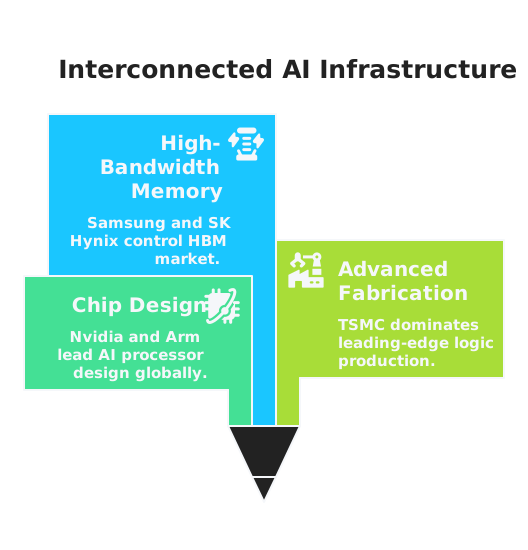
- A specialized type of dynamic random-access memory that stacks multiple DRAM chips vertically to dramatically increase data transfer speeds and reduce power consumption. It is essential for training and running large AI models, acting as a high-speed intermediary between the processor and data storage. Samsung and SK Hynix together control nearly 80% of the global HBM market, making it one of the most concentrated chokepoints in the AI supply chain.
- TSMC
- Taiwan Semiconductor Manufacturing Company, the world’s largest dedicated independent semiconductor foundry. TSMC manufactures chips for companies that do not own their own fabrication plants, including Nvidia, Apple, and AMD, and is the sole producer of the most advanced logic nodes below 5 nanometers. Its dominance in cutting-edge fabrication makes it a central actor in the geopolitics of technology, not just the economics.
- On-Device AI
- Artificial intelligence processing performed directly on a local device, such as a smartphone, sensor, or industrial robot, rather than in a remote cloud data center. It requires specialized, low-power AI chips and offers advantages in latency, privacy, and offline operation. South Korea’s K-On-Device project is a public initiative to develop ten such sovereign AI chips, aiming to reduce reliance on imported processor designs.
- Rare Earth Minerals
- A group of seventeen chemically similar metallic elements that are critical for manufacturing high-performance magnets, advanced electronics, and defense systems. They are vital for the electric motors in robotics and the miniaturization of semiconductors. Vietnam’s restriction on the export of unprocessed rare earths is a strategic move to force domestic processing and capture more of the manufacturing value chain.
RELATED STORIES