
A 2026 review in the International Journal of Molecular Sciences proposes that oral squamous cell carcinoma stem cells persist through the coordinated failure of three cellular systems—bioelectric membrane potential, gap junction communication, and the Hippo–YAP signalling pathway. Together they lock the YAP protein inside the nucleus, where it activates a SOX2‑centred stemness programme that resists chemotherapy and radiation.
The model suggests that targeting any single system will fail because the other two maintain the stem cell state. Betel quid, a major risk factor across South and Southeast Asia, may disrupt all three simultaneously, offering a mechanistic link to the region’s high OSCC recurrence rates.
Eliminating a tumour is not the hard part. A surgeon’s knife or a course of radiation can erase the mass a scan sees. The hard part is the cells that survive—the ones that look quiet for months, then rebuild the cancer from scratch. For oral squamous cell carcinoma, those cancer stem cells (CSCs) have long evaded a clean explanation, because no single mutation seems to drive them. What a model published this month proposes is that the explanation is not a single broken switch but three broken systems that act as each other’s backups.
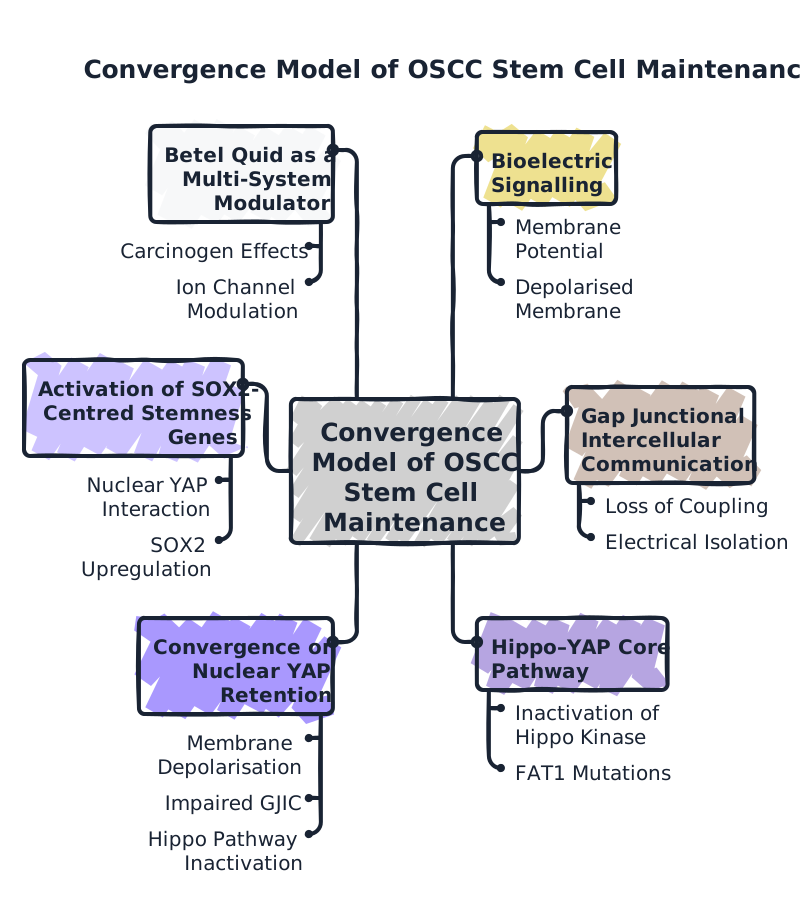
The first is the cell’s electrical identity: its membrane potential. The second is the network of gap junctions that couple cells together. The third is the Hippo–YAP signalling cascade. In a healthy cell, these systems keep the YAP protein safely in the cytoplasm. In an OSCC stem cell, all three fail together, holding YAP in the nucleus where it turns on a stem‑cell gene programme built around SOX2. The result is a cell that resists therapy and reseeds the tumour.
For an oral surgeon in Bengaluru watching a patient return nine months after a clean resection, that relapse is not a statistic. It is a signal that the three‑part lock the model describes is still intact.
No single drug can break a three‑way lock
The IJMS review, published July 2026, maps three dysregulated systems that converge on a common endpoint. Depolarised membrane potential in OSCC cells, driven by changes in ion channel activity, feeds into Hippo–YAP regulation; loss of gap junction coupling isolates the cell from signals that would normally suppress stemness; and mutations like FAT1 disable the Hippo kinase cascade, preventing YAP from being phosphorylated and degraded. Together, these three failures hold YAP in the nucleus, where it partners with transcription factors to activate SOX2 and other stemness genes. The review further hypothesises that betel quid—a mix of areca nut, lime, and often tobacco—may be uniquely capable of striking all three systems at once, explaining its outsize role in region‑specific recurrence.
The model’s sharpest claim is not a new drug target. It is a design rule: to break the cancer stem cell cycle, you have to disable the lock, not just one of the bolts.
The review authors caution, however, that no multi‑pathway perturbation experiment has yet shown that blocking all three systems outperforms blocking two in OSCC. The framework’s central claim remains untested.
India’s burden makes the stakes plain. According to Indian oncology experts and recent 2026 coverage, India accounts for roughly 274,000 new oral cancer cases annually. Nadimul Hoda, who heads oral oncology at Kidwai Memorial Institute of Oncology in Bengaluru, emphasises this figure when discussing the country’s burden.
The global trajectory offers little comfort. OSCC cases are projected to climb about 30% in the next decade, according to the 2026 IJMS review, and five‑year survival still stagnates near half—a figure the authors call a direct consequence of cancer stem cells that escape initial treatment.
The model’s three inputs and their convergence on nuclear YAP are easier to follow in the diagram below.
Earlier this year, Muthu Kumaraswamy Shanmugam, a cancer nanomedicine researcher, demonstrated that acid‑resistant protein nanocages can deliver drugs orally to combat treatment‑resistant gastric cancer cells, describing the work as opening a new avenue for treating gastric cancers that have become unresponsive. Though the study targets gastric cancer, its multi‑component approach echoes the convergence logic. Mohamad Assi, a cancer biologist, describes how Hippo–YAP and autophagy are linked through integrin signals, and suggests that pairing hydroxychloroquine with chemotherapy could weaken solid tumours by modulating this axis.
A systems‑level problem needs a systems‑level fix
The convergence model is not yet a treatment. It is a hypothesis, and the funding to test it is modest—drawn from academic grants aimed at reducing regional cancer mortality rather than from pharmaceutical pipelines. That financial reality, the IJMS review authors acknowledge, shapes the work toward conceptual synthesis and early‑stage validation, not rapid translation.
The path from a conceptual model to a usable therapy is narrow. Preclinical validation in OSCC organoids and xenograft models could take two to four years, and clinical trials—if successful—would likely follow a decade later, according to the review’s authors.
Still, the logic of multi‑target disruption is gaining traction in other solid tumours. Researchers like Shanmugam and Assi are already showing that combination strategies can overcome resistance, even if they are not yet testing the exact three‑way lock described for OSCC. The convergence model’s value lies in turning scattered experimental hints into a unified framework that tells drug developers which levers to pull together.
For the oral surgeon in Bengaluru, that gap between a compelling model and a usable therapy is measured in months and recurrences. The convergence framework does not close it. It does, for the first time, map the three levers that must be pulled simultaneously to break the cancer stem cell cycle. The next step—perturbing all three in OSCC models—will determine whether the map leads to a destination or remains an elegant hypothesis.
Beyond the headline
The Science Gap
Bioelectric signalling, gap junction coupling, and Hippo–YAP are still studied in separate silos, so the idea that they form a single control system for stemness has not reached most clinical practice. The convergence model makes explicit how much of the causal chain from betel quid to relapse‑prone tumours has never been experimentally tested. Without multi‑pathway perturbation experiments, it remains uncertain whether this integrated view truly explains more than existing single‑axis models.
The Bigger Picture
By describing OSCC stem‑cell maintenance as an emergent property of three interacting systems, the model points to a broader oncology insight: aggressive tumours may arise where several regulatory layers break down together, not from one dominant mutation. That framing explains why drugs that hit only one node often underperform and encourages combination strategies designed from a systems perspective rather than from isolated pathway diagrams.
The Reach
If validated, the convergence framework could influence Western trial design for other head‑and‑neck cancers or HPV‑linked oral tumours, prompting early testing of ion‑channel modulators or Hippo–YAP agents in combination regimens. Academic cancer centres might also alter biomarker panels, adding functional readouts of membrane potential and gap junction status to genomic profiles when selecting patients for experimental therapies.
What the convergence model means for those fighting OSCC
If the convergence model holds, it changes how researchers and health systems approach OSCC recurrence. Here is what that means for each group.
- Oncologist treating OSCC in South/Southeast Asia
You should monitor research developments on multi-target therapies for OSCC, particularly those addressing bioelectric signalling, gap junctions, and the Hippo–YAP pathway. Pre‑clinical validation of the convergence model could influence future clinical guidelines, but for now, reinforce early detection and robust control of betel quid and tobacco use in your patient population.
- Pharmaceutical R&D manager for oncology
Evaluate your pipeline for compounds that modulate membrane potential, gap junction communication, or the Hippo–YAP pathway. Consider preclinical studies for combination therapies in OSCC, focusing on rationally paired agents that disable the three‑lock system simultaneously, rather than incremental single‑target additions.
- Public health official in betel quid‑endemic regions
Continue strengthening public health campaigns and policy interventions aimed at reducing betel quid chewing, emphasising its complex and multi‑faceted role in cancer development. The model provides a new biological narrative to support existing WHO‑classified carcinogen warnings and could strengthen compliance with areca‑control policies.
- Cancer researcher focused on stem cell biology
Design experiments to test the convergence model’s predictions by co‑modulating Vmem, gap junction communication, and Hippo–YAP activity in OSCC cell lines or animal models. The model’s authors provide testable forecasts; your group could be among the first to validate or refute them, and the field is open for publication.
Explainer
- Oral squamous cell carcinoma
- Oral squamous cell carcinoma (OSCC) is the most common type of oral cancer, arising from the mucosal lining of the mouth and strongly linked to tobacco, alcohol, and betel quid use. It is often diagnosed late, contributing to a high mortality rate, and its frequent recurrence is driven by cancer stem cells that evade standard therapy. The convergence model provides a new mechanistic framework for why those stem cells persist after treatment.
- Cancer stem cells
- Cancer stem cells (CSCs) are a subpopulation of tumour cells with the ability to self-renew and regenerate the entire tumour after treatment, making them responsible for relapse and therapy resistance. They can remain dormant for long periods and are often not eliminated by conventional chemotherapy or radiation. The convergence model proposes that OSCC CSCs are maintained by three interlocking cellular systems that act as redundant safeguards.
- YAP protein
- YAP is a transcriptional co‑activator that normally resides in the cytoplasm and is kept in check by the Hippo signalling pathway. When the pathway is inactivated, YAP moves to the nucleus and turns on genes that promote cell growth, survival, and stemness. In OSCC, nuclear YAP drives a SOX2‑centred stemness programme that locks cells into a treatment‑resistant state.
- Hippo–YAP pathway
- The Hippo–YAP pathway is a conserved signalling cascade that controls organ size and cell proliferation by restricting YAP activity. When the pathway is disrupted—for example, through FAT1 mutations—YAP is no longer phosphorylated and degraded, leading to its nuclear accumulation and oncogenic transcription. The convergence model includes Hippo inactivation as one of three coordinated failures that sustain OSCC stem cells.
- Betel quid
- Betel quid is a mixture of areca nut, slaked lime, and often tobacco, chewed for its stimulant effects across South and Southeast Asia. The World Health Organization classifies it as a Group 1 carcinogen, and its use is a leading cause of OSCC in the region. The convergence model hypothesises that betel quid carcinogens may simultaneously disrupt membrane potential, gap junctions, and Hippo–YAP signalling, making it a uniquely potent trigger.
- Gap junction communication
- Gap junctions are direct channels between adjacent cells that allow ions and small signalling molecules to pass, maintaining tissue homeostasis and electrical coupling. Loss of this communication is common in many cancers and isolates cells from growth‑suppressing signals from neighbours. In OSCC, reduced gap junction coupling is one of the three inputs that the convergence model identifies as helping lock YAP in the nucleus.
RELATED STORIES


