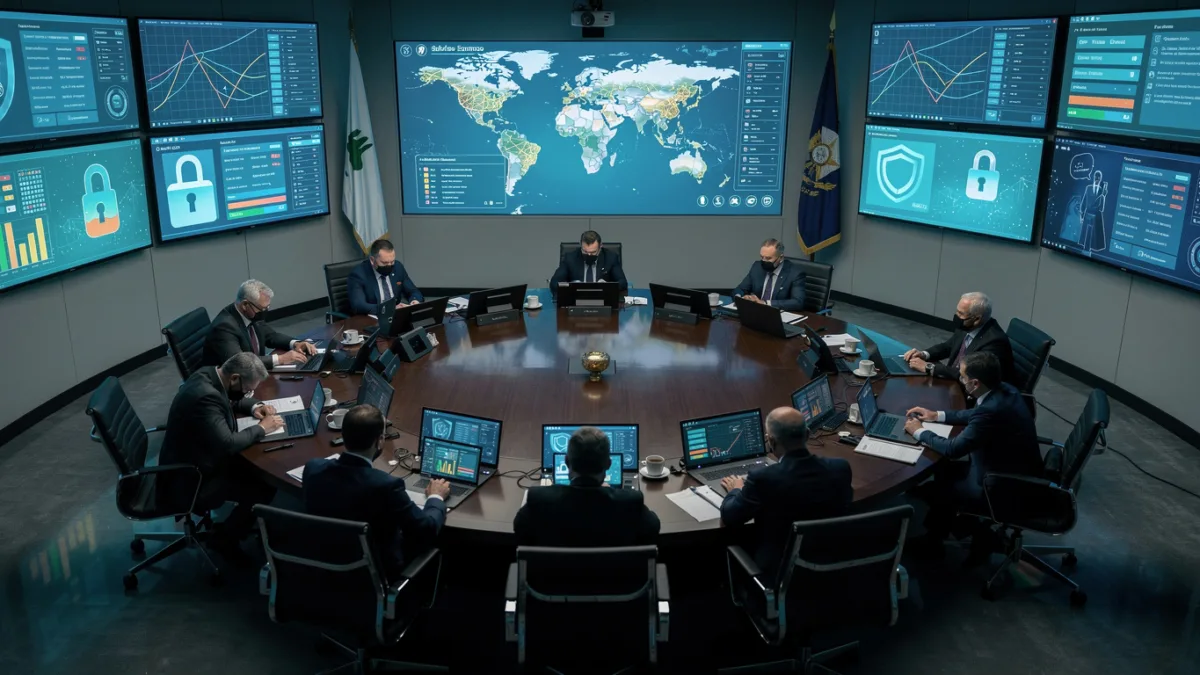
On 5 June 2026, the Five Eyes intelligence alliance — the United States, United Kingdom, Canada, Australia, and New Zealand — issued a joint cyber-security advisory naming China’s Ministry of State Security as the force behind a sustained campaign to recruit Western officials and contractors through professional networking sites. The advisory describes the effort as persistent and evolving, aimed at acquiring military capabilities, confidential research, and policy information across all five member states.
The Chinese Embassy in London rejected the accusations as politically motivated. What the advisory leaves out is as telling as what it names: no specific victims, no individual perpetrators, no prosecutions.
Spies have always gone where the targets are. For most of the last century that meant embassy cocktail parties, trade fairs, and the occasional approach on a train platform. The address has changed. The method has not.
What the Five Eyes alliance described on 5 June 2026 is the relocation of an old craft onto platforms that several billion people open every morning. The joint advisory accuses China’s Ministry of State Security of using sites like LinkedIn to identify, groom, and recruit people with access to sensitive government, defence, and technology work. It is the first time all five governments have moved together on this specific method, on the same day, in the same words.
Synchronised messaging is the point. It is also the limit. A coordinated warning tells you what five governments agree is happening. It does not tell you what any of them intend to do about it.
The warning names a method, not a culprit caught
The scale was documented years before this advisory landed. In 2023, MI5 reported that more than 20,000 UK individuals in sensitive roles had been approached through professional networking sites by suspected Chinese agents over the preceding period. That figure did the heavy lifting then, and it does it again now.
Ken McCallum, Director General of MI5, said hostile states were exploiting these platforms at “industrial scale” to reach people with access to sensitive information. The phrase is precise. This is not a handful of operatives improvising; it is a production line.
The fusion of intelligence requirements with industrial ambition is the part Western governments find hardest to counter.
What the targets reveal is broader than a CV suggests. Profiles expose project histories, hinted clearance levels, travel patterns, and dense maps of colleagues and government contacts. The National Security Act 2023 in Britain and the Foreign Agents Registration Act in the United States give prosecutors tools for cases that begin on social media. The full joint advisory published by CISA stops short of naming a single recruited individual.
The advisory documents the threat. It does not document a response — which is where the more useful question begins.
The platform is new, the calculation is old
Every few years a Western security service issues a warning about a hostile state exploiting an open system the West built for its own convenience. The system changes — passenger manifests, then telephone networks, now HR suites and professional platforms. The logic underneath does not. States mine the infrastructure that democracies depend on to stay competitive, precisely because closing it would cost more than the leak.
That is the structural tension the advisory cannot resolve. LinkedIn’s own security team removed 21.6 million fake accounts in the first half of 2023, detecting most before any user reported them. The volume tells you the openness is a feature, not a fault — and features are hard to legislate away.
So the warning is real, and the method is genuinely at scale. But strip away the synchronised timing and you find the same arithmetic that has governed this contest for a decade: what Beijing gains, what it risks, what the West can afford to close off. The platform moved onto the phone. The calculation did not move at all.
Beyond the headline
The power behind it
The real driver is not freelance spies improvising online but a system where intelligence requirements, industrial ambitions, and party control are tightly fused. The Ministry of State Security can align recruitment on Western platforms with Beijing’s technology and military priorities, while Chinese firms benefit downstream. That fusion blurs the line between civilian and state activity, complicating any Western attempt to separate normal engagement from hostile targeting.
The bigger picture
This episode sits inside a broader shift where intelligence collection rides on commercial infrastructure the West designed for openness. Instead of breaking into embassies, states mine cloud suites and professional platforms that companies depend on to compete. Democracies want to keep these efficiencies even as they become core attack surfaces in long-term competition with China.
The reach
One less visible ripple runs through Western higher education. Universities train the engineers and analysts later targeted on professional platforms, and many already host fee-paying students or partnerships linked to Chinese institutions. That makes campus career fairs and alumni networks fertile hunting ground, pushing university career services — not just defence ministries — onto the front line of counter-espionage.
Three groups now carry a risk they did not choose
With the advisory public but no prosecutions attached, the burden of response has shifted onto the people and institutions the campaign targets directly.
- Professionals in defence, tech, and government roles
Review your networking security settings using LinkedIn’s Safety Center at linkedin.com/safety, focusing on contact visibility and profile detail. Treat any unsolicited recruiter who pushes you toward encrypted apps or personal email as a reportable approach, and tell your security officer before the second message, not after.
- Employers in high-risk sectors
Fold social-engineering scenarios involving professional networks into your security training within the next month, and consult your national authority’s guidance — the UK NCSC at ncsc.gov.uk or CISA at cisa.gov. Align HR and security teams so unusual external “recruiter” activity triggers a review rather than a shrug.
- University career and compliance offices
Audit how alumni networks, industry-mentoring schemes, and career fairs expose students heading into sensitive sectors. Brief final-year engineering and analytics cohorts on off-platform recruitment tactics before they graduate into the roles these operators are watching.
FAQ
How can I spot a suspicious “headhunter” message?
Be wary of unsolicited contacts offering unusually high pay, vague job descriptions, or pressure to move quickly onto encrypted apps or personal email. Requests for non-public policy drafts, internal process documents, or technical configurations are clear red flags. Verify recruiter identities through known company channels, and report any approach that pressures you to keep the conversation secret from your employer.
What can employers do beyond basic training?
Integrate social-engineering scenarios involving professional networks into regular security awareness programmes, and add clauses on reporting suspicious approaches to employment contracts. Align HR and security teams so unusual external “recruiter” activity triggers a review. Some governments also recommend periodic scans for impersonation of company executives on networking platforms and tailored guidance during onboarding for staff in high-risk roles.
What happens if I share information without realising?
Even if contact begins innocently, sharing non-public technical or policy details with a foreign state entity can breach confidentiality, export-control rules, or official-secrets laws. Consequences range from disciplinary action and loss of clearance to criminal investigation. Authorities urge anyone who suspects they were targeted to inform their security officer promptly; early reporting is treated as a mitigating factor in many jurisdictions.
Explainer
- Five Eyes
- An intelligence-sharing alliance of the United States, United Kingdom, Canada, Australia, and New Zealand. It grew out of a UK-US signals-intelligence pact signed in 1946 and remains the deepest such arrangement among democracies. Its 5 June 2026 advisory was the first time all five governments warned about social-media recruitment on the same day in coordinated language.
- Ministry of State Security
- China’s principal civilian intelligence and counter-intelligence agency, founded in 1983. It handles both foreign espionage and domestic security, giving it unusually broad authority over Chinese firms and researchers. The Five Eyes advisory names it directly as the body directing recruitment of Western officials through professional networking platforms.
- Robust pragmatism
- The UK government’s stated approach to China, balancing continued trade against firm responses to security threats. Security Minister Dan Jarvis outlined it as engaging economically while tightening red lines on espionage and cyber intrusion. The framing lets London avoid choosing between confrontation and commerce, a tension the new advisory sharpens rather than settles.
RELATED STORIES