Australia’s housing correction has broadened to every major city. The national median price fell to $928,000 in July, and Sydney, Melbourne, Brisbane, Adelaide, and Perth are all now in decline for the first time since early 2023.
The RBA is expected to hold rates on 11 August, but tax changes have already shifted investor demand. Negative gearing is now restricted to new builds.
Regional home values fell nationally in June. The decline—the first since January 2023—ended a run that outlasted every capital-city correction. Brisbane, Adelaide, and Perth, the mid-sized capitals that powered Australia’s boom, are now sliding too.
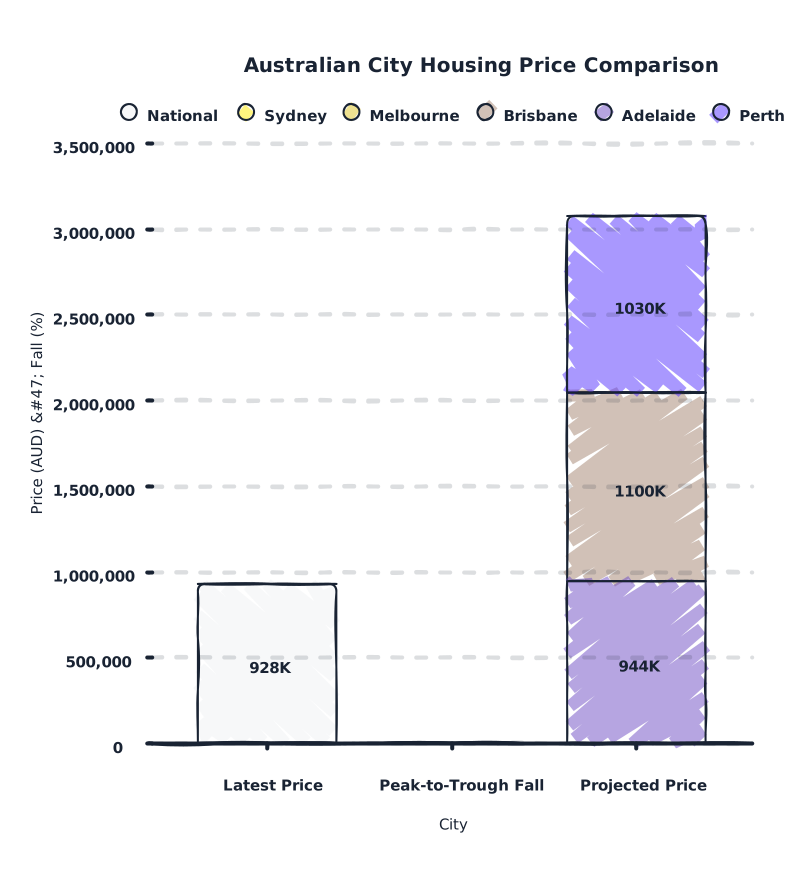
The national median price sits at $928,000, down $19,000 from its March peak. But the number that counts is where the weakness is spreading. Brisbane’s 40-month growth streak is over. Adelaide and Perth have slipped from their May highs.
For the first time in three years, no major market is untouched.
Three forces converged. The RBA raised the cash rate in February, March, and early May, tightening borrowing capacity. The May 12 budget restricted negative gearing to new builds and legislated the removal of the 50% capital gains tax discount from July 2027. And the US-Iran conflict, escalating since February, injected uncertainty into global capital flows.
What started as a routine downturn in overheated Sydney and Melbourne has become a broader test of Australia’s economic resilience.
Brisbane’s 40-month growth run ends
Cotality‘s daily dwelling values index fell 0.9% in July across the five largest capitals, with Sydney and Melbourne leading declines, while Perth posted a modest 0.1% rise. Auction clearance rates remained weak, and vendor activity slowed as sellers delayed market entry.
The end of Brisbane’s 40-month growth streak is the sharpest signal yet.
Brisbane’s median price slid roughly $8,000 since May, returning to its March level of $1.1 million. The 40-month run that began in February 2023 is now reversed.
Adelaide and Perth each lost about $4,000 from their May highs. The declines, though modest, mark a sharp reversal from the boom conditions of 2025.
The gap between peak prices and current values across the capitals is easier seen than read.
Nerida Conisbee, chief economist at Raine & Horne, attributes the accelerated downturn to the federal budget. “The slide was accelerated by the federal government’s surprise move,” she said.
RBA Governor Michele Bullock expressed surprise at the housing slump. “I expect that things will settle down,” she said.
The May budget restricted negative gearing deductions to newly built properties. The 50% capital gains tax discount on investment properties will vanish from July 2027.
For Western investors, Australian listed property vehicles face near-term pressure. A-REIT indices and housing-linked developers are directly exposed. Softer inflation has reduced the odds of further rate hikes. This shifts the outlook toward price volatility rather than a crash.
Fewer than 1% of mortgaged households face negative equity.
Loan arrears are minimal, and the financial system remains stable. The correction is a wealth hit, not a solvency crisis.
| Entity | Current rule | New rule | Effective date |
|---|---|---|---|
| Negative gearing on existing dwellings | Deductions allowed on all investment properties | Deductions restricted to newly built properties | May 12, 2026 |
| Capital gains tax discount for investment properties | 50% discount on gains for assets held over 12 months | Discount removed | July 2027 |
| Source: May 12, 2026 federal budget | |||
The tax changes that outlast the rate cycle
Listings are rising in Brisbane, Perth, and Adelaide, while buyer demand retreats. NAB reported a 15% drop in home loan applications from the first quarter to the June quarter. Westpac, Equifax, and Loan Market each documented falling mortgage demand.
Rents continue to climb. Vacancy rates hover near 1.6%, pushing rental yields higher. Louis Christopher of SQM Research expects yields to rise from roughly 3.8% toward 5.5% over two to three years.
Auction clearance rates tracked below 50% for nine consecutive weeks. The ABS inflation release in October will determine whether the RBA holds or cuts. A pause on 11 August is expected, but if inflation re-accelerates, the correction deepens.
The RBA’s August pause offers a breathing spell, not a reversal.
Tax changes will keep reshaping investor behavior long after rates stabilize. Mid-sized capitals and regional markets now face a structural headwind their recent booms never priced in.
Beyond the headline
The bigger picture
Australia’s housing correction is a case study for property markets from Vancouver to Auckland. Markets priced for perfection are now facing simultaneous monetary tightening and fiscal shock. The lesson: when interest rates, tax policy, and geopolitical risk converge, even the most supply-constrained markets can flip.
The timing
The downturn began in February 2026, the same month the RBA started raising rates and the US-Iran conflict escalated. The Iran conflict’s psychological impact on buyer sentiment turned what might have been a gradual cooldown into a sharp correction. Capital paused, and the May budget then removed the incentives that had propped up investor demand.
The money trail
The budget’s tax changes redirect several billion dollars in annual deductions away from property investors. Those savings will no longer offset rental losses, directly squeezing returns for leveraged landlords. Capital is already shifting toward higher-yield alternatives and new construction, reshaping the distribution of housing-related profits.
Four decisions for money in motion
With the correction spreading and the RBA holding fire, each group linked to Australian property faces a different calculus.
- Western investor in Australian residential property
You face a dual squeeze: falling prices and reduced tax benefits. Negative gearing is now confined to new builds, and the CGT discount disappears from July 2027. Review your portfolio for properties bought before May 12, 2026, which may be grandfathered, and consult the ATO’s guidance on 2026-2027 changes. Consider shifting capital toward new construction or higher-yield rental markets if you intend to stay in the sector.
- Western expat considering moving to or living in Australia
Purchase prices are softening, but rents are climbing. Vacancy rates near 1.6% mean rental markets are tight, with median weekly Sydney rents around A$841. If you plan to buy, assess mortgage serviceability under current bank buffers, which are several points above the cash rate. Weigh waiting for further price declines against the risk of rising rents while you delay.
- Global real estate fund manager with APAC exposure
The Australian correction is an early signal for APAC markets facing similar macro forces. Analyze the interplay of rate cycles, tax policy, and geopolitical risk in your portfolio. Sydney and Melbourne’s peak-to-trough falls of around 5% suggest the correction is not a crash, but the spread to mid-sized capitals and regional markets indicates systemic sensitivity that could inform risk models for other supply-constrained markets.
- Australian diaspora considering repatriation
Falling prices in Brisbane, Adelaide, and Perth may create entry opportunities, but the market has not found a floor. The RBA’s August pause is not a guarantee of stability. Monitor the ABS inflation release in October and the RBA’s subsequent signals. If you plan to buy, factor in the higher taxes on investment properties and the tighter lending standards now in place.
FAQ
Eligibility for negative gearing after May 2026
From May 12, 2026, negative gearing deductions are limited to newly constructed residential properties. Existing dwellings purchased after that date no longer qualify for full interest and loss deductions against wage income. Investors need to confirm whether their property meets the ‘new build’ criteria and the relevant acquisition dates.
Transition to new capital gains tax rules
The removal of the 50% capital gains tax discount on investment properties takes effect from July 2027. Gains realised after that date will be taxed at full marginal rates unless specific exemptions apply. Investors planning to sell should factor in the disposal timing and potential grandfathering for assets held before the change.
Mortgage serviceability under higher rates
Following RBA rate hikes, banks have tightened serviceability buffers, often assessing borrowers at rates several percentage points above the mortgage rate. Prospective buyers should check each lender’s current buffer and minimum deposit requirements. Even if headline rates stabilise, borrowing capacity will remain constrained.
Explainer
- Cotality
- A property data provider that tracks daily dwelling values across Australian capitals. Its index showed the 0.9% July decline that underpins the current correction narrative. The firm’s data is widely cited by analysts and media for housing market trends.
- Negative gearing
- The practice of offsetting rental property losses against other income. The May 2026 budget restricted this to new builds only. Previously, investors could claim losses on any investment property, making it a key tax strategy for Australian landlords.
- Capital gains tax discount
- A 50% reduction on the tax payable for capital gains on assets held over 12 months. The discount will be removed for investment properties from July 2027. This change aims to reduce tax concessions for property investors and shift capital toward other investments.
- RBA
- The Reserve Bank of Australia, the country’s central bank. It sets the cash rate, which influences borrowing costs across the economy. The RBA raised rates three times in early 2026 before its expected pause in August.
- Trimmed mean inflation
- A measure of underlying inflation that excludes the most volatile items, used by the RBA for policy decisions. A softer-than-expected reading in late July 2026 reduced pressure for further rate hikes. The Australian Bureau of Statistics publishes the data quarterly.
RELATED STORIES