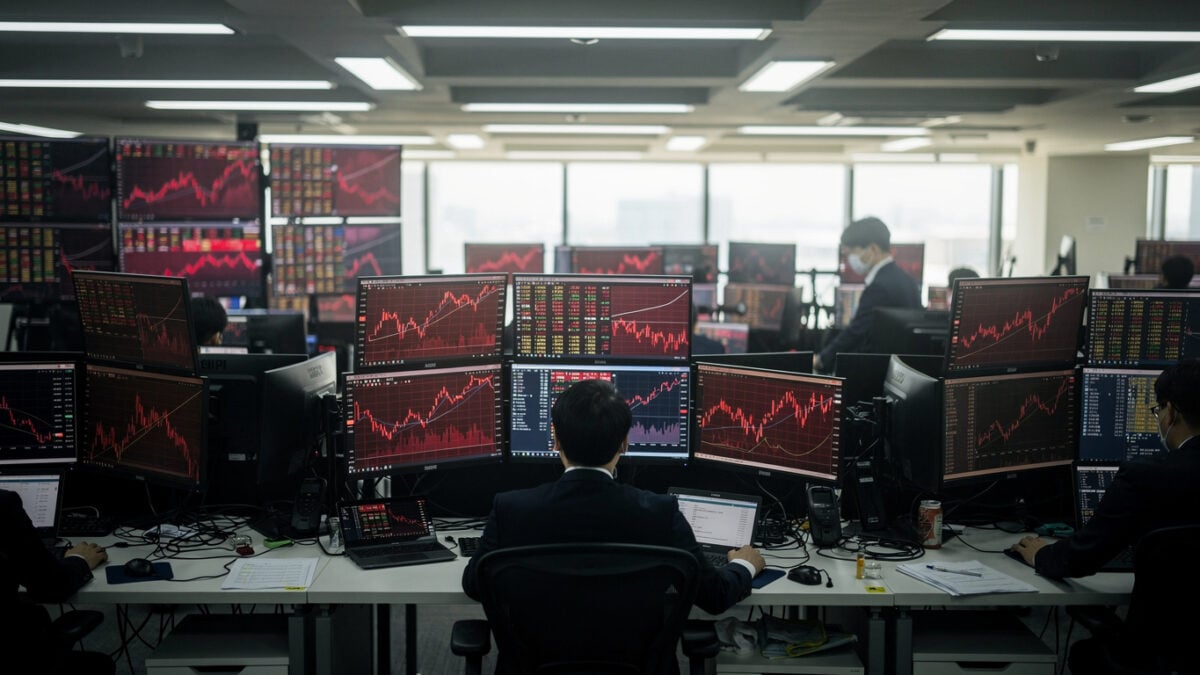
South Korea’s KOSPI closed down 8.29% on June 8, 2026, after a near-9% intraday plunge that tripped the Korea Exchange circuit breaker for the second time this year. Samsung Electronics lost 10.2% and SK Hynix fell 7.6%, dragging Asia’s best-performing major index into its worst session of 2026. Japan’s Nikkei 225 fell 3.9%, Taiwan’s TAIEX 3.5%, as a strong U.S. jobs report and renewed Iran-Israel fighting hit risk assets at once.
Brent crude rose above $88.50 a barrel on the geopolitical premium. The numbers mark an abrupt end to the AI-driven rally that made Seoul and Taipei the year’s standout markets.
The KOSPI was up about 24% for the year before June 8, 2026. That is the figure the crash headlines skipped, and it is the one that explains the violence of the fall.
When an index that has climbed almost a quarter in five months drops 8.29% in a single session, the move is not really about the day’s news. It is about how much money was riding on the rally continuing. A strong U.S. jobs report and a fresh round of Iran-Israel strikes supplied the trigger. The crowd of leveraged bets sitting on Korean and Taiwanese tech supplied the fuel.
Samsung Electronics and SK Hynix were the day’s heaviest casualties. Both are central to the global semiconductor cycle, and both had run hard on the same AI optimism now unwinding. The question is no longer what caused the fall. It is whether the trade that built the gain is over.
A 24% gain meets a 4% U.S. data shock
The sell-off began on Wall Street. On June 7, 2026, the Nasdaq Composite fell 4.18% to 15,780.42, its worst single day since April 2025. The trigger was a labour report: U.S. nonfarm payrolls rose by 265,000 in May, with unemployment holding at 3.9%, according to the U.S. Bureau of Labor Statistics. Strong jobs mean the Federal Reserve has less reason to cut rates soon.
For high-growth tech stocks, that matters more than for almost anything else. Their valuations rest on cheap future money. Push the first rate cut further out, and the maths under the rally weakens immediately.
Toru Nishihama, chief economist at Dai-ichi Life Research Institute in Tokyo, called the rout “a classic risk-off move” driven by fears the Fed will delay cuts and by Middle East tensions lifting oil. Masayuki Kichikawa, chief macro strategist at Sumitomo Mitsui DS Asset Management, was blunter on the cause: the AI-led rally had left Asian tech valuations stretched, leaving markets exposed to any sign that U.S. rates stay higher for longer.
Korea’s circuit breaker did its job. Under Korea Exchange rules, a market-wide halt of 20 minutes kicks in when the KOSPI falls 8% from the prior close. That measures the speed of the fall, not its full extent — the index can keep dropping once trading resumes, as it did. The figures below set Seoul’s loss against its neighbours.
| Metric | Figure | Source | Date |
|---|---|---|---|
| KOSPI one-day fall | 8.29% | Korea Exchange | Jun 8, 2026 |
| Nikkei 225 one-day fall | 3.9% | Japan Exchange Group | Jun 8, 2026 |
| Nasdaq Composite fall | 4.18% | Nasdaq | Jun 7, 2026 |
| U.S. May payrolls | +265,000 | BLS | May 2026 |
| Brent crude intraday | $88.71/bbl | ICE via Reuters | Jun 8, 2026 |
U.S.-listed funds carried the losses straight into Western portfolios. The iShares MSCI South Korea ETF (EWY), MSCI Japan (EWJ) and MSCI Taiwan (EWT) all dropped sharply in pre-market and early U.S. trading. Implied volatility on these funds spiked. That signals elevated downside risk over the next three to six months — unless Fed expectations soften or the conflict cools.
The currency is the tell, not the index
The won weakened past KRW 1,420 per dollar in early June 8 trading. That is its softest level since late 2024, before it pared losses as authorities signalled vigilance, according to Bank of Korea intraday data. A falling currency is what turns a stock correction into capital flight.
The mechanism is plain. Foreign investors holding Korean tech do not just lose on the share price. They lose again when the won buys fewer dollars on the way out. EPFR Global flow figures show Asia ex-Japan equity funds shed about $1.2 billion in the week to June 5, 2026, with tech vehicles taking most of it.
The Bank of Korea’s base rate sits at 3.25% after its May 23, 2026 decision. That gives policymakers little room. Cut to defend growth and the won falls further; hold to defend the won and leveraged tech positions stay under pressure.
This is the trap a rally built on borrowed dollars always sets. The gain that made the KOSPI the year’s best index was never a clean Korean growth story. It was a leveraged bet on cheap U.S. money and stable oil. Both assumptions broke in the same week, and 8.29% is what that costs.
Beyond the headline
The bigger picture
This sell-off exposes how deeply Asia’s equity cycle is now wired into two outside engines: U.S. monetary policy and Middle Eastern energy. When a single U.S. data release and a regional conflict can reprice AI-heavy indices from Seoul to Taipei at once, the tech boom looks less like an independent growth story and more like a leveraged bet on cheap dollars and stable oil.
The money trail
Beneath the missiles and Fed speeches, the real story is where borrowed capital sat: in crowded AI and chip trades across Korea, Taiwan and U.S. megacaps. As margin-financed positions unwind, brokers and volatility sellers take the first losses. Cash-rich sovereign funds and large asset managers get a chance to pick up quality tech at lower prices.
The reach
One quiet casualty is the pension schemes that shifted money into Asia and global tech funds to chase the AI wave. Through those vehicles, swings in Seoul or Taipei feed straight into the funding ratios of retirement plans in London, Frankfurt or Chicago. That tightens the room trustees have to take risk, just as demographic pressures build.
The decisions facing money with skin in this trade
With the FOMC meeting days away and the won testing two-year lows, anyone exposed to Asian tech faces choices that cannot wait for calm.
- ETF and fund investors
Review your exposure to Asia-focused funds such as iShares MSCI South Korea (EWY), MSCI Japan (EWJ) and MSCI Taiwan (EWT). Pull the fund fact sheets on ishares.com and check the semiconductor sector weights and recent volatility figures before you adjust any allocation over the coming quarter.
- Rate-sensitive investors
Watch the June 17-18, 2026 FOMC statement and Summary of Economic Projections at federalreserve.gov. If the dot plot shifts toward fewer or later cuts, the discount rate used to value high-growth tech rises worldwide — and the pressure that hit Seoul does not stay in Seoul.
- Investors weighing entry points
If you hold dry powder, treat the next BoK and Financial Services Commission communication on market stability, due after the late-June circuit breaker review, as a signal. Tighter margin or short-selling rules mean authorities are prioritising volatility control over a fast rebound.
Explainer
- Iran-Israel strikes
- The renewed military exchange between Iran and Israel in early June 2026, the first since April. The clashes lifted Brent crude above $88.50 a barrel by adding a geopolitical risk premium to oil. EU foreign policy chief Josep Borrell condemned the escalation and warned it could destabilise energy markets and global trade flows.
- Circuit breaker
- A market-wide trading halt that pauses all stock trading when an index falls sharply in one session. Under Korea Exchange rules revised in 2021, a 20-minute halt triggers when the KOSPI or Kosdaq drops 8% or more from the prior close. June 8, 2026 was its second activation of the year, after a record 12.06% plunge on March 4.
- FOMC
- The Federal Open Market Committee, the Federal Reserve body that sets U.S. interest rates. It meets roughly every six weeks and publishes a “dot plot” showing each member’s rate projections. Its June 17-18, 2026 meeting is the next event markets expect to confirm whether rate cuts are being pushed further out.
RELATED STORIES