A 14-year-old student killed seven people at Debsirin Nonthaburi School near Bangkok on Friday morning, using a handgun legally owned by his grandfather. The shooter killed his two grandparents at home before driving to the school and opening fire on staff, then died from a self-inflicted gunshot.
Investigators recovered 26 spent cartridges and 34 additional rounds at the school. The attack is the third mass shooting in Thailand in under five years to trigger national debate without producing durable changes to firearm regulation.
The handgun was legal. It was registered. It was stored in a family home, and the 14-year-old gained access to it, loaded it, and carried it to a school on a Friday morning. That sequence—legal ownership, lethal access—is not a loophole so much as a feature of how Thailand regulates firearms. Since October 2022, when a former police officer killed 36 people at a nursery in Nong Bua Lam Phu, the laws governing storage, supervision, and transfer have barely moved.
The Prime Minister described the shooter as an individual under significant stress, not a typical criminal. The framing is revealing. It directs attention toward mental health and academic pressure while leaving the question of how a minor obtained a legal handgun unasked. That omission is where the policy debate stalls every time.
A school that was supposed to be different
Debsirin Nonthaburi is not just any school. It belongs to a chain that has educated members of Thailand’s elite—royalty, prime ministers, the country’s most powerful families. Admission is fiercely competitive. The academic pressure is intense, and the Prime Minister himself acknowledged it as a possible contributing factor. The attack began around 9:30 AM, targeting staff rather than students—a detail that separates it from the American school shootings the perpetrator had researched on his computer.
The sequence of violence started at home. The shooter killed his grandparents first, then drove to the school with a handgun and ammunition that belonged to them. Police investigators found the spent cartridges and unused rounds inside the school building. The weapon was never supposed to be in a child’s hands.
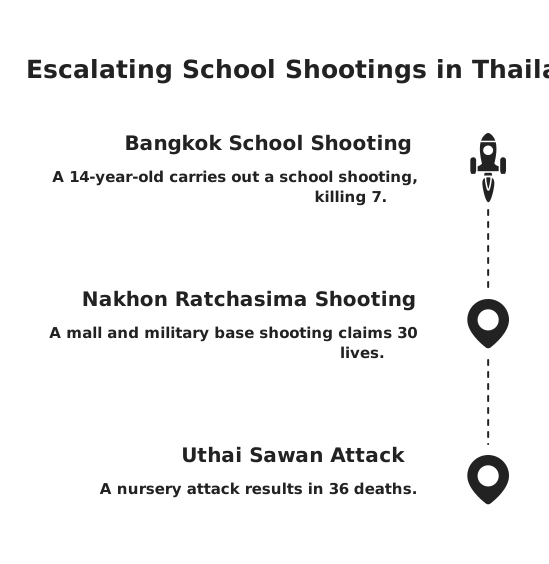
The pattern these events follow is now familiar enough to map. The timeline below traces the major mass shootings that have shaped Thailand’s public conversation around guns—each one followed by statements of resolve, none by the legislative follow-through those statements promised.
The promises that stop mattering
The October 2022 nursery attack in Uthai Sawan, Nong Bua Lam Phu, claimed 36 lives, most of them young children. A former police officer carried out the shooting before taking his own life. The weapon was legally owned. The incident triggered national mourning and official pledges of reform, yet no decisive tightening of gun laws followed. The perpetrator’s status as a former officer and the tragedy’s scale made it legible as a crisis of individual breakdown rather than a regulatory failure, and the window for legislative change closed.
Thailand’s civilian gun ownership rate is among the highest in Southeast Asia. One widely cited figure suggests one in seven people may own a firearm, though Thai journalists and researchers have questioned the accuracy and public awareness of this statistic. What is not in dispute is the availability. Guns are present in homes, and the legal framework for securing them—licensing, storage, transfer—has not been updated to address what happens when a minor can reach one.
A government announcement on firearm-licensing review in the next parliamentary cycle would mean the shooting has moved from grief to institutional response. If it does not arrive, the conversation will likely remain fixed on policing and mental health, not on the weapons themselves. The gun—legal, registered, and lethal in the wrong hands—will wait for the next morning.
Beyond the headline
The Pattern
Thailand’s violence problem keeps surfacing in the same institutional spaces meant to signal safety and order: schools, malls, family homes. The repetition suggests the next five to ten years will be shaped less by spectacular individual crimes than by the collision between weak access controls and highly visible public institutions.
The Response Gap
The gap is not a lack of sympathy after tragedy. It is the absence of sustained regulatory follow-through once the public moment passes. If the system continues to respond with investigation and grief alone, the policy response will remain slower than the speed at which firearms and online influence can turn personal crisis into mass harm.
What Isn’t Being Said
The dominant framing emphasizes the shooter’s stress and the school’s prestige. The uncomfortable omission is the practical question of how a minor accessed a legally owned handgun. Including that issue changes the story from an individual breakdown into a chain of adult responsibility around storage, supervision, and licensing.
What to watch in the coming weeks
With the Thai government facing renewed pressure to act on firearm regulation, the response—or its absence—will shape safety assessments for anyone with a stake in the country.
- Western parent of a university student in Thailand
Check your child’s institution for any updated security protocols or campus access changes announced after this shooting. Thailand’s Royal Thai Police and Government Public Relations Department are the most reliable sources for official safety measures. Discuss with your child what they know about firearm storage among peers and families—the risk is domestic access, not public threats.
- European tour operator with Southeast Asia packages
Client concern is likely to spike in the immediate aftermath and fade if no further incidents occur—the historical pattern in Thailand shows attention decays within weeks. Monitor the Royal Thai Police for any new security directives affecting public venues. Consider preparing a brief, factual safety statement for clients referencing official government guidance rather than media coverage.
- US-based investor with APAC emerging market exposure
Recurring mass shootings in prestige institutions can signal governance gaps that affect the broader investment climate. Watch whether the Thai cabinet initiates a formal firearm-licensing review in the coming parliamentary cycle—action indicates institutional responsiveness. Continued inaction, particularly after an elite-school tragedy, may point to deeper policy paralysis worth factoring into long-term stability assessments.
- Policy professional researching youth mental health in Southeast Asia
This incident provides a case study in how academic pressure, firearm access, and youth mental health intersect in a high-development Southeast Asian context. The Thai Ministry of Public Health and Department of Mental Health are the agencies to track for any new guidance on school-based crisis response or student counseling. The framing choice—mental health versus gun control—will itself be a data point about how the state distributes responsibility.
Explainer
- Debsirin Nonthaburi School
- A campus in the prestigious Debsirin school chain, located near Bangkok, which has educated Thai royalty, prime ministers, and members of the country’s elite. Admission is highly competitive, making the institution a marker of social mobility and academic ambition for many families. The chain’s status amplifies the political resonance of the shooting beyond that of an ordinary school.
- Anutin Charnvirakul
- Prime Minister of Thailand since 2024, leading a coalition government after the 2023 general election in which his Bhumjaithai Party placed third. His public comments on the Debsirin shooting framed the perpetrator as a stressed individual rather than a criminal—a rhetorical choice that may influence the national conversation around the event. Prior to becoming premier, he served as deputy prime minister and health minister, championing the country’s cannabis decriminalisation policy.
- Uthai Sawan nursery attack
- A mass shooting on October 6, 2022, in Nong Bua Lam Phu Province, in which a former police officer killed 36 people—most of them young children—before taking his own life. The attack triggered national mourning and official pledges of gun-law reform that did not materialise into significant legislative change. It remains the deadliest mass shooting in Thai history and the closest precedent for the current debate over firearm regulation.
RELATED STORIES