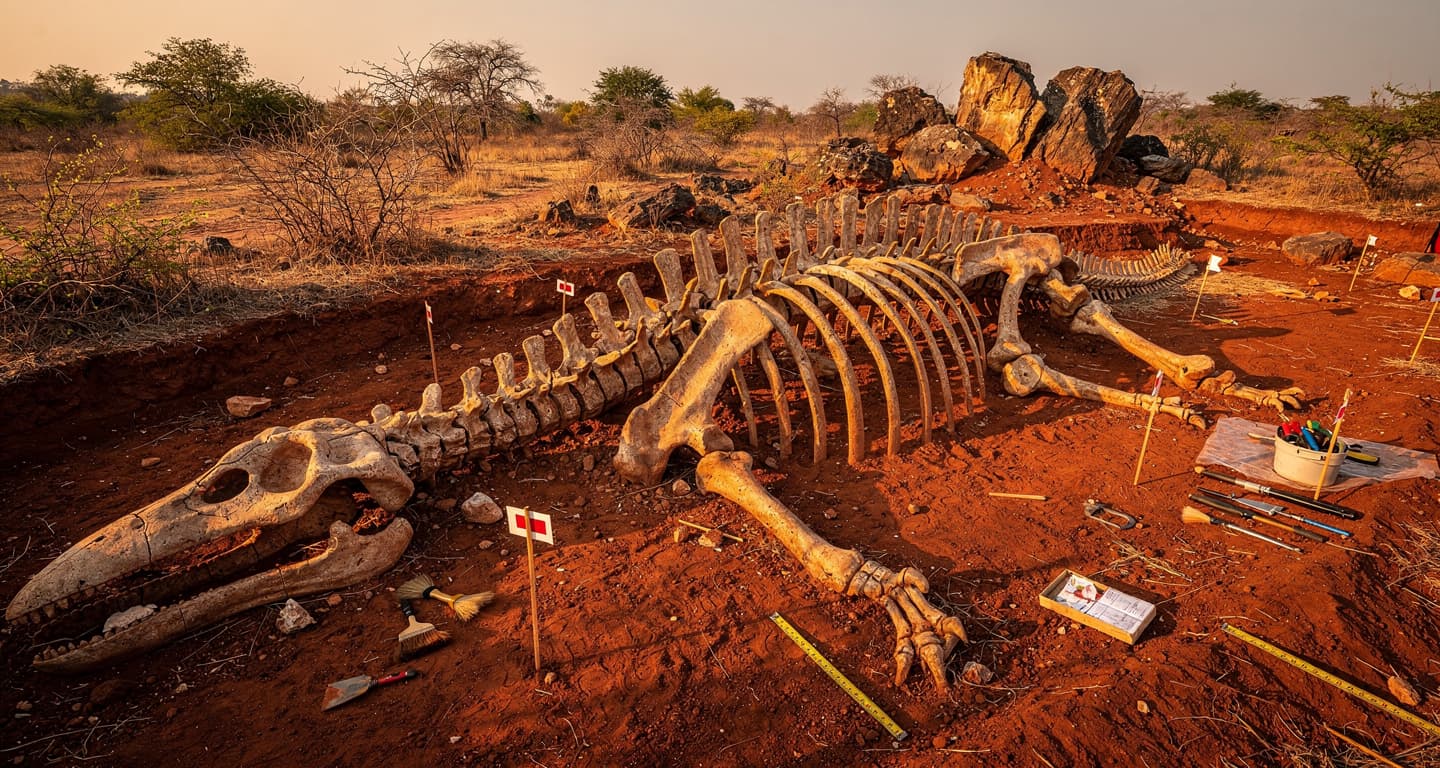
Thailand has formally described its fifteenth dinosaur species, Uragasaurus kalasinensis, a long-necked mamenchisaurid sauropod — the first of its kind found in mainland Southeast Asia. The identification, published in Scientific Reports, is based entirely on a single fossil vertebra from the Phu Noi site in Kalasin Province, using high-resolution CT scanning to reveal internal structures that distinguish it from all known sauropods.
The vertebra dates to the Late Jurassic, roughly 150 million years ago. The find extends the known range of mamenchisaurids southward and highlights Thailand’s growing importance as a fossil-rich region for Jurassic-era vertebrates.
Thailand’s newest dinosaur species has no skull, no limbs, no ribs. Its entire identity rests on a single vertebra smaller than a shoebox. That bone, described in Scientific Reports on 13 July 2026, positions a new genus of long-necked sauropod — mamenchisaurid — inside mainland Southeast Asia, where none had been confirmed before.
The animal it came from stretched an estimated 18 metres from head to tail, its neck alone reaching as tall as a three-storey building. It lived about 150 million years ago, in a floodplain ecosystem on what is now the Khorat Plateau of northeastern Thailand. The formal name, Uragasaurus kalasinensis, honours the Kalasin Province site where it was dug from the Phu Kradung Formation, a fossil locality that has quietly become one of Southeast Asia’s richest vertebrate deposits.
For a region whose dinosaur record was once a blank, the find is less a single splash than a long arc. Thailand has now named 15 dinosaur species since the 1970s. But a mamenchisaurid — a group whose closest relatives are known from China — signals that the Jurassic dispersal of these giants was wider than textbooks show.
A single vertebra, one new genus
What makes a bone a new species? In this case, the answer is inside it. The vertebra, designated holotype PRC 460, was studied with CT scanning that exposed a distinct pattern of internal air cavities and bony struts not seen in any other sauropod. Lead author Apirut Nilpanapan, a palaeontologist at Mahasarakham University, told the BBC that “the vertebra’s unique internal structure clearly showed it was a mamenchisaurid.”
The features are sharply specific: Y-shaped intraprezygapophyseal laminae and teardrop-shaped pneumatic fossae, anatomical fingerprints that researchers used to justify a new genus within the family Mamenchisauridae. Paul Upchurch, professor of palaeobiology at University College London, noted in coverage of the paper that naming a new species from one bone is unusual but acceptable when it shows a “unique suite of features.” That threshold, the team argues, was met. The full description is open-access.
The fossil comes from the Phu Noi locality, a site that has yielded over 6,000 fossil specimens, more than 90% of them dinosaur fragments. The sheer density of remains has turned the site into a high‑resolution window into a Jurassic ecosystem full of fish, turtles, crocodiles, and multiple dinosaur lineages. Stephen L. Brusatte, professor of palaeontology at the University of Edinburgh, called the find “a tantalising glimpse of how these giant long‑necked dinosaurs evolved in Asia.”
Yet the specimen’s singularity imposes real limits. Without additional bones, the dinosaur’s full anatomy, its life history, and even its precise evolutionary relationships remain provisional. The sauropod community will be watching what emerges from the next field seasons at Phu Noi.
Northeast Thailand’s long fossil arc
Thailand’s dinosaur record is not new. The first species, a sauropod called Phuwiangosaurus sirindhornae, was unearthed in the early 1980s and formally named in 1994. That discovery led to the establishment of the Phu Wiang Dinosaur Museum and a network of protected fossil parks under the Department of Mineral Resources. Today, under regulations enforced by the department, all vertebrate fossils are state property and must be deposited in designated museums — a framework that has enabled systematic cataloguing of sites like Phu Noi. The department oversees fossil permits and curation nationwide.
The Uragasaurus vertebra fits into a steady institutional build‑up. The Phu Noi site, part of the Phu Kradung Formation, has produced a fossil assemblage dominated by dinosaurs, with more than 90% of its 6,000‑plus specimens being dinosaur remains. It is one of Southeast Asia’s richest non‑marine vertebrate sites, and the momentum is unlikely to stop. Expected fieldwork over the next two to three field seasons could yield more bones from the same animal, which would sharpen the picture considerably.
If they do not appear, the debate over how much a single vertebra can carry will sharpen. For now, Uragasaurus is a single data point on a map that is slowly filling in. The next excavations at Phu Noi will determine whether this is the beginning of a fuller portrait or a carefully argued hypothesis that stands alone. That waiting game, more than the size of the animal, is what the field will be watching.
Beyond the headline
The Bigger Picture
Uragasaurus underscores how Northeast Thailand has become a key datapoint in reconstructing Mesozoic ecosystems across Asia, complementing better‑known Chinese and Mongolian sites. Rather than an isolated curiosity, it slots into a pattern of new Southeast Asian vertebrate finds that are gradually filling in once‑blank areas on global palaeobiogeographic maps.
The Science Gap
Media focus on the dinosaur’s size and neck length obscures the real scientific uncertainty: how far one vertebra can be used to infer relationships, body proportions and distribution patterns. The core gap is comparative — without additional bones, Uragasaurus remains a carefully argued hypothesis about mamenchisaurid diversity, not a fully resolved lineage.
The Reach
For Western museums and research groups that curate major sauropod collections, Uragasaurus is a reminder that key comparative material now lies in Thai institutions. That shift means collaborations, specimen loans and joint fieldwork increasingly need to extend into Northeast Thailand if global sauropod evolution studies are to remain comprehensive.
Three groups that can act on this discovery
The formal description of Uragasaurus turns a long‑suspected presence into a documented fact. With follow‑up fieldwork likely and Thai institutions increasingly open to international research partnerships, the next steps are tangible.
- Palaeontologists and museum curators
Key comparative material now sits in Thai collections. For anyone modelling sauropod evolution, access to specimens from Phu Noi and the Phu Wiang Dinosaur Museum is becoming non‑negotiable. The open‑access Scientific Reports paper provides CT imagery and morphological descriptions; contact details for the Mahasarakham University team are available via the Nature site.
- Travellers and science tourists
The Phu Wiang Dinosaur Museum in Khon Kaen Province and the broader Khorat fossil parks offer tangible glimpses of this arc. Exhibits are expected to integrate Uragasaurus in the coming months. Check the Department of Mineral Resources website for visitor updates and potential public talks about recent fieldwork.
- Science funders and policy watchers
Thailand’s fossil heritage is drawing international attention, which could lead to more funding for geological surveys and museum infrastructure. Watch for announcements of joint Thai‑Western dig programmes; they will signal how seriously both sides treat this emerging Jurassic hotspot.
Explainer
- Mamenchisaurid
- A family of long‑necked sauropod dinosaurs best known for extremely elongated necks — some species had necks accounting for half their total body length. Most mamenchisaurid fossils have been found in China, with Uragasaurus being the first confirmed member from mainland Southeast Asia. Their presence in Thailand pushes the group’s known range southward during the Jurassic–Cretaceous transition.
- Sauropod
- The group of large, herbivorous dinosaurs that includes the biggest land animals ever to exist, such as Brachiosaurus and Diplodocus. They are characterised by long necks, small heads, pillar‑like legs, and long tails. Thailand’s 15 named dinosaurs include several sauropods, from Phuwiangosaurus to Uragasaurus.
- Holotype
- In taxonomy, the single physical specimen designated as the definitive example of a new species. All future comparisons and identifications are measured against it. For Uragasaurus kalasinensis, the holotype is the vertebra labelled PRC 460, deposited in a Thai institutional collection.
- CT scanning
- A technology that uses X‑rays to produce cross‑sectional images of an object, often revealing internal structures without damaging it. In the Uragasaurus study, CT imaging exposed the vertebra’s internal air cavities and bony laminae — features invisible from the outside — that proved crucial for identifying the specimen as a new mamenchisaurid.
RELATED STORIES