South Korea activated its highest emergency response on July 27 after a heat dome pushed Yangsan to 40.3°C and Busan to a 122-year record of 38.8°C. Miryang’s two agricultural reservoirs, Maheul and Baegan, dropped to near zero capacity, threatening domestic water cuts for 100,000 residents before August ends.
Miryang Dam, at 34.6% storage, is on track to reach ‘severe’ drought stage by late August, which would impose up to 20% reductions on household and industrial water. The summer monsoon ended in the south on July 26 without delivering significant rain.
A temperature record that had stood since 1904 fell on July 29 when Busan reached 38.8°C. On the same day, Yangsan recorded 40.3°C at 3:34 p.m. KST, capping a week in which the Korea Meteorological Administration’s highest heatwave warning tier was extended to Miryang and eight other areas.
The emergency response is already at full force. The Central Disaster and Safety Countermeasures Headquarters, chaired by the Interior Minister, is coordinating cooling shelters and workplace inspections. Yet the water systems these measures are designed to protect are showing their limits.
In Miryang, two agricultural reservoirs are effectively empty. Irrigated farmland has been switched to every-other-day watering, and the multipurpose Miryang Dam is draining toward a threshold that would force household rationing. This is not a story about a single heatwave. It is about infrastructure calibrated to a climate that has moved. The emergency apparatus is operating as designed. The reservoirs it depends on are not.
Reservoirs drained, rainfall missing
On July 28, the average storage rate across Miryang’s agricultural reservoirs was 33.3% — just 43% of the normal level for this time of year. Maheul and Baegan reservoirs held between 0% and 1% of capacity. Around nine others hovered near 10%. The Korea Rural Community Corporation has started pumping river water uphill into reservoirs and opened direct canal supply lines, but officials acknowledge that without rainfall major crop losses are likely this month.
“Place the lives and safety of the people as the top priority,” Yun Ho-jung, Minister of the Interior and Safety, directed agencies at the Central Disaster and Safety Countermeasures Headquarters. The activation of the highest crisis tier on July 27 mandates expanded cooling shelters, workplace inspections, and intensified monitoring of vulnerable groups.
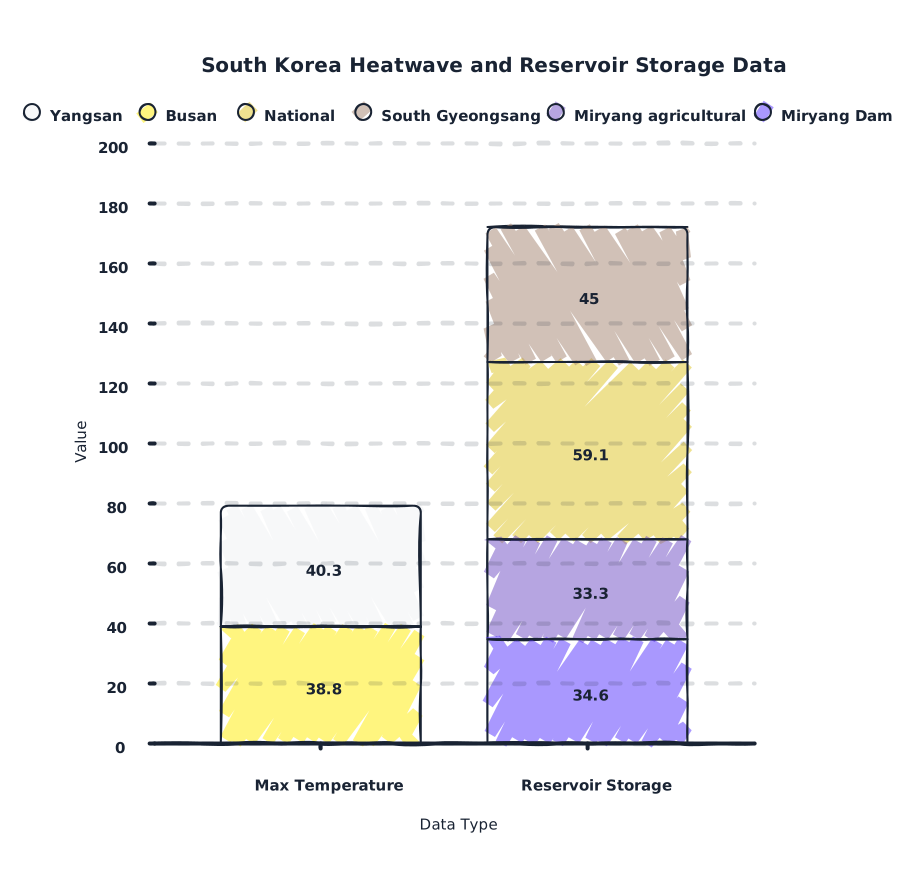
The figures below show how local reservoir levels have diverged from the national average.
| Metric | Figure | Source | Date |
|---|---|---|---|
| Yangsan maximum temperature | 40.3°C | KMA | July 29 |
| Busan maximum temperature | 38.8°C | KMA | July 29 |
| National reservoir storage | 59.1% | KRC | July 27 |
| South Gyeongsang reservoir storage | 45.0% | KRC | July 27 |
| Miryang agricultural reservoirs | 33.3% | Seoul Economic Daily | July 28 |
| Miryang Dam storage | 34.6% | Seoul Economic Daily | July 29 |
| Source: Korea Meteorological Administration, Korea Rural Community Corporation, Seoul Economic Daily | |||
Choi Hyun-su, executive director for water resources at KRC, said branches under drought ‘caution’ or higher have activated rapid response systems, prioritising emergency water funds where conditions are most severe. Yoon Seok-dae, president of Korea Water Resources Corporation, inspected Miryang Dam and directed staff to adjust river‑maintenance releases and strengthen contingency plans for alternative municipal supplies.
Western demand for Korean electronics and automobiles drives industrial water use along the Nakdong River basin, correlating with the same water systems now under strain. European and North American summer tourism adds to urban water and cooling demand in metropolitan areas already facing heat alerts.
A pattern of symptoms managed
South Korea’s disaster framework is responding with all available tools. The Korea Rural Community Corporation is pumping river water uphill; the Korea Water Resources Corporation has tightened releases. The Ministry of the Interior and Safety is running the highest heatwave crisis alert, a system revamped in May 2026 to account for more severe heat. Yet none of these measures address the underlying mismatch between reservoir design capacity and the speed at which compound droughts are now arriving.
KRC data shows that nationwide storage is at 59.1% of capacity, already 17 points below normal. In South Gyeongsang, the figure is 45.0% — a 40% deficit from the historical average. The heat dome that produced Yangsan’s 40.3°C is forecast to persist through at least August 6, and the Changma monsoon has already concluded without replenishing the south.
Whether Miryang tips into domestic rationing now depends on rainfall that has not appeared in any short‑term forecast. The emergency apparatus is aggressive; the systems it protects are not designed for a climate where the monsoon can skip a province while the rest of the peninsula floods.
Beyond the headline
The Bigger Picture
South Korea’s crisis illustrates how monsoon‑dependent water systems and disaster frameworks built for once‑a‑decade droughts are colliding with more frequent, overlapping extremes. Reservoirs engineered around historical inflow patterns now face simultaneous heat‑driven evaporation, higher irrigation demand and shifting rainfall. As climate baselines move, emergency mechanisms designed for rare events are being used continuously, exposing the need to redesign infrastructure and governance around compound, not isolated, hazards.
The Pattern
Miryang’s trajectory follows a recent sequence: severe floods in central Korea in 2025, a reservoir‑driven household water shutdown in Gangneung that same year, and now record heat with failing monsoon support in the southeast. Each episode shows different facets of the same trend — hydrological variability intensifying at both wet and dry extremes. Rather than outliers, these events form a pattern of escalating strain on regional water systems, suggesting that ‘normal’ years are becoming the exception.
The Reach
The same climate dynamics drying Miryang’s reservoirs also feed into volatility for electronics and automotive exports. Heat and drought constrain industrial water use, bias power grids toward emergency conservation, and unsettle agricultural inputs. For Western institutions dependent on just‑in‑time deliveries, Korea’s compound climate stress is effectively an upstream risk factor in manufacturing reliability, not just a local weather story.
What the next four weeks demand
With Miryang Dam potentially reaching ‘severe’ drought stage within weeks, the following decisions are now urgent for those with exposure to South Korea.
- Western semiconductor procurement manager
Assess whether water rationing in the Nakdong River basin could disrupt manufacturing operations. Review alternative sourcing or inventory strategies, and monitor Korea Water Resources Corporation bulletins for any tightening of industrial water supply contracts.
- European tour operator with South Korea packages
Review planned August itineraries for cities in South Gyeongsang Province. Check travel advisories and heatwave guidance on your national foreign ministry’s website; consider rescheduling outdoor activities during midday hours and informing travellers about potential local water restrictions.
- US-based investor with APAC emerging market exposure
Evaluate the long‑term climate resilience of South Korean assets in your portfolio, particularly those with significant water dependencies or agricultural exposure in the affected regions. Follow Korea Rural Community Corporation and Korea Meteorological Administration updates for signals of persistent drought that could weigh on industrial output.
- Western expat living in South Gyeongsang Province
Prepare for possible domestic water supply cuts by securing emergency water stores. Identify the nearest cooling centres and stay informed through local government advisories. The Ministry of the Interior and Safety’s heatwave portal provides English‑language safety guidance.
FAQ
How are South Korea’s heatwave alerts relevant to visitors?
South Korea now uses a top‑tier ‘serious’ heatwave warning when perceived temperatures exceed about 38°C. Authorities strongly advise avoiding midday outdoor activity and expand cooling shelters. Travellers should expect limitations on outdoor events, altered work schedules and active public messaging around hydration and sun exposure.
What domestic water restrictions could be imposed in Miryang?
If Miryang Dam’s drought stage reaches ‘severe’, local authorities may implement up to 20% cuts in domestic and industrial water supply for roughly 100,000 residents. This could mean scheduled supply interruptions, pressure reductions and bans on nonessential uses such as car washing or garden watering.
Could food supplies be affected?
Current drought stages already trigger a 30% cut in agricultural water use, enforced through every‑other‑day irrigation. Travellers may see parched paddies and stressed crops; if shortages persist, higher local food prices or reduced menu diversity are possible. Awareness of farm‑level restrictions helps reduce strain on limited supplies.
Explainer
- Changma
- The Korean summer monsoon, typically lasting from late June to late July, provides the majority of annual rainfall. Its behaviour is governed by the seasonal movement of the East Asian monsoon front. The 2026 Changma ended in the southern region on July 26 without delivering significant rain to South Gyeongsang Province, leaving reservoirs critically low.
- Heat dome
- A persistent high‑pressure system that traps hot air near the surface and can last for days to weeks. The current event over the Korean Peninsula is formed by the combined North Pacific High in the lower and middle atmosphere and the Tibetan High in the upper atmosphere. Adiabatic warming as air descends under the dome further amplifies surface temperatures.
- Miryang Dam
- A multipurpose dam in South Gyeongsang Province providing water for agriculture, industry and roughly 100,000 residents. It was at 34.6% storage in late July 2026 and had already moved through ‘interest’ and ‘caution’ drought stages. A further decline to ‘severe’ would trigger mandatory domestic water supply cuts.
- Korea Rural Community Corporation
- A state‑run agency responsible for managing agricultural water resources, including over 3,000 reservoirs nationwide. It operates a four‑stage drought response framework and is currently pumping river water and prioritising emergency funds in Miryang to offset evaporative and irrigation losses.
- Central Disaster and Safety Countermeasures Headquarters
- South Korea’s highest‑level emergency governance body, chaired by the Minister of the Interior and Safety. It was activated on July 27, 2026, to coordinate national responses to the heatwave and drought, including mobilising cooling shelters, health surveillance and water‑supply contingency plans.
RELATED STORIES