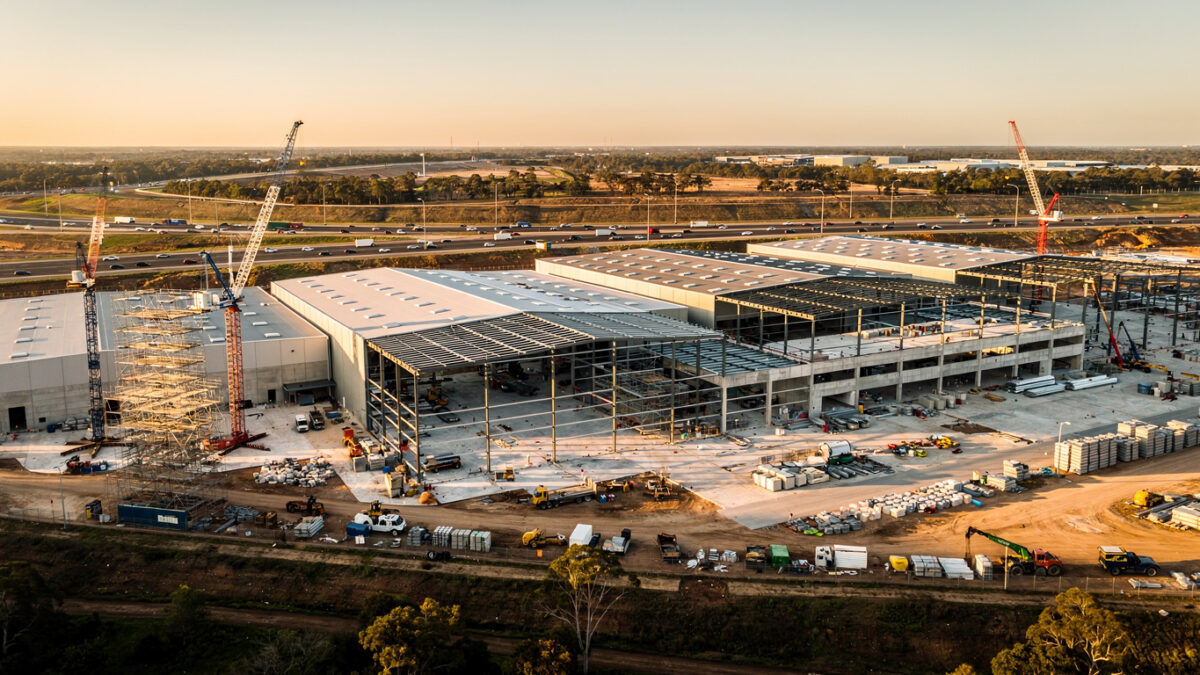
Japan’s Mitsubishi Estate Asia and Singapore’s ESR confirmed on 31 May 2026 a joint venture to build the Huntingwood Logistics Estate in Western Sydney, a 114,005-square-metre warehouse platform with a total development value of A$750 million. The site, held in ESR’s portfolio since 2022, sits on 24.6 hectares near the M7 freight corridor. It marks the second partnership between the two firms.
The headline number is the build value. The number that matters is vacancy — below 1 per cent in Western Sydney, and the reason this much capital keeps arriving.
Below 1 per cent. That is the industrial vacancy rate in Western Sydney in early 2026, and it explains a A$750 million bet better than any press release.
On 31 May 2026, Mitsubishi Estate Asia and ESR confirmed they will jointly develop the Huntingwood Logistics Estate, a 114,005-square-metre warehouse complex on a 24.6-hectare site west of central Sydney. The total development value is A$750 million — not the A$490 million figure that circulated when the deal first surfaced. ESR has held the land since 2022, waiting for the right moment to activate it.
That moment is now, because the maths has shifted. Prime Western Sydney industrial rents have climbed more than 40 per cent since 2021, and vacancy has effectively vanished. For two of the region’s largest property players, a piece of land sitting idle for four years has quietly become one of the most defensible asset types they own.
ALSO WORTH READING

The land ESR sat on until the rents made the call
The structure is straightforward: a joint venture pairing ESR-managed capital with Mitsubishi Estate Asia, the Asian investment arm of one of Japan’s largest developers. Neither firm has disclosed the equity split or the vehicle names. What they have disclosed is the scale, and the scale is the argument.
ESR acquired the Huntingwood site in 2022. It then waited. The decision to build now, rather than in 2022, is the tell — this is a developer that timed the rent cycle rather than the land cycle, and the rent cycle has finally caught up with the price it paid.
The wider market backs the timing. CBRE’s Q1 2026 Australia Industrial & Logistics report records national industrial investment volumes of roughly A$3.5 billion for the quarter, with Sydney taking the largest share. Prime Sydney industrial yields have compressed to around 4.25 to 4.50 per cent on continued rental growth. Full detail sits in CBRE’s quarterly figures.
One caveat sharpens rather than softens the case. CBRE’s own analysts flag that yield compression at these levels leaves thin margin for error if construction-cost inflation outpaces rental growth — a risk that weighs heaviest on greenfield schemes like Huntingwood, where the building does not yet exist.
Western Sydney is being priced as infrastructure, not real estate
JLL’s Q1 2026 Sydney Industrial Snapshot puts prime warehouse rents in Western Sydney at roughly A$170 to A$190 per square metre per year net. That is the floor under deals like this one.
Set against Greater Melbourne’s west, where prime rents run closer to A$130 to A$150 per square metre, the Sydney premium is plain. Against the UK, the picture inverts. CBRE’s 2026 West London report shows prime logistics along the M25 corridor exceeding £20 per square foot — roughly A$330 per square metre. Western Sydney still prices at a discount to a mature European hub, even after a 40 per cent run.
That discount is the opening pan-Asian capital is moving to close. Mitsubishi and ESR are not treating a warehouse belt as conventional property. They are treating it as supply-chain infrastructure, sitting alongside ports and airports, and pricing it accordingly.
For a Western third-party logistics operator that runs Sydney as its distribution base for Australia and New Zealand, the shift is concrete: the prime shed stock around the freight corridors is increasingly owned and leased from boardrooms in Tokyo and Singapore, not local landlord networks.
Beyond the headline
The bigger picture
The Huntingwood project is part of a broader shift in which Western Sydney becomes a core node in Asia-Pacific supply chains rather than a peripheral industrial fringe. As e-commerce and just-in-time inventories push occupiers closer to large consumer markets, investors are effectively treating Western Sydney’s logistics belt as regional infrastructure, comparable to ports and airports, rather than conventional real estate. That reclassification helps explain why long-horizon Asian capital is willing to pay record land prices for well-located warehouse platforms.
The money trail
Behind the joint-venture headline sits a capital stack increasingly dominated by pan-Asian institutions rather than local Australian super funds. Mitsubishi Estate Asia and ESR are using Sydney industrial to recycle capital from more cyclical asset classes in Japan and elsewhere into income-secure logistics yields, while also earning development margins. For Western investors, that means competing with balance-sheet heavyweights whose return targets and holding periods differ from listed REIT benchmarks, potentially pushing private-market pricing ahead of public-market valuations.
The reach
One under-discussed implication is for Western third-party logistics providers and retailers that rely on Sydney as a distribution base for ANZ. As Asian developers control more of the prime shed stock around key freight corridors, lease negotiations, expansion options and built-to-suit opportunities will increasingly be shaped in boardrooms in Tokyo and Singapore. For Western corporates, maintaining reliable access to modern Sydney facilities may hinge on forming deeper regional relationships with these capital providers rather than relying solely on domestic landlord networks.
What Huntingwood changes for your exposure to Sydney industrial
With prime yields already compressed to around 4.25 per cent and vacancy near zero, the next 6 to 12 months will test whether rents can keep justifying the build cost — and that decides three sets of choices.
- Institutional investors
You cannot buy into the JV directly, so track ESR-linked Asia-Pacific logistics REITs and the Sydney books held by Blackstone and Goodman Group instead. Watch CBRE’s and JLL’s H1 2026 Australia industrial reports, expected by Q3 2026: continued sub-2 per cent vacancy confirms appetite, while any yield softening signals more selective deployment.
- Western logistics and retail operators
If Sydney is your ANZ distribution base, your future lease terms are increasingly set by Tokyo and Singapore landlords. Open built-to-suit and expansion conversations with ESR-sponsored platforms now, rather than waiting for the first Huntingwood buildings to deliver in phases over the next 18 to 30 months.
- Western expats in Western Sydney
The estate reinforces warehousing and transport jobs along the M7/M4 corridor more than it shifts your rent, which still tracks broader Sydney housing and interest rates. The visible day-to-day change is freight traffic and noise near key interchanges during peak logistics hours.
FAQ
How is the Huntingwood Logistics Estate joint venture structured?
ESR states the estate is developed through a joint venture pairing ESR-managed capital with Mitsubishi Estate Asia, but it has not disclosed the equity split or vehicle names. ESR commonly uses unlisted development partnerships for Australian projects. Western investors typically cannot invest directly into such JVs, but may gain exposure through ESR-linked listed entities or mandates run by global managers allocating to ESR-sponsored Australian logistics platforms.
When will the Huntingwood warehouses be ready for tenants?
ESR’s announcement confirms planning approvals are secured and infrastructure works are underway, but it does not publish specific completion dates. Comparable Western Sydney estates of similar scale typically take 18 to 30 months from civil works to practical completion of the first warehouses, depending on staging and pre-leasing. Prospective tenants and investors should expect initial buildings to arrive in phases rather than as a single delivery.
How will the estate affect local housing and traffic?
NSW planning documents for the Western Sydney Employment Area prioritise freight access and jobs, not residential development. Large estates like Huntingwood sit near major motorways such as the M7 and M4, so heavy-vehicle movements mostly use designated freight routes. Employees may add marginal pressure to nearby rental markets over time, but the main immediate effect for residents is increased truck traffic and noise at key interchanges during peak hours.
Explainer
- Joint venture
- A joint venture is a business arrangement where two or more parties pool capital and share risk in a single project while remaining separate companies. In Australian logistics, JVs let a land-holder like ESR combine its site and development expertise with an equity partner’s balance sheet, here Mitsubishi Estate Asia. For Huntingwood, the structure keeps the equity split and vehicle names private, which is why outside investors cannot buy in directly.
- ESR
- ESR is a Singapore-headquartered logistics real estate group, one of the largest such platforms across the Asia-Pacific. It develops and manages warehouses and distribution centres, and sponsors listed REITs and unlisted funds that channel institutional capital into industrial property. Its Huntingwood site, bought in 2022, shows its model of holding land until rent and vacancy conditions justify the build.
- Industrial yield
- An industrial yield is the annual net rental income of a warehouse divided by its capital value, expressed as a percentage. Prime Sydney industrial yields compressed to around 4.25 to 4.50 per cent in early 2026, meaning prices rose faster than rents. Lower yields signal strong investor demand but leave thinner margin if construction costs or interest rates climb, the central risk hanging over greenfield projects like Huntingwood.