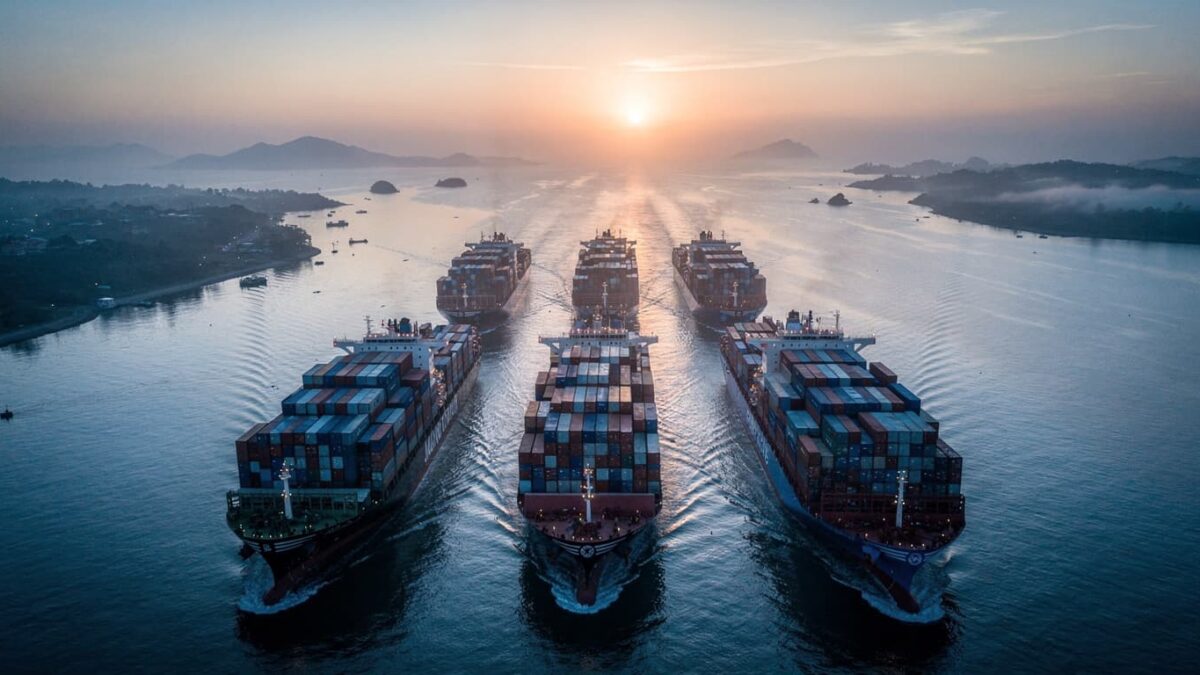
The Strait of Malacca — through which roughly one-third of global seaborne trade and 40% of global seaborne oil shipments pass daily — is emerging as the next strategic pressure point in a chain of crises set in motion by the Hormuz shutdown. With 80% of China’s crude oil imports transiting the strait and ASEAN merchandise trade exceeding US$3.8 trillion in 2024, a Malacca disruption would not be a regional shipping problem. It would be a macroeconomic event with direct consequences for inflation, currency stability, and supply chains across Europe and North America.
The real vulnerability is not naval — it is legal and financial. Any coercive move on Malacca would weaponise insurance markets, payment channels, and crisis governance frameworks long before a single warship fired a shot.
The Hormuz crisis has already redrawn the map of global risk. Now analysts and policymakers are watching a second chokepoint with growing unease: the Strait of Malacca, the 550-mile waterway between the Malay Peninsula and Sumatra that functions as the circulatory system of global trade between East Asia and the Indian Ocean. What the Hormuz shutdown — which cut global oil supply by 10.1 million barrels per day in March and pushed North Sea Dated crude to around US$130 a barrel — demonstrated above all else is how quickly geography becomes macroeconomics. The lesson has not been lost on the governments, strategists, and energy traders now stress-testing Malacca scenarios.
The contest over Malacca is not primarily about warships. It is about whose legal and financial architecture governs the strait when something goes wrong — whose insurance frameworks set the terms, whose currency denominates the settlements, and whose crisis diplomacy holds the line. That is the dimension that the headline about Trump’s Beijing visit, and the broader US-China rivalry over Gulf energy flows, points toward but rarely names directly.
With the Hormuz shutdown already forcing roughly 13,000 flight cancellations across the Asia-Pacific in May alone, the appetite for a second chokepoint crisis is zero. The question is whether the governance architecture around Malacca is robust enough to prevent one — or whether, as with Hormuz, the guardrails will only become visible once they have failed.
RELATED


The numbers behind the vulnerability
The International Energy Agency assessed in 2023 that approximately one-third of global seaborne trade and 40% of global seaborne oil shipments transit the Strait of Malacca — figures that make it, by volume, the single most consequential maritime chokepoint on earth. For China, the exposure is existential in strategic terms: around 80% of Beijing’s crude oil imports pass through the strait, a dependency that has driven Chinese strategic discourse around what analysts call the “Malacca dilemma” for more than a decade. It is the primary reason China has invested heavily in overland alternatives — the China-Pakistan Economic Corridor, the Gwadar and Kyaukpyu port projects — none of which yet approach the throughput capacity of the strait itself.
Collin Koh, Senior Fellow at the S. Rajaratnam School of International Studies in Singapore, argues that any attempt by major powers to militarise Malacca in response to wider regional crises would face strong resistance from ASEAN littoral states determined to preserve it as an open, demilitarised waterway. That resistance has institutional form: Malaysia, Singapore, and Indonesia formalised the Malacca Strait Patrol in 2006, combining coordinated sea patrols, air surveillance, and intelligence exchange. A second layer, the IMO Cooperative Mechanism launched in 2008, creates a structured platform for user states and industry to fund navigational safety without altering sovereignty claims.
Koureus Nasseri, an energy security analyst at the IEA, has noted that prolonged disruption at chokepoints like Hormuz or Malacca could trigger sharp spikes in tanker rates and benchmark crude prices, with knock-on effects for inflation in oil-importing economies worldwide. The Hormuz precedent — the largest supply disruption in recorded history — provides the calibration. World Bank data show ASEAN merchandise trade exceeded US$3.8 trillion in 2024, with a significant share dependent on Malacca-linked sea lanes connecting the South China Sea with the Indian Ocean.
| Metric | Figure | Source |
|---|---|---|
| Share of global seaborne trade | ~one-third | IEA, 2023 |
| Share of global seaborne oil shipments | ~40% | IEA, 2023 |
| China’s crude imports via Malacca | ~80% | NBR, 2023 |
| ASEAN merchandise trade dependent on Malacca-linked lanes | US$3.8 trillion (2024) | World Bank, 2024 |
| Hormuz disruption (March 2026) | 10.1 mb/d supply loss; Brent ~US$130/bbl | IEA, 2026 |
The legal architecture — and where it breaks down
Under the 1982 UN Convention on the Law of the Sea (UNCLOS), the Strait of Malacca qualifies as an international strait, granting ships of all states the right of transit passage that coastal states cannot suspend in peacetime. That legal guarantee is real, but it is not self-enforcing. The layered governance regime — UNCLOS at the top, the Malacca Strait Patrol and IMO Cooperative Mechanism in the operational middle, and user-state naval presence just outside territorial waters at the edges — was designed for piracy and environmental incidents, not great-power coercion.
The more realistic threat scenarios do not involve a formal blockade, which would trigger immediate UNCLOS challenges, WTO repercussions, and the full weight of US Indo-Pacific naval posture. They involve grey-zone harassment, sanctions-driven insurance restrictions, and payment system pressure — the same financial and legal instruments that have proved so effective in other theatres. The US Indo-Pacific Strategy and Pentagon posture reviews explicitly identify Malacca and the Singapore Strait as critical sea lines of communication whose security underpins alliance commitments to Japan, South Korea, and Australia. The EU’s 2021 Indo-Pacific strategy frames the straits’ openness as vital to European supply chains, underpinning expanded naval deployments through the Coordinated Maritime Presences initiative in the Northwest Indian Ocean.
Watch for the next ASEAN Defence Ministers’ Meeting-Plus (ADMM-Plus) communiqué, expected in the coming months. If it explicitly names great-power competition or freedom of navigation in the context of Malacca, it signals ASEAN willingness to internationalise the governance question. If it does not — and history suggests it probably will not — expect littoral states to continue managing the strait through quiet, sovereignty-centred mechanisms and bilateral hedging with both Washington and Beijing.
Beyond the headline
The bigger picture
The debate over Malacca’s vulnerability is really about who gets to set the rules of globalisation’s plumbing: the sea lanes, currencies, and insurance systems that make trade possible. As Hormuz has demonstrated, chokepoints are no longer just about warships and missiles — they are about whose legal and financial architecture governs crisis management when something goes wrong. The strait that looks like a geography problem is actually a contest over institutional power.
The reach
A Malacca scare would not stay in Southeast Asian waters; it would show up as higher freight surcharges on electronics to Rotterdam, pricier petrol in Berlin, and more volatility in Asian currency and bond markets held by Western funds. It would also harden debates in Washington, Brussels, and Canberra over how much economic exposure to China and contested sea lanes is tolerable, potentially accelerating trade diversification and reshoring policies that are already well advanced.
Our take
Treating Malacca purely as a naval chessboard misses the point: the real leverage lies in who controls payment channels, insurance frameworks, and crisis diplomacy around the strait. ASEAN’s instinct to keep outside militarisation in check is rational but insufficient on its own — the Hormuz precedent shows that governance gaps get exploited before anyone has agreed on the rules. Unless regional states and external powers build more transparent, rules-based crisis mechanisms now, the next Hormuz-style shock could arrive in Southeast Asian waters with fewer guardrails and considerably higher global costs.
What this means for governments, businesses, and investors watching Malacca
With Hormuz demonstrating in real time how a chokepoint crisis transmits instantly into inflation, equity volatility, and currency pressure, Western governments and businesses with exposure to Asia-Pacific supply chains face concrete decisions now — not after the next disruption begins.
- Monitor the IEA’s maritime chokepoint assessments: The IEA’s commentary on safeguarding energy flows through maritime chokepoints provides the most authoritative public data on Malacca throughput, alternative routing capacity, and supply disruption scenarios. It is the baseline document for any serious risk assessment.
- Track ADMM-Plus language on sea-lane security: The next ASEAN Defence Ministers’ Meeting-Plus communiqué is the clearest leading indicator of whether ASEAN is willing to formalise great-power competition as a Malacca governance issue. A shift in language would signal a meaningful change in the diplomatic environment for shipping and energy contracts.
- Review insurance and freight exposure to Lombok and Sunda rerouting: Any Malacca disruption scenario pushes vessels onto longer alternative routes through the Lombok or Sunda Straits, adding days of transit time. Businesses with time-sensitive Asian supply chains should model the cost impact of rerouting now, while insurance markets are still pricing Malacca risk at normal levels.
- Watch yuan settlement trends among Gulf exporters: Gulf exporters experimenting with renminbi settlement for energy trades — partly to hedge US sanctions risk — represent a structural shift in how Malacca-transiting energy is priced and paid for. Western financial institutions with Asian bond and currency exposure should treat this as a long-duration risk factor, not a short-term anomaly.
- Engage Australia’s Defence Strategic Review framework: Canberra has explicitly identified Southeast Asian maritime chokepoints as central to national security and is expanding cooperation with Indonesia, Singapore, and Malaysia on maritime domain awareness. For Australian and allied businesses, this creates both risk context and potential partnership frameworks for infrastructure resilience planning.