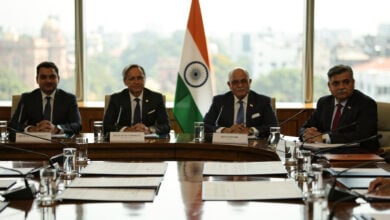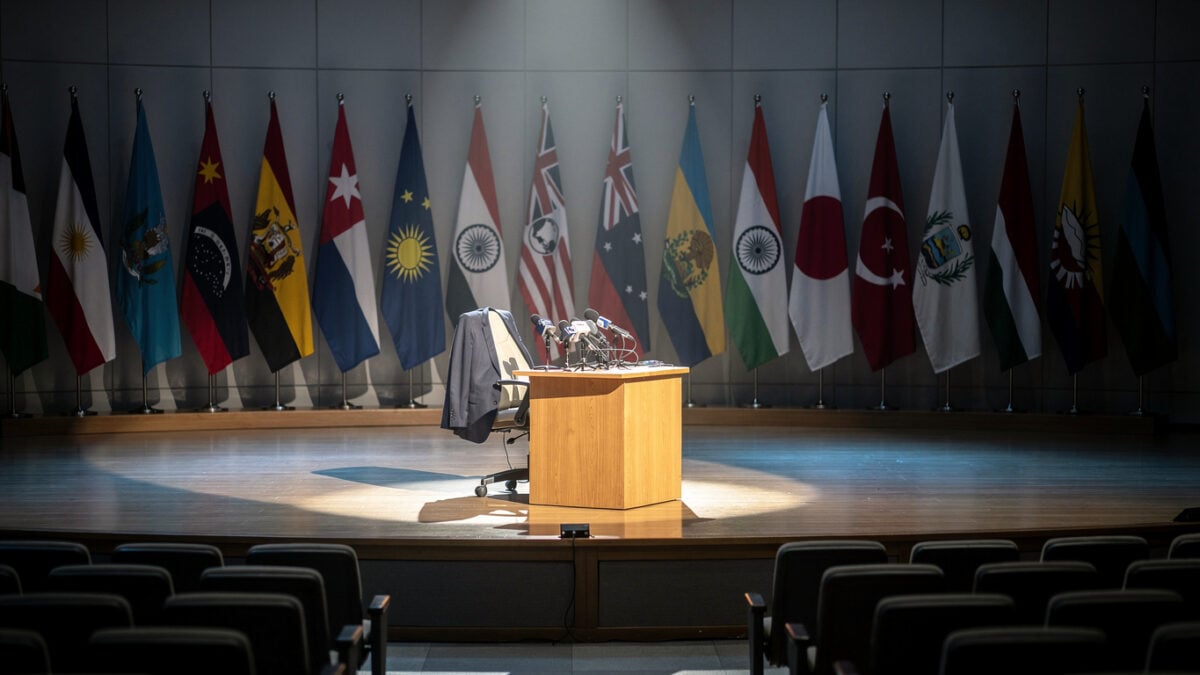
Defense Secretary Pete Hegseth arrived in Singapore on Wednesday, May 28, 2026, to attend the Shangri-La Dialogue — the Indo-Pacific’s premier annual security forum — as Washington faces mounting allied anxiety over two concrete weapons delivery failures: a paused USD 14 billion arms package to Taiwan and delayed Tomahawk missile shipments to Japan. The trip is Hegseth’s fourth visit to the Indo-Pacific and his first since accompanying President Trump to Beijing earlier in May.
The real question allies are asking is not whether Hegseth will reassure them, but whether reassurances still mean anything. Chinese Defense Minister Dong Jun is expected to skip the forum for the second consecutive year.
The weapons were approved. The contracts were signed. They just have not arrived — and that gap between American commitment and American delivery is now the dominant anxiety at Asia-Pacific’s most important security gathering. Hegseth lands in Singapore carrying the diplomatic weight of two unresolved arms failures: a USD 14 billion package to Taiwan that the Trump administration paused without a consistent explanation, and Tomahawk cruise missiles destined for Japan that have been delayed, setting back Tokyo’s long-range strike programme by an undefined timeline.
For allies who have structured their defence planning around US reliability, the sequencing is deeply uncomfortable. Hegseth delivered some of the most explicit public language on Taiwan deterrence at this same forum in May 2025, warning that any Chinese attempt to take the island by force would bring “devastating consequences” and that the threat “could be imminent.” Twelve months later, he returns to Singapore after sitting in the room when Trump told Xi that the same arms package was a “very good negotiating chip.”
The divergence between those two positions — one month apart — is precisely what Indo-Pacific defence ministers, chiefs of staff, and procurement officials will be measuring when Hegseth takes the podium. Indonesia’s own deepening entanglement with Washington’s regional posture, including a contested proposal granting US military overflight access through Indonesian airspace that remains under internal review in Jakarta, illustrates how broadly Washington’s credibility questions now radiate across the region.
RELATED
Delayed missiles, paused packages, and conflicting signals
The USD 14 billion arms package to Taiwan has produced three separate and incompatible official explanations. Acting Navy Secretary Hung Cao told a Senate hearing the pause was driven by a munitions review tied to Operation Epic Fury — the US military campaign against Iran — to ensure adequate domestic stockpiles. Trump told reporters the package was simply not approved yet, adding “I may do it; I may not do it.” He then told Fox News it was a negotiating chip with Beijing. Pentagon officials have not reconciled these positions publicly.
The December 2025 arms sale to Taiwan — an USD 11 billion package including M142 HIMARS rocket systems, M109A7 howitzers, Altius drones, and ATACMS — was approved and triggered immediate warnings from Beijing that it would “accelerate the push towards a dangerous and violent situation across the Taiwan Strait.” That sale proceeded. The larger follow-on package did not.
Evan Sankey, an analyst at the Cato Institute focused on US foreign policy toward China and East Asia, framed the pause as serving dual purposes simultaneously: managing the diplomatic calendar ahead of a planned Trump-Xi meeting in Washington in September while addressing a genuine munitions constraint. “It is both things,” Sankey has said, describing the overlap as a “happy coincidence” for an administration that prefers ambiguity to commitment.
Hegseth is scheduled to meet Singaporean Prime Minister Lawrence Wong and Minister for Defence Ng Eng Hen, along with bilateral sessions with other regional partners. Official readouts from those meetings — expected within days — will be parsed closely for whether the language on Taiwan commitments hardens, softens, or simply avoids the question.
Lazard’s geopolitical advisory team, in its 2026 outlook published earlier this year, argues that the October 2025 US-China tariff truce left structural frictions — technology export controls, Taiwan arms policy — entirely unresolved. Political summits, the team concludes, will not by themselves stabilise the underlying strategic rivalry.
| Recipient | Package | Value | Status |
|---|---|---|---|
| Taiwan | HIMARS, ATACMS, Altius drones, M109A7 howitzers | USD 11 billion | Approved December 2025; delivered |
| Taiwan | Follow-on munitions and systems package | USD 14 billion | Paused — rationale disputed |
| Japan | Tomahawk cruise missiles | Undisclosed | Delayed — long-range strike programme set back |
How structural rivalry outlasts diplomatic atmospherics
Trump accompanied by Hegseth visited Beijing earlier in May 2026 — the first such visit of the second Trump term — and the optics of that trip have not faded from the minds of officials now gathering in Singapore. Trump’s public framing of the Taiwan arms package as a negotiating instrument with Xi broke with a decades-old US position that Washington does not consult Beijing on arms sales to Taipei. The breach was not accidental. It was stated on camera.
EY’s 2026 geostrategic outlook notes that governments across the Asia-Pacific are now treating economic security and defence procurement as inseparable policy tracks, accelerating industrial policy, investment screening, and supply-chain restructuring in direct response to perceived instability in great-power relationships. That framing captures something Hegseth’s bilateral meetings will struggle to address: allies are not just looking for verbal assurances, they are building institutional hedges that will outlast any single speech.
The pattern is familiar to anyone who has watched Washington’s alliance management through previous periods of strategic ambiguity — which is to say, it is familiar to everyone in the room at Shangri-La. The question is whether this iteration is a tactical adjustment or a structural shift. Hegseth’s own words from May 2025 — “they are preparing, and therefore we must be ready as well” — now sit uncomfortably alongside his principal’s negotiating posture.
Beyond the headline
The Bigger Picture
Hegseth’s trip lands in an Indo-Pacific where governments are rewriting economic and security rules simultaneously, not treating them as separate tracks. Regional leaders are no longer simply asking whether the US will defend Taiwan — they are weighing how to rebalance trade, technology, and defence ties in case Washington’s posture becomes more transactional over the next few years. EY’s 2026 geostrategic analysis confirms that Asia-Pacific governments are already embedding that hedging logic into industrial policy and investment screening.
The Money Trail
Behind the rhetoric on Taiwan and deterrence is a contest over who supplies — and profits from — the region’s rearmament. If allies conclude that US export decisions are unpredictable, they have clear incentives to diversify toward European, Israeli, or indigenous systems, shifting billions in long-term procurement away from US prime contractors and, over time, eroding one of Washington’s most durable tools of regional influence. That procurement logic is already entering budget discussions in Tokyo, Canberra, and Seoul.
The Timing
Questions over Taiwan support are surfacing just as Trump and Xi prepare for multiple summits in 2026 — Lazard counts up to four leader-level engagements — and governments are locking in new industrial and defence policies. Leaders attending Shangri-La must position themselves before any US-China bargains are struck, ensuring they are not left adjusting to a new balance of power decided largely above their heads. The forum’s timing, days before that diplomatic calendar accelerates, is not incidental.
What Hegseth’s Singapore trip means for your exposure to Indo-Pacific risk
With US arms reliability now an open question and Trump-Xi summit diplomacy running in parallel to allied reassurance efforts, the Shangri-La Dialogue’s outcomes over the next 72 hours will carry concrete implications across several categories of reader.
-
Investors and capital allocators
Lazard’s geopolitical advisory team flags persistent strategic risk in the Taiwan Strait as a baseline assumption for 2026, not a tail scenario. Wellington Management similarly identifies Taiwan-related contingencies as a key risk for supply chains and portfolios with Asia-Pacific exposure. Monitor the official US readout of Hegseth’s bilateral meetings — if language on Taiwan commitments stays vague or avoids delivery timelines, expect accelerated hedging by regional governments and corresponding volatility in defence-sector equities tied to Indo-Pacific contracts.
-
Western defence and technology firms
The paused USD 14 billion Taiwan package and Japan’s delayed Tomahawks signal that approved US arms deals can be suspended on diplomatic grounds with limited notice. Firms with long-cycle Indo-Pacific production programmes — particularly those dependent on Foreign Military Sales licensing — should review contract structures for political-risk clauses and assess whether European or indigenous-programme partnerships offer more stable order books over the next three-to-five years.
-
Government and policy professionals
EY’s 2026 geostrategic outlook confirms that Asia-Pacific governments are accelerating investment screening, industrial policy, and supply-chain restructuring in direct response to great-power instability. Western officials engaged in trade, technology export controls, or security cooperation frameworks should track the Shangri-La readouts closely — the forum’s communiqués and bilateral statements will signal whether allies are beginning to formalise hedging arrangements that could affect technology-sharing agreements and Five Eyes coordination.
-
Business travellers and executives with regional operations
The broader question of US military access and regional security architecture is already affecting overflight and basing negotiations across Southeast Asia — Jakarta’s still-unresolved deliberations over US military overflight rights through Indonesian airspace illustrate how quickly commercial aviation and logistics can become entangled in security politics. Executives with supply chains or personnel in Taiwan, Japan, or Singapore should ensure business continuity plans account for a scenario in which the diplomatic calendar produces an unexpected shift in US-China posture before year-end.