South Korea’s President Lee Jae Myung is preparing a tax-revision bill that would raise property holding taxes — potentially tripling them over time — to cool the housing market and push household wealth into equities. He framed the plan at a July 23 policy debate with a direct warning that the country could face Japan-style “lost decades” if it does not act.
The push comes even as several economists assess the probability of a near-term housing crash as limited. The real agenda is a structural shift in household balance sheets away from the 75.8% of assets concentrated in property.
President Lee Jae Myung cited the spectre of Japan’s 1990s property collapse on July 23 to justify a coming tax offensive on housing. The economists who model bubble risk for a living, however, read the numbers differently. The gap between the official warning and the professional consensus is the story — and it reveals less about the housing market’s immediate danger than about a political project to rewire where Korean households store their wealth.
A tax plan with a long fuse and a specific target
At the national real estate policy debate, Lee laid out a framework of “gradual differential taxation.” The standard burden would fall on a typical single-home owner-occupier. Low- and middle-income households and non-capital regions would get relief. Luxury homes, ultra-high-value properties, multiple-home owners, and speculative holdings would face surcharges, to be codified in a bill the Ministry of Economy and Finance is expected to submit by early August.
Taken together, the proposals aim to cool a market where real assets made up 75.8% of household wealth as of end-March 2025, leaving only 24.2% in financial assets. Lee has called for property holding taxes to be tripled over time, acknowledging the political cost of confronting a population that has long treated housing as the primary store of value.
| Entity | Current rule | Proposed rule | Effective date |
|---|---|---|---|
| Single-home owner-occupier | Standard holding tax rate | Standard burden maintained | 2027 tax year (expected) |
| Low- and middle-income households | Standard rate | Tax relief | 2027 tax year (expected) |
| Non-capital region properties | Standard rate | Tax relief | 2027 tax year (expected) |
| Luxury and ultra-high-value homes | Standard rate plus surtax | Higher surcharges | 2027 tax year (expected) |
| Multiple-home owners | Higher rate | Higher surcharges | 2027 tax year (expected) |
| Non-residential speculative holdings | Standard investment rate | Higher surcharges | 2027 tax year (expected) |
| Source: President Lee Jae Myung’s remarks at the July 23, 2026 national real estate policy debate | |||
Yet the economists who track Korean housing for a living are not sounding alarms. Kang Min Joo, senior economist at ING, delivered a blunt assessment: “I think the probability of a real asset bubble burst in Korea is limited.” The reason is years of tight mortgage rules. The loan-to-value ratio has fallen from a previous high of 80% to below 40%, and even lower in Seoul. Debt-to-income caps have constrained leverage well below the levels that preceded Japan’s crash.
Gareth Leather at Capital Economics called bubble fears exaggerated. Rapid price gains are concentrated in Seoul, where values remain only 10% above January 2022 levels. In Busan, prices have fallen to roughly 80% of that baseline. Large down payments required of buyers, he noted, reduce the risk of negative equity and banking stress.
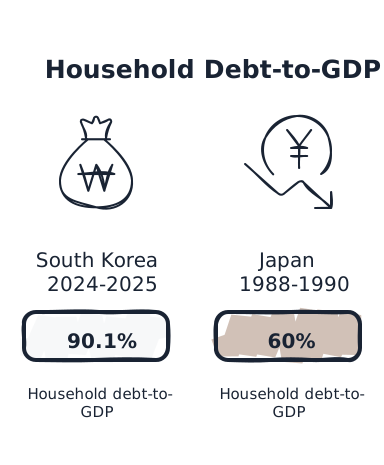
Ma Tieying of DBS Group Research identified structural parallels with pre-crash Japan — high credit-to-GDP ratios and large stock market capitalizations — but flagged a critical difference. Korea lacks the massive speculative foreign capital inflows and sharp currency appreciation that amplified Japan’s bubble. That gives the Bank of Korea more policy room, and the central bank has already responded more preemptively to inflation and financial imbalances than Japan’s did before 1990.
The comparison between the two economies is easier seen than read.
The machinery behind the warning
The real power in this story sits with the tax and regulatory apparatus, not the president’s rhetoric. Lee cannot unilaterally set taxes. The Ministry of Economy and Finance drafts the annual tax revision proposals, which the cabinet reviews and submits as bills to the National Assembly. The Assembly’s standing committees and plenary must approve any changes to tax laws. Rates and thresholds can be adjusted later via enforcement decrees, but the framework requires legislative passage.
The process matters because the timeline is already set. A bill introduced in late July or August 2026 would mean higher rates and new thresholds apply from the 2027 tax year onward. That gives households several months to adjust — and gives the market time to price in the shift. The broader household pivot from property to stocks is already underway, with Korean brokerage accounts for minors jumping 272% year-on-year in the first quarter of 2026.
The Kospi, which Lee targeted to reach 5,000 during his 2025 campaign when it sat near 2,500, now trades in the mid-6,000s. The rally has been volatile, driven by Samsung Electronics and SK Hynix — together more than 30% of the index. The tax push is designed to deepen that equity culture, but it arrives at a moment when the market is already stretched.
A more aggressively cooled Korean housing market would reverberate across East Asia. Japanese policymakers may highlight Korea’s experiment as validation for tighter macroprudential tools without repeating the rate-hike mistakes of 1989–1990. Chinese authorities, already intervening heavily in real estate, could use any visible Korean success in rebalancing toward equities to support further efforts to redirect savings from housing. The tax bill, when it lands in the National Assembly, is the first real test of whether Lee’s agenda produces a gentle rebalancing or a politically costly confrontation with property owners whose wealth hinges on housing remaining the dominant asset.
Beyond the headline
The Precedent
Lee’s invocation of Japan’s “lost decades” is not just rhetorical — it invokes a specific policy failure where late, aggressive rate hikes punctured an asset bubble and locked growth into long-term malaise. He is arguing for earlier, more targeted tools, implicitly redefining what “prudence” should look like in a highly leveraged society.
The Power Behind It
The real power lies with the Ministry of Economy and Finance, tax authorities, and the Bank of Korea. These institutions decide how quickly holding taxes rise, how exemptions are narrowed, and how tight mortgage caps become. Their choices will determine whether Lee’s agenda produces a gentle rebalancing or a costly confrontation with property owners.
The Reach
One non-obvious actor is the global semiconductor industry. If tax-driven cooling restrains domestic consumption or triggers political resistance that destabilizes broader economic policy, confidence in Korea’s growth narrative could wobble, affecting valuations and capital expenditure plans at Samsung and SK Hynix — and rippling through Western tech supply chains.
With the tax bill expected within weeks, three decisions loom
The coming tax revision bill will determine how quickly Korean household money moves from property to equities — and who bears the cost.
- Western investor with South Korean equity exposure
Assess how increased domestic equity investment — and any associated volatility in large-cap tech — could affect your existing or planned South Korean portfolio allocations. The Kospi’s rally has been concentrated in Samsung Electronics and SK Hynix; a tax-driven inflow of retail money could amplify that concentration or broaden it to financials and asset managers.
- Western property investor considering South Korean real estate
Re-evaluate the risk-reward profile of Korean property investments. Higher holding taxes, stricter lending conditions, and the government’s stated intent to curb price speculation shift the calculus for direct real estate exposure and for funds with Korean residential and commercial assets. The timeline matters: new tax rates would likely apply from 2027.
- Global semiconductor procurement manager
Monitor the economic fallout of these housing reforms for any ripple effects on Korean consumer confidence and the long-term stability of critical semiconductor supply chains. If consumption slows or political resistance destabilizes policy, Samsung and SK Hynix — the memory and foundry backbone of global tech supply chains — could face a more difficult operating environment.
- Policy analyst focused on East Asian financial stability
Analyze the specific mechanisms of Korea’s proposed tax reforms and macroprudential tools as a potential model for other highly leveraged economies. The experiment — using fiscal tools to unwind a housing concentration without a monetary shock — will be watched closely in Tokyo, Beijing, and Taipei.
FAQ
When would new property taxes actually take effect?
Under Korea’s budget calendar, tax revision proposals are typically unveiled in the second half of the year and submitted to the National Assembly ahead of budget deliberations. If a bill is introduced in late July or August 2026, higher rates and new thresholds would most likely apply from the 2027 tax year onward, giving households several months to adjust.
Will single-home owner-occupiers pay more?
President Lee and finance officials have consistently signaled that forthcoming property tax revisions will differentiate between ordinary owner-occupiers and households holding multiple or luxury homes. Draft concepts suggest relief or lighter burdens for single-home owners living in their property, especially outside the capital region, with progressively higher surcharges for investors with several dwellings or ultra-high-priced units.
How do the tax changes interact with mortgage rules?
Alongside tax reforms, authorities are debating tighter rules on jeonse (rental-deposit) loans and conventional mortgages, including stricter loan-to-value and debt-to-income caps for speculative purchases. Proposals floated at the July 23 policy debate would curb deposit-loan access for high-value properties while keeping exceptions for young households and newlyweds, meaning households may face both higher taxes and more constrained leverage.
Explainer
- Kospi
- The Korea Composite Stock Price Index, the main equity benchmark of the Korea Exchange. It tracks all common stocks listed on the exchange, weighted by market capitalisation, with Samsung Electronics and SK Hynix together accounting for more than 30% of the index’s value. Its heavy concentration in large-cap tech makes it particularly sensitive to global semiconductor cycles.
- Loan-to-value ratio
- A regulatory limit on how much a borrower can take out as a mortgage relative to the property’s appraised value. South Korea’s Financial Services Commission has tightened LTV caps over the past decade, pushing the ratio below 40% in Seoul — down from a previous high of 80% — to curb speculative lending. Lower LTV ratios reduce the risk of negative equity if housing prices fall.
- Jeonse
- A unique Korean rental system where a tenant pays a large lump-sum deposit — typically 50-80% of the property’s value — instead of monthly rent, and the landlord returns the deposit at the end of the lease. The system is deeply intertwined with the housing market, as landlords often use jeonse deposits to finance additional property purchases, creating a leverage chain that regulators are now scrutinising.
- Bank of Korea
- South Korea’s central bank, responsible for monetary policy, financial stability, and issuing the won. It has used macroprudential tools — such as tighter lending rules — more aggressively than many peers, aiming to limit household debt without relying solely on interest-rate hikes. Its policy flexibility is a key factor in economists’ assessments that a housing crash is unlikely.
RELATED STORIES