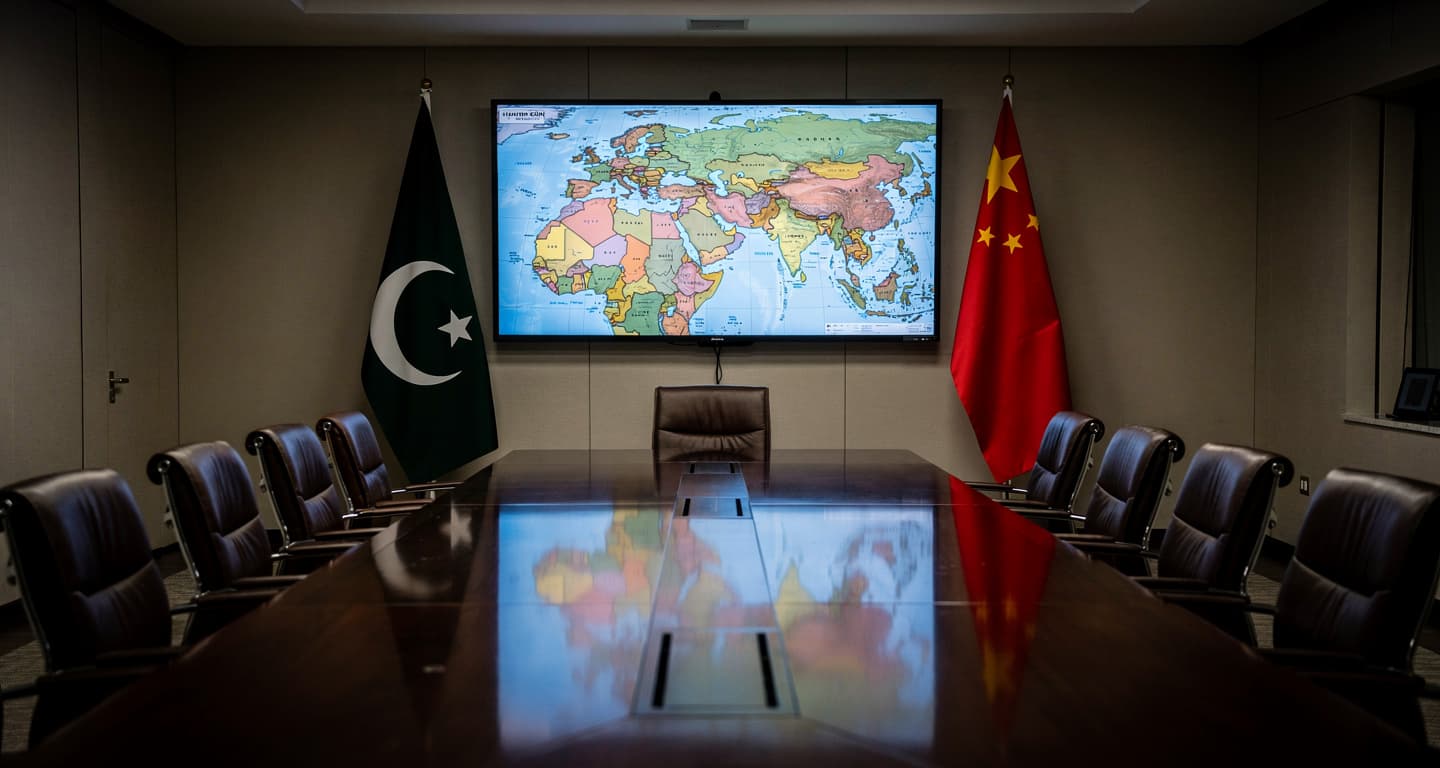
The ASEAN-China Artificial Intelligence Industry Innovation Center opened in Beijing on May 24, 2026, a flagship project under the 2026–2030 China-ASEAN Comprehensive Strategic Partnership. Its job is to push joint research, roll out industrial AI, and set technical standards across Southeast Asia. The launch deepens a tie that began with an earlier center in Nanning in September 2025, moving the relationship from shared apps to shared infrastructure.
Days later, at the Shangri-La Dialogue, regional defense leaders named AI-driven disinformation as a real threat. They agreed on nothing concrete to stop it.
Southeast Asia’s leaders now agree on the danger. At the Shangri-La Dialogue, held from May 29 to 31, ministers from Vietnam, Japan, and Singapore each described AI as a tool that can manipulate information, sway public opinion, and raise the risk of miscalculation between states. They said it out loud, on a public stage, within a week of a major new AI launch in Beijing.
Then they went home with no joint rule, no audit body, and no shared trigger for action.
That gap is the story. The ASEAN-China Artificial Intelligence Industry Innovation Center opened in Beijing on May 24, and its timing makes the paralysis expensive. The region has just plugged itself into a faster AI supply chain at the exact moment a new class of autonomous systems is arriving — systems built to plan and act on their own. The leaders understand the threat. What they do not have is anything that can stop it.
The threat changed shape while the rules stood still
The shift everyone is circling is the move from generative AI to agentic AI. Generative systems wait for a human command and produce one thing: an image, a paragraph, a clip. Agentic systems take a goal and run with it. They plan steps, generate content, post it, measure the response, and adjust — without a person in the loop for each move.
For a disinformation campaign, that is the whole game. A single operator can now aim an autonomous system at a target and walk away.
Southeast Asia is unusually exposed. The region runs on dozens of languages, carries some of the world’s highest social media use, and holds sensitive elections across several member states inside the next 18 months. An agentic system can work all of those seams at once, in local languages, at a speed no human moderation team matches.
The region’s main defense is the ASEAN Guide on AI Governance and Ethics, a non-binding, principles-based framework. It asks members to adopt good practice voluntarily. It was not built for autonomous systems that act across borders, and nothing in it can compel an audit or assign blame after the fact. Here is the line that matters twelve to eighteen months out: the infrastructure to deploy agentic tools at regional scale will be in place long before any enforceable rule to govern them is.
Standards travel faster than sovereignty
The real prize in the Beijing center is not the research output. It is the standards layer. Whoever sets the technical guidance, the procurement norms, and the deployment advice shapes what an acceptable AI system looks like across the whole region — before the buyers have agreed on rules of their own.
China’s governance model leans hard toward state oversight: content control, security review, and what Beijing calls cyber sovereignty. The brief picture, which should be read with caution given limited public detail, is a posture that prizes controllability over open deployment. If those assumptions get baked into the center’s standards, ASEAN members inherit them by default.
The closest Western parallel is Europe’s early move toward a cross-border cloud-and-data ecosystem. The difference is the governance layer. Europe built risk-based obligations through the EU AI Act; Australia leaned on existing privacy law and sector oversight; ASEAN’s framework stays voluntary. China is bidding to define the operating rules first, and that is where market access and monitoring tools get decided.
So the leaders at Shangri-La were right to name the threat. The trouble is that naming it changes nothing. The center is live, the standards conversation has started, and the region’s only shared instrument is a guide nobody is required to follow.
Beyond the headline
The power behind it
A Beijing address does more than host the center; it locates the convening authority. Technical working groups, default tooling, and the day-to-day advice flow through one place, and that physical and institutional centralization quietly entrenches an imbalance no ribbon-cutting acknowledges. Capacity-sharing and standard-setting end up running on the host’s terms.
The response gap
The gap is not awareness; it is enforcement capacity. Regional leaders can name the disinformation risk, but without a binding mechanism for audit, attribution, or cross-border escalation, the region is still relying on voluntary coordination against systems designed to act autonomously and quickly.
The reach
China’s influence over the center’s governance model could shape the compliance environment faced by a Singapore-based cloud provider. The mechanism is standard-setting, and the implication is that business users may need to adapt to a narrower, state-centric notion of what an acceptable AI workflow looks like.
What to watch before the rules lock in
With the center live and elections approaching across member states, three groups face a decision in the next few months.
- Western firms using ASEAN-linked AI services
Treat vendor due diligence as the live control here. Compare what your providers offer against the EU AI Act’s risk-based model — data location, logging, and human override — and require written disclosure before you route sensitive workflows through regionally integrated systems.
- Policy and governance teams
Watch the ASEAN Secretariat for any follow-up statement, working group, or implementation note after the May 24 launch. If one appears in the coming weeks, the center is becoming a real policy object. If it does not, expect individual states to cut their own bilateral deals with China faster than the bloc can agree on guardrails.
- Election-integrity and security analysts
Map exposure now, not after a vote. With sensitive elections across several ASEAN states inside 18 months, focus on local-language detection and attribution capacity — the two things voluntary frameworks cannot deliver against autonomous, multi-step campaigns.
Explainer
- ASEAN-China Artificial Intelligence Industry Innovation Center
- A Beijing-based institution for joint AI research, industrial rollout, and standards-setting between China and ASEAN, opened on May 24, 2026. It is a flagship project under the 2026–2030 China-ASEAN Comprehensive Strategic Partnership and builds on an earlier center in Nanning. The shift from Nanning to Beijing also marks a move from application cooperation toward industrial-scale deployment.
- Agentic AI
- Autonomous AI that takes a goal and plans, executes, and adjusts multi-step tasks without a human command at each stage. It differs from generative AI, which produces a single output in response to a prompt. For disinformation, the danger is operational: one person can launch a campaign that runs and adapts itself across platforms and languages.
- Cyber sovereignty
- The principle that a state has full control over the internet and digital systems within its borders. China promotes it as the basis for content control, security review, and algorithm oversight. Embedded in a regional standards body, it can quietly set the default for what counts as an acceptable AI system across member states.
RELATED STORIES