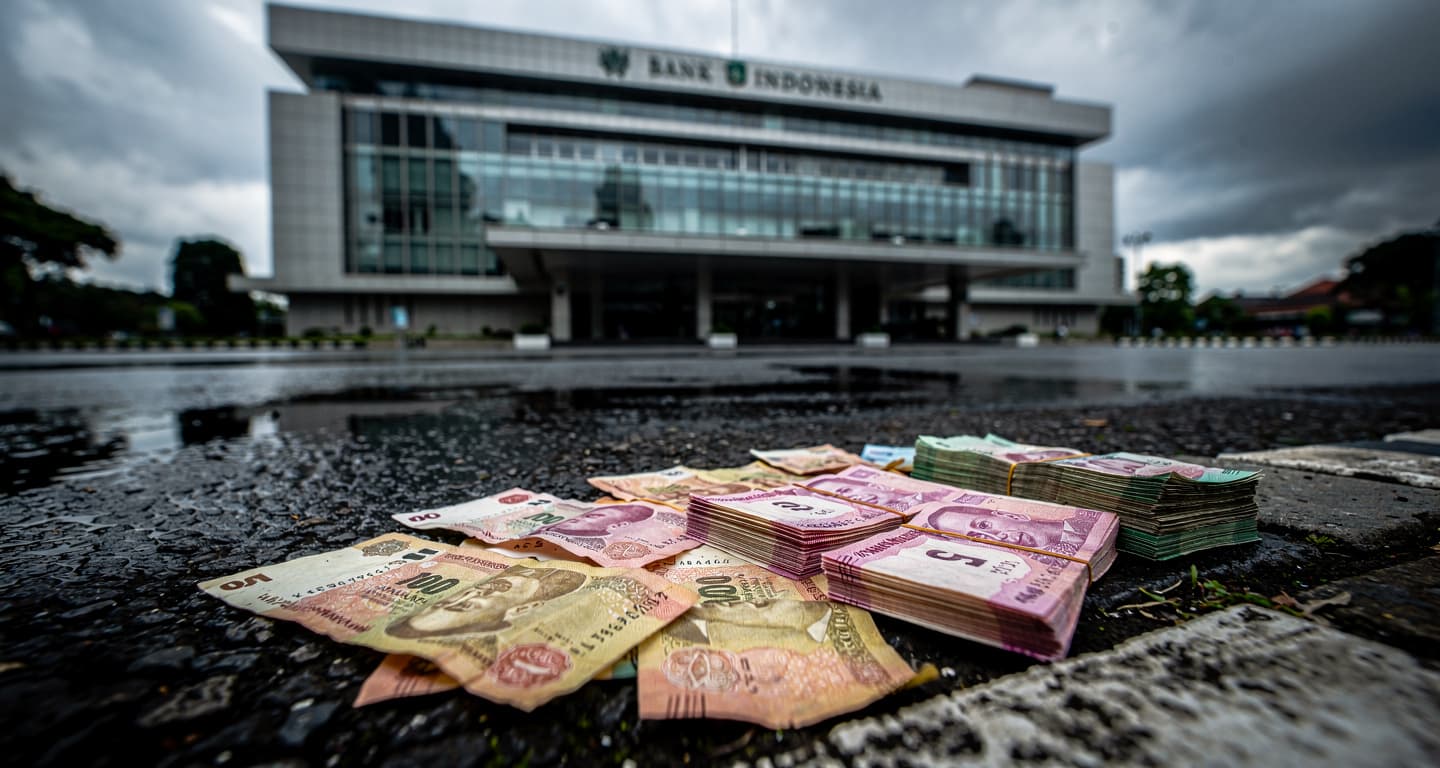
Bank Indonesia, the country’s central bank, is buying government debt under a “burden sharing” arrangement to help finance President Prabowo Subianto’s social spending — a step that puts its post-1998 independence in question. The International Monetary Fund projects Indonesia’s central government deficit will reach 3.05% of GDP in 2026, breaching the 3% ceiling fixed in law. The Rupiah has fallen to near 18,000 per US dollar, a level last seen during the 1998 crisis.
Fitch affirmed Indonesia’s BBB rating in November 2025 but warned that pressure to relax the fiscal rules could weaken policy credibility. The figure markets are watching is not the deficit. It is whose money is buying the debt.
A central bank buying its own government’s bonds is the figure that should worry investors more than any deficit number. Indonesia’s Bank Indonesia is doing exactly that, under a deal known as burden sharing, to help cover the cost of President Prabowo Subianto’s spending plans.
This is the number the headlines skip. Everyone is quoting the deficit. The deficit is a symptom. The cause is who pays for it — and increasingly, the answer is the central bank itself.
For two decades, Indonesia sold investors one promise: a central bank that stayed out of politics and fiscal rules written into law. That promise was built in the wreckage of 1998, when the Rupiah collapsed and the IMF arrived with conditions. The new government is now testing how much of that promise it can spend.
The Rupiah has already answered, sliding toward 18,000 per dollar. The bigger question is whether the institution meant to defend it is still working for the market — or for the budget.
The deficit is the symptom, not the disease
Start with the projection markets trust most. The IMF expects Indonesia’s central government deficit to hit 3.05% of GDP in 2026, up from 2.29% in 2024. That figure clears the legal ceiling by a sliver — but it clears it.
The cap is not a guideline. Law No.17/2003 on State Finance fixes the annual deficit at 3% of GDP and total government debt at 60%. It has been suspended once, during the pandemic, by emergency legislation. The 39.6% debt-to-GDP ratio recorded in 2025 still sits comfortably inside the debt limit, according to IMF World Economic Outlook data released in April 2026. The deficit line is the one under strain.
Sri Mulyani Indrawati, Indonesia’s finance minister until 2024, warned publicly that large permanent spending must respect the 3% cap to keep investor confidence. Her successor inherited a free school meal program reaching tens of millions and rising energy subsidy costs.
Fitch Ratings affirmed Indonesia at BBB with a stable outlook in November 2025, the lowest rung of investment grade. It flagged the risk plainly: pressure to relax the fiscal rules could weaken policy credibility if not managed prudently. S&P Global said in March 2025 that a sustained breach of the 3% ceiling could trigger downward pressure on the rating.
What ratings agencies cannot fully price is the financing method. A deficit funded by the bond market is one thing. A deficit funded by the central bank is another — and that is where the real test sits.
The institution built to say no
Indonesia’s central bank was designed to refuse. After 1998, independence was the price of credibility — a bank that could hold rates high even when the government wanted cheap money. That refusal is what investors paid a premium for.
Now the bank is buying government paper. Governor Perry Warjiyo has said the burden-sharing purchases are temporary, targeted, and done at market mechanisms to support recovery without undermining stability. The wording matters because the precedent does. Temporary tools have a way of becoming permanent ones.
The defence has a cost. Bank Indonesia’s policy rate stands at 6.25%, the highest since 2016, holding the line on the Rupiah while the bank simultaneously absorbs state debt. The Asian Development Bank’s 2026 outlook notes that the current-account balance has slipped from a small surplus in 2023 to a slight deficit in 2025 — a buffer for the currency, quietly gone.
So return to the question the opening left open. The deficit can be measured. Independence cannot. Once investors stop trusting the bank to act for the market rather than the budget, the credibility discount Indonesia spent two decades earning starts to reverse — and no single budget line brings it back.
Beyond the headline
The power behind it
The real fight is between the presidency and Bank Indonesia’s board, not the budget arithmetic. Whoever decides how far burden sharing goes in practice decides whether Indonesia keeps its post-crisis model of technocratic management or shifts toward a credit regime built around near-term growth and patronage.
The money trail
The winners from today’s mix of subsidies, export controls, and central-bank financing are not only low-income households. They include connected commodity exporters, state firms, and local contractors tied to big social programs. Tracking where subsidised credit and export licences land will reveal more than any official talk of food security.
What isn’t being said
Debate fixes on whether Indonesia can afford new welfare programs. Far less is said about the cost if data quality erodes. Once investors start doubting GDP or fiscal numbers, the credibility discount vanishes and risk premia rise regardless of the actual deficit path.
Three positions to reassess before the August budget
Indonesia presents its 2027 draft budget to parliament in August–September 2026. If it sidelines the 3% deficit cap, that signals a structural break. Here is how that risk lands for you.
- Bondholders and EM fund investors
Review the Indonesia sections of the IMF and ADB 2026 outlooks against your holdings in Indonesian sovereigns, EM local-currency funds, or Indonesia-heavy ETFs. A one-notch downgrade to sub-investment grade would force some mandated funds to sell, widening spreads. Both institutions publish free country data you can match to your exposure now.
- Commodity and equity investors
Watch state-linked producers in coal, palm oil, and nickel, plus listed Indonesian banks. Tighter export controls and the requirement that exporters hold foreign-currency earnings in state-controlled banks can compress earnings and bank margins. Map which names in your portfolio carry that policy risk before the budget lands.
- Expats and businesses banking in Indonesia
Rupiah weakness cuts your local costs in dollar terms, but check Bank Indonesia’s current FX-earnings rules at bi.go.id before large cross-border moves. Holding-period and reporting requirements have tightened. Cross-check with your home country’s tax guidance to stay compliant.
FAQ
Can Indonesia legally suspend the 3% deficit cap?
Yes, but it requires parliamentary approval. Law No.17/2003 caps the central government deficit at 3% of GDP and debt at 60%. During COVID-19, Law No.2/2020 suspended these limits until end-2022, after which the cap returned. Any new suspension would likely come with a formal government regulation setting out the timeframe and conditions — and would be read by markets as a structural signal.
How do the FX-earnings retention rules affect smaller firms?
Bank Indonesia’s rules primarily target corporate commodity exporters, who must place a set share of proceeds in Indonesian banks for a minimum period before converting or remitting abroad. Non-compliance can trigger administrative sanctions. Banks may apply similar documentation expectations to smaller firms or high-value individual transfers, so SMEs with overseas clients should confirm evidence requirements and timelines with their banks.
What happens to bondholders if Indonesia is downgraded?
Fitch, S&P, and Moody’s rate Indonesia at the lowest rung of investment grade with stable outlooks, but all warn that a sustained fiscal breach or heavy central-bank financing could prompt negative revisions. A one-notch cut to sub-investment grade would force some global bond funds to sell Indonesian sovereigns under mandate rules, widening spreads and pushing local yields higher.
Explainer
- Burden sharing
- An arrangement in which a central bank buys government debt directly to help fund the budget. Bank Indonesia first used it during the pandemic and has revived it under the current government. Governor Perry Warjiyo insists the purchases are temporary and conducted at market mechanisms, but each use makes the next one easier to justify.
- Law No.17/2003
- Indonesia’s State Finance Law, enacted five years after the 1998 crisis to enforce fiscal discipline. It caps the annual central government deficit at 3% of GDP and total government debt at 60%. The only suspension came during COVID-19 under separate emergency legislation, which lapsed at the end of 2022.
- Bank Indonesia
- Indonesia’s central bank, granted formal independence in 1999 as part of the post-crisis reforms. It sets the 7-day reverse repo rate, which stood at 6.25% after the April 2026 meeting — its highest since 2016. Its credibility rests on being seen to act for monetary stability rather than the government’s spending needs.
RELATED STORIES