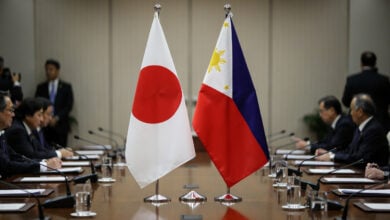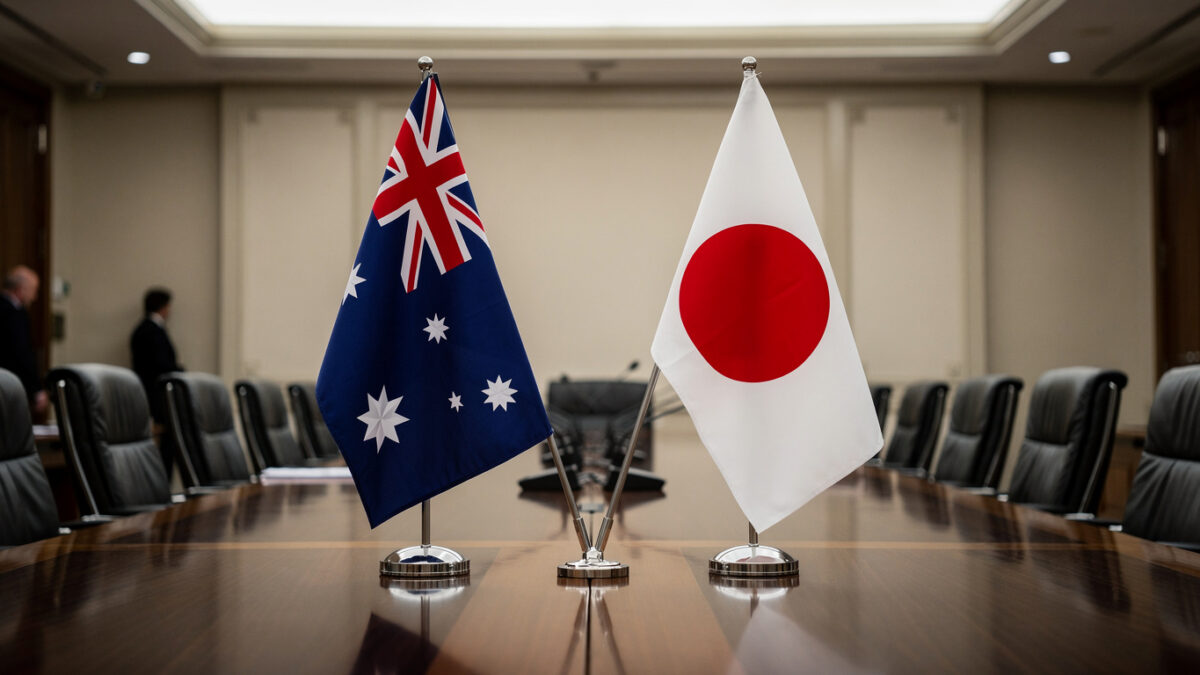
Australia and Japan agreed in Canberra on May 4, 2026 to deepen cooperation on security, supply chains, and critical minerals, and to help Pacific Island Countries fight money laundering. The deal pairs Australia’s record A$2.2 billion in Pacific development aid with Japan’s emerging role as a supplier of military hardware and security grants. Together they offer the Pacific a third option between Washington and Beijing — one that does not force a choice.
The leaders did not mention climate change, which Pacific governments call their top security threat. That silence may decide how far the partnership goes.
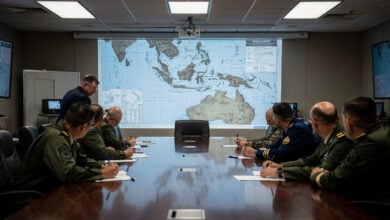
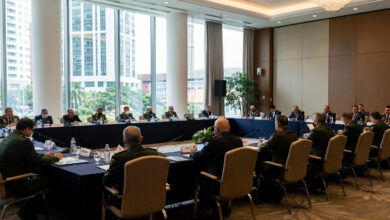
Middle powers have tried to organise the Pacific before, and the islands have a long memory for who showed up only when a rival did. The pattern is back. On May 4, in Canberra, Australia and Japan agreed to coordinate their security work across the Pacific, dividing the labour between Australian aid and policing and Japanese hardware.
The framing in Tokyo and Canberra is that this gives Pacific Island Countries a genuine alternative to China. The framing is half right. What the two governments are building is real, and it is more capable than anything the islands have been offered by a non-Chinese partner in years. But the offer leaves out the one threat the islands say matters most. That gap is not an oversight. It tells you what the partnership is actually for.
The division of labour is the whole strategy
Australia brings the chequebook. Its Official Development Assistance reached a record A$2.2 billion for the Pacific in the 2026–27 budget, up from the A$1.9 billion committed in 2024–25. Its Pacific Maritime Security Program has already delivered Guardian-class patrol boats to twelve island states and Timor-Leste.
ALSO WORTH READING

Japan brings the weapons. Tokyo’s December 2023 revision of its Three Principles on Transfer of Defense Equipment and Technology cleared the way to export lethal arms to partners such as Australia and New Zealand. On April 18, 2026, Canberra contracted Mitsubishi Heavy Industries to build eleven Mogami-class frigates for A$10 billion. Each ship carries a range of 10,000 nautical miles — enough to patrol the Pacific without refuelling.
The two roles are designed to fit together. That is the point worth holding onto.
Japan has been working the islands directly, too. In February 2026 it hosted the third Japan–Pacific Islands Defense Dialogue, signing maritime security and disaster-relief agreements with Papua New Guinea, Tonga, and Fiji. Its Official Security Assistance framework, launched in 2023 and expanded the following year, is expected to grow further under the 2025–26 budgets, with PNG and Tonga named as priority recipients.
The islands have learned to row between the reefs
What looks like a binary from Canberra rarely looks like one from Suva or Honiara. The islands have spent two decades learning to take from every suitor without belonging to any. Fiji and others call it being “friends to all, enemies to none.”
Vanuatu showed how the game is played. In May 2026 its cabinet approved a revised Nakamal Agreement security pact with Australia — but only after stripping out language that would have limited China’s security and investment role. The first version failed in 2025. Canberra got its pact. Beijing kept its door open. Vanuatu kept both.
That is the manoeuvre every island capital is now studying. The Solomon Islands will test how deep it can go with China while still drawing Australian and Japanese support. PNG will leverage competing port and policing offers for better terms. Few will sign anything that reads as choosing a side.
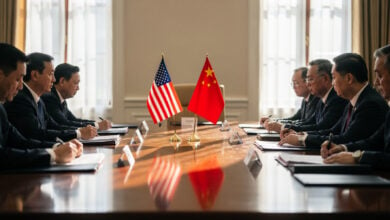
So the partnership is capable, coordinated, and aimed squarely at China. It is also missing the thing the islands keep asking for. Every few years an outside power arrives offering security and means its own definition of the word. The islands have heard the word before. They will judge this offer by whether it finally includes the rising sea.
Beyond the headline
The bigger picture
This is not only about China. It signals the United States quietly handing front-line Pacific security work to aligned middle powers. As Canberra and Tokyo step forward, the region’s security is increasingly shaped in small mini-lateral deals rather than broad island-led forums — tilting the agenda toward maritime and military concerns over social and climate resilience.
What isn’t being said
The statements stress sovereignty, infrastructure, and shared values, then fold climate into vague development language or drop it entirely. For many island leaders that omission is loud. It suggests the real driver is outside fear of China, not the slow-onset threats Pacific societies call existential — opening a widening gap between the partnership’s language and local priorities.
The regional split
Island responses are already diverging. Some governments see a chance to lock in patrol boats, training, and infrastructure; others fear being pulled into bloc politics that wrecks their “friends to all” stance. The split tracks domestic political cycles and how urgently each state feels climate and debt pressure, foreshadowing uneven alignment across Melanesia, Micronesia, and Polynesia.
The choices facing money, governments, and the islands
With the PALM leaders’ meeting expected in 2027 to test how serious Tokyo’s commitment runs, four readers should be watching different parts of the same picture.
- Investors in critical minerals and shipping
The May 4 agreement names supply chains and critical minerals as priority cooperation areas. Watch the Australia–Japan working groups for procurement signals, and price Pacific sea-lane risk into any shipping or commodity exposure before tensions over dual-use ports harden.
- Western defence and industrial firms
Japan’s December 2023 export rules opened a market that was closed for seventy years. The A$10 billion Mogami frigate deal is the template. Track Mitsubishi Heavy Industries’ subcontracting and Japan’s OSA tenders for PNG and Tonga, where joint ventures will be decided over the next two budget cycles.
- Pacific policymakers and regional bodies
The partnership’s silence on climate is your leverage. Vanuatu proved that pact terms are negotiable. Press for explicit climate-security funding in any new OSA package and at the 2027 PALM meeting — the absence of it is the partnership’s clearest weak point.
- Diplomats tracking US-China rivalry
Watch for a trilateral Australia–Japan–US announcement on Pacific maritime domain awareness, expected within the coming year. Its arrival would mean the middle-power axis is hardening into structure; its absence would signal continued caution about provoking Beijing.
Explainer
- Official Security Assistance (OSA)
- A Japanese grant scheme, launched in 2023, that funds defence equipment and infrastructure for partner militaries. It marks a break from Japan’s long-standing rule that overseas aid stay strictly civilian and non-military. Papua New Guinea and Tonga were named priority recipients, with the grants channelled through Tokyo’s cabinet on a case-by-case basis rather than a standing budget line.
- Official Development Assistance (ODA)
- Government aid aimed at economic development, distinct from military or security funding. Australia is the largest ODA donor to the Pacific, using it to anchor its “Pacific family” influence. Its 2026–27 Pacific commitment of A$2.2 billion is a record, but it carries no defence component — which is precisely the gap the partnership with Japan is built to fill.
- Japan–Pacific Islands Defense Dialogue
- A multilateral defence forum Japan convenes to build security ties across the Pacific. Its third session, held in February 2026, drew delegations from 28 countries. The dialogue is the diplomatic vehicle through which Tokyo signed maritime security and disaster-relief agreements with Papua New Guinea, Tonga, and Fiji — the soft entry point before harder OSA hardware follows.