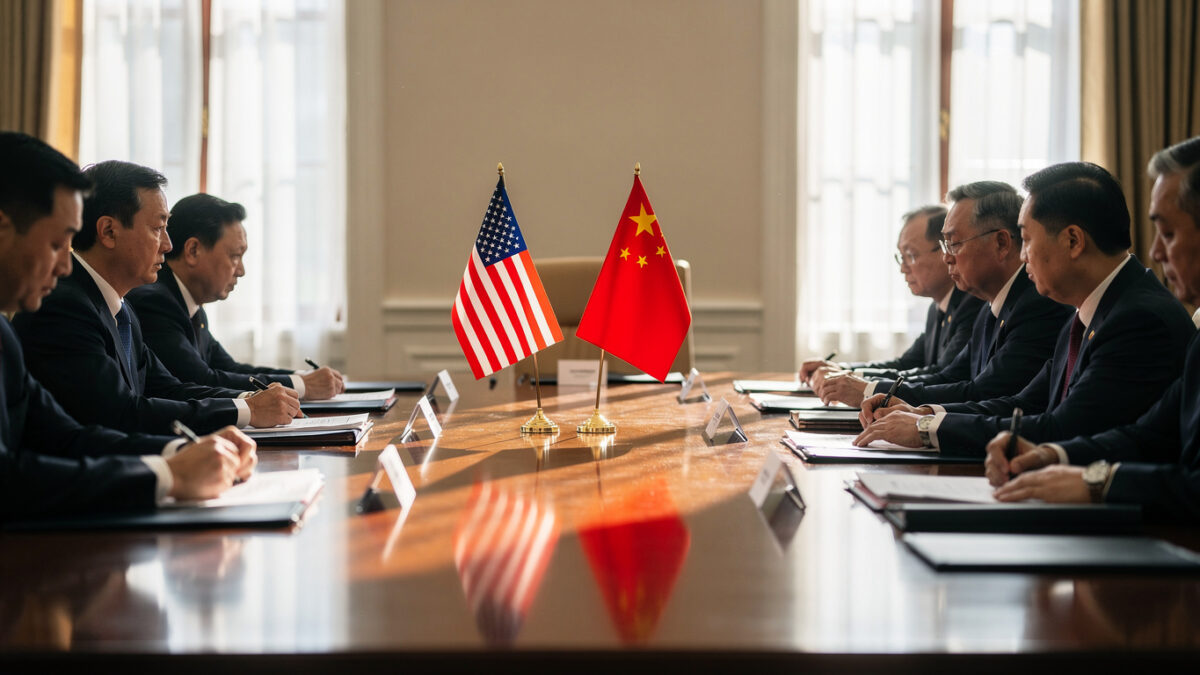
The United States has placed a USD 14 billion arms sale to Taiwan on hold days after President Donald Trump returned from a summit with Chinese President Xi Jinping — a pause that Taipei, Tokyo, Seoul, and Manila are all reading as something more permanent than a logistics delay. Trump acknowledged discussing Taiwan’s arms situation directly with Xi, breaking with decades of US protocol that kept weapons sales to the island off the bilateral agenda with Beijing. The US Navy’s acting chief attributed the pause to munitions demands from Operation Epic Fury, the US military engagement against Iran. Few in the region believe that explanation.
The hold follows US lawmakers approving the sale in January 2026, and Trump confirming in February that he had already raised arms sales with Beijing — before the Iran conflict began. With at least three Xi-Trump meetings calendared through December 2026, the pause may extend well into next year.
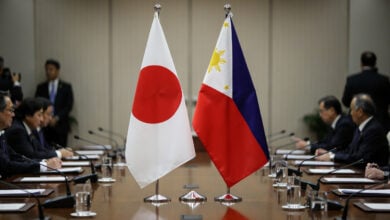
Something has shifted in the Taiwan Strait calculus, and it is not just about one arms deal. Across the Indo-Pacific, the governments of South Korea, Japan, and the Philippines have begun quietly accelerating domestic defence spending, deepening bilateral security arrangements with each other, and reducing their operational reliance on Washington — all within the same six-month window in which the Trump administration signalled that Taiwan’s security might be a bargaining chip with Beijing. The Taiwan arms pause is the headline. The regional hedge is the story.
Trump’s language upon returning from China was unambiguous in its ambiguity. “I think the last thing we need right now is a war that’s 9,500 miles away,” he told reporters, after confirming he had discussed Taiwan’s arms situation with Xi “in great detail.” That framing — Taiwan as a distant problem rather than a treaty-adjacent commitment — landed in Taipei like a verdict. By April 2026, 40% of Taiwanese held a negative view of the United States, up from 24% two years earlier. That 16-percentage-point shift in two years is not sentiment drift. It is a strategic reassessment by an island that has built its entire defence posture around a relationship now openly in question.
The US has supplied approximately 90% of Taiwan’s weapons between 1950 and 2025, according to data from the Stockholm International Peace Research Institute. Replacing that supply chain is not a near-term option. What Taiwan — and its neighbours — are calculating instead is how much deterrence value remains in an alliance whose guarantor has started negotiating its terms with the other side.
ALSO WORTH READING

The arms pause and what it actually signals
US lawmakers approved the USD 14 billion Taiwan arms package in January 2026. By February, Trump had confirmed he was already discussing the sale with Beijing — weeks before the Iran conflict that the administration now cites as the reason for the pause. The acting head of the US Navy told a Senate hearing that the hold was necessary to preserve munitions stocks for Operation Epic Fury. Taipei has not publicly challenged that explanation. It does not need to.
Arms sales to Taiwan are not transfers from existing stockpiles. They are manufacturing orders that take years to fulfil. The US already carries a USD 30 billion backlog in committed but undelivered weapons to Taiwan — a figure that predates the Iran conflict by years. Pausing a new order on munitions grounds, when the existing backlog demonstrates Washington’s comfort with delayed delivery, does not hold together as a logistical argument. It holds together as a diplomatic one.
Trump’s own words complicate the official line further. He described Taiwan’s arms situation as a “negotiating chip” ahead of the Xi summit — a direct break with the decades-old US practice of keeping Taiwan’s weapons supply off the bilateral agenda with Beijing. The Xi summit also prompted Trump to adopt Chinese government framing: describing Taiwan as seeking independence and referring to the situation as “the Taiwan problem,” language that positions Taipei as the provocateur rather than the party under pressure.
| Metric | Figure | Source / Date |
|---|---|---|
| US share of Taiwan arms sales, 1950–2025 | ~90% | Stockholm International Peace Research Institute |
| Current undelivered arms backlog (pre-pause) | USD 30 billion | US Congressional testimony, 2026 |
| Arms sale now on hold | USD 14 billion | Approved by US lawmakers, January 2026 |
| Taiwan’s proposed additional defence budget | USD 40 billion | Taiwan government proposal, 2026 |
| Amount passed by Taiwan’s opposition-controlled parliament | ~USD 27 billion (approx. two-thirds) | Taiwan Legislative Yuan, 2026 |
| Taiwanese with negative view of US (April 2026) | 40% | Polling data, April 2026 |
Strategic ambiguity was always a gamble — Trump has called it
Since the 1970s, US policy toward Taiwan has rested on strategic ambiguity: a deliberately vague commitment to Taiwan’s security that gave Washington flexibility, gave Taipei reassurance, and gave Beijing just enough uncertainty to deter military action. The policy was never a guarantee. It was a calculated bluff — and it worked precisely because no one tested it too hard.
Trump has now tested it publicly, on camera, in Beijing’s direction. The State Department language that successive administrations carefully calibrated to support Taiwan without crossing Beijing’s red lines is being revised in real time by a president who sees the relationship as transactional. That is a structural change, not a rhetorical one.
The regional response reflects this. South Korea, Japan, and the Philippines are not waiting for Washington to clarify its position. They are building defence industrial capacity, signing bilateral security agreements with each other, and accelerating links with what officials in the region describe as “like-minded countries” — a coalition that conspicuously no longer assumes US leadership as its foundation. The Taiwan situation, as James Whitfield would note, is less a crisis in a bilateral relationship than a stress test of the entire post-1945 hub-and-spokes security architecture Washington built in the Pacific — and the spokes are starting to wonder about the hub.
China’s pressure on Taiwan, meanwhile, operates well below the threshold of open conflict. Taiwan receives millions of cyber attacks daily targeting government websites and infrastructure. Chinese military vessels operate within 24 nautical miles of Taiwan’s coast on a routine basis — up to 10 vessels at any given time. A senior Taiwanese security official has described the situation to correspondents as “gray zone warfare,” arguing that the focus should shift from preparing for a D-Day scenario to managing the daily erosion of Taiwan’s security environment. The disruption Beijing can cause to Taiwan without firing a shot is already substantial — as coverage of China’s military exercises and their effect on Taipei’s airspace has documented in detail.
Beyond the headline
The bigger picture
The Taiwan arms pause is a data point in a larger structural shift: the slow unwinding of US unipolarity in the Indo-Pacific. For seven decades, Washington’s security guarantees allowed allied governments in the region to underinvest in their own defence and defer hard choices about sovereignty. That model is now visibly failing. The simultaneous hedging by South Korea, Japan, and the Philippines — building domestic defence industries, deepening intra-regional security ties, and reducing operational dependence on US forces — represents a collective judgement that the hub-and-spokes system can no longer be taken as given. Taiwan is the most exposed node in that system, but it is not the only one recalculating.
The reach
The actor most immediately affected beyond Taiwan is the global semiconductor industry. Taiwan Semiconductor Manufacturing Company (TSMC) produces the majority of the world’s most advanced chips — components embedded in everything from smartphones to precision weapons systems. A deterioration in Taiwan’s security environment, even short of armed conflict, raises insurance costs, complicates supply chain planning, and accelerates the politically driven but economically painful effort to relocate advanced fabrication capacity to the United States, Japan, and Germany. Western technology companies and defence contractors are the mechanism through which Taiwan’s geopolitical risk becomes a Western boardroom problem.
The pattern
This is not the first time a US administration has used arms sales to Taiwan as a pressure-release valve in the bilateral relationship with Beijing. What is different now is the public acknowledgement. Previous administrations managed Chinese objections quietly, delayed deliveries administratively, and maintained the fiction that arms decisions were made on security grounds alone. Trump has collapsed that fiction by confirming, on the record, that he discussed Taiwan’s weapons with Xi and that he is “making decisions.” The precedent that sets — that arms sales are openly negotiable with Beijing — will outlast this administration regardless of how the current pause resolves.
What the US credibility gap means for you
With the arms pause in place, at least three Xi-Trump meetings scheduled before December 2026, and Taiwan’s opposition parliament having blocked one-third of the proposed defence budget, the island’s security calculus is shifting faster than at any point since the 1996 Taiwan Strait Crisis — and the consequences extend well beyond Taipei.
-
Investors and business travellers in the Indo-Pacific
Supply chain exposure to Taiwan is the immediate financial risk to quantify. Companies with significant procurement dependence on Taiwanese semiconductor fabrication — particularly those sourcing advanced nodes from TSMC — should be stress-testing alternative sourcing scenarios now, not after a crisis. The geopolitical risk premium on Taiwan-dependent supply chains is rising regardless of whether armed conflict materialises; insurance markets and corporate treasury teams in the US, Europe, and Australia are already adjusting. If your firm has not conducted a Taiwan supply chain audit in the past 12 months, it is behind the curve.
-
Policy-watchers and security analysts
Watch Taiwan’s Legislative Yuan for any further movement on the blocked defence budget — the opposition’s refusal to pass the full USD 40 billion package is a domestic political fault line with direct implications for deterrence credibility. Also watch whether the September Xi visit to Washington produces any public statement on Taiwan; a joint communiqué that includes Taiwan language would represent a significant formalisation of the shift Trump has already signalled informally. The US State Department’s Taiwan policy page at state.gov is the primary official channel for any formal language changes.
-
Travellers and expatriates in the region
The security environment around Taiwan is deteriorating in measurable, documented ways — Chinese military vessels operating within 24 nautical miles of the coast, millions of daily cyber attacks on government infrastructure, and routine airspace disruptions affecting commercial aviation. None of this constitutes an imminent invasion scenario, but it does mean that travel insurance, evacuation planning, and embassy registration are practical steps rather than precautionary ones for anyone living or working in Taiwan. Check your home government’s Taiwan travel advisory; several Western governments have updated their guidance in 2026.
-
Citizens in US-allied countries
The question of whether Washington’s security commitments are negotiable — with allies excluded from the negotiation — is no longer hypothetical. South Korea, Japan, and the Philippines are all drawing the same conclusion simultaneously and acting on it. For citizens of NATO countries watching this dynamic, the parallel with European defence debates is direct: the case for building independent or coalition-based security capacity, rather than relying on a US commitment that may be subject to revision, has never been more concrete or more urgent.