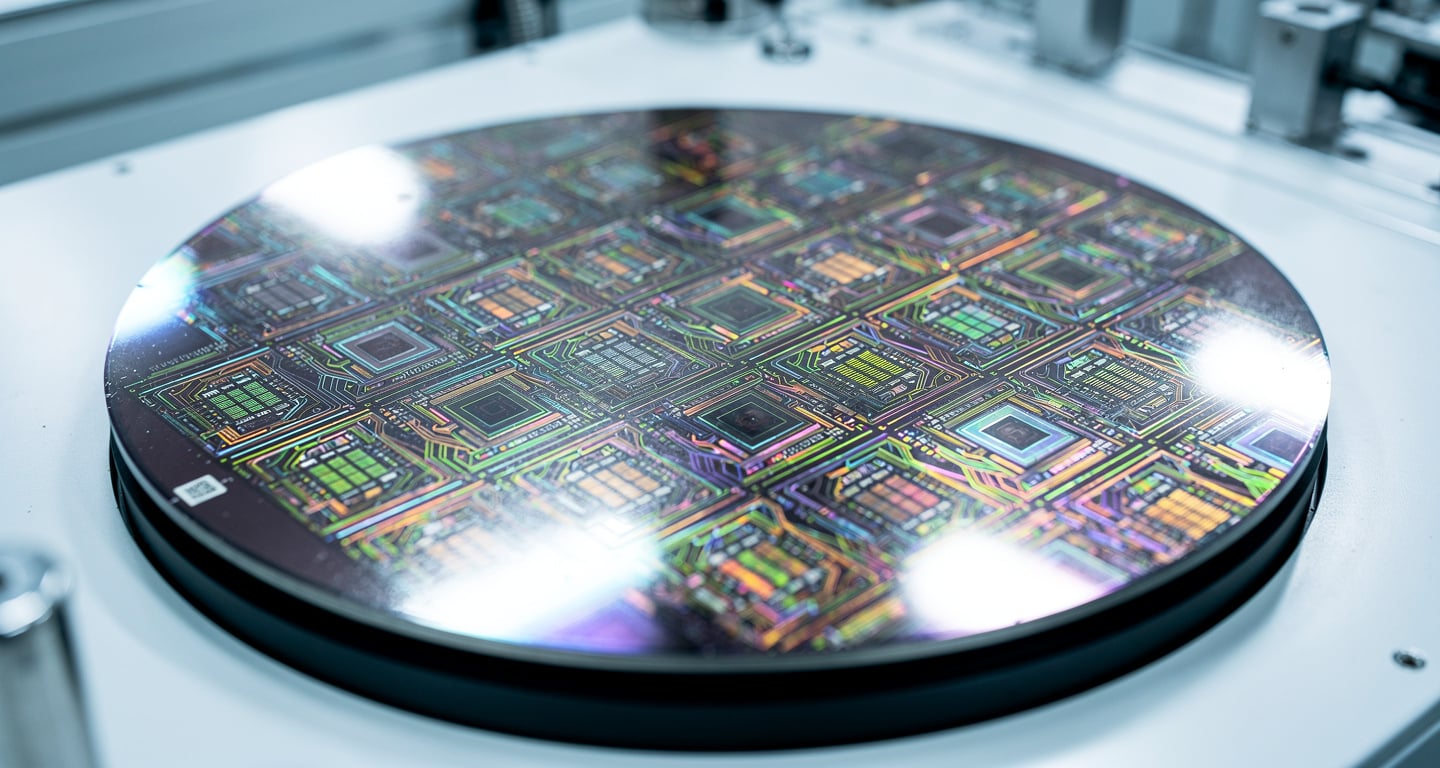
Taiwan, South Korea, and Japan are riding an American artificial-intelligence hardware boom that has pushed Taiwan’s output growth to a 14% annual pace, lifted South Korea’s memory chip operating profits by over 500% in the past year, and driven all three economies to record exports and current-account surpluses in 2025. The danger is structural: Taiwan’s integrated circuit exports now represent 42.3% of its total export basket, and South Korea’s semiconductors account for 22.9%, concentrating both economies on a single American technology cycle.
Deindustrialisation is running beneath the headline numbers. South Korea’s manufacturing employment share fell from 27.8% in 1990 to 16.4% in 2024 — and the chip boom is not reversing it.
The prosperity looks undeniable from the outside: record surpluses, surging equity indices, factories running at capacity. But the boom obscuring East Asia’s structural vulnerability is itself the problem. Taiwan, South Korea, and Japan have not diversified away from dependence on a single external demand source — they have simply traded one for another, swapping China’s insatiable appetite for commodities and components for America’s insatiable appetite for chips and servers. When the AI hardware cycle turns, as cycles do, the exposure will be acute.
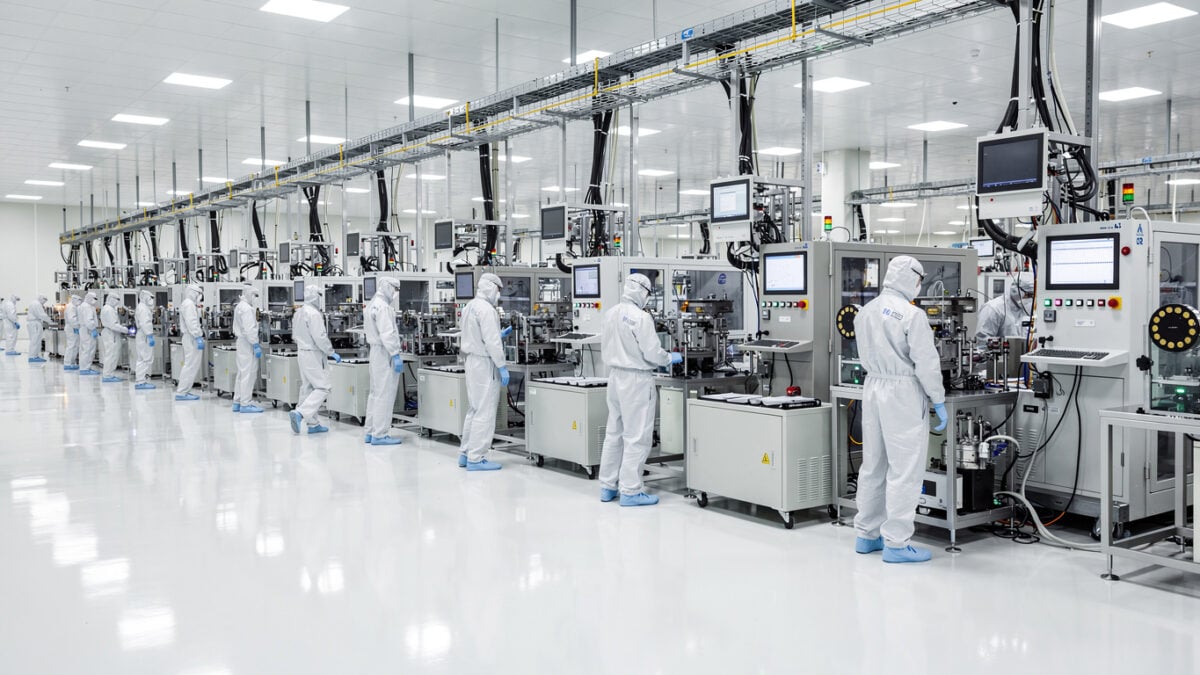
Taiwan’s integrated circuit exports reached US$224.8 billion in 2025, up 18.2% year-on-year and accounting for 42.3% of the island’s total exports, official data from the Ministry of Economic Affairs confirm. South Korea’s semiconductor exports hit US$145.5 billion, a 17.3% annual increase, helping generate a record US$105.9 billion trade surplus — the largest since 2014. Japan, which long ago ceded dominance in logic chips, is benefiting through a different channel: semiconductor manufacturing equipment exports reached ¥4.08 trillion in 2025, up 14.7%, according to the Semiconductor Equipment Association of Japan.
Beneath those figures, manufacturing’s grip on employment has been loosening for three decades. Taiwan’s manufacturing employment share fell from 36.8% in 1990 to 28.3% in 2024. South Korea’s dropped from 27.8% to 16.4% over the same period, OECD labour force data show. The chip boom is capital-intensive, not labour-intensive — it does not rehire the workers the broader deindustrialisation trend has displaced. The concentration risk across Taiwan and South Korea’s export baskets becomes sharper when mapped against those employment trends.
RELATED


Chip concentration and the reform gap
Alicia García-Herrero, Chief Asia-Pacific Economist at Natixis, argues that Taiwan, South Korea, and Japan risk over-concentration in semiconductor supply chains tied to US tech demand and need structural reforms to boost domestic services and productivity to offset deindustrialisation. The diagnosis is not new, but the current boom is making governments less willing to act on it.
Both Taiwan and South Korea have responded to China-related competitive pressures with industrial policy rather than structural reform. Taiwan’s Statute for Industrial Innovation provides tax credits for R&D and smart machinery investments, explicitly targeting semiconductors and advanced manufacturing. South Korea’s 2024 revision of the Special Tax Treatment Control Act expanded K-Chips tax credits, allowing up to a 25% deduction on facility investments in national strategic technologies including advanced semiconductors. Both measures reinforce the existing concentration rather than diversify away from it.
Richard Katz, Senior Fellow at the Carnegie Council for Ethics in International Affairs, contends that Japan’s past response to China’s manufacturing rise left it with hollowed-out industries, and that Tokyo must now pair its semiconductor revival with broader labour market and services reforms to avoid repeating that pattern. Japan’s TOPIX Electrical Appliances subindex has outperformed the broader TOPIX by roughly 20 percentage points year-to-date as of mid-May 2026, per Tokyo Stock Exchange data released May 18, 2026 — a signal of investor enthusiasm that also reflects how narrowly the equity rally is concentrated.
Taiwan’s Taiwan Stock Exchange Electronics Subindex has risen more than 40% year-to-date as of mid-May 2026, outpacing the broader Taiex, while South Korea’s KOSPI semiconductors & equipment subindex gained over 50% over the same period, Korea Exchange figures from May 16, 2026 confirm. The rally is real — and so is the single-factor risk embedded in it.
| Economy | Semiconductor export value (2025) | Year-on-year growth | Share of total exports |
|---|---|---|---|
| Taiwan | US$224.8 billion (integrated circuits) | +18.2% | 42.3% |
| South Korea | US$145.5 billion | +17.3% | 22.9% |
| Japan | ¥4.08 trillion (manufacturing equipment) | +14.7% | Not directly comparable |
The China shock that never ended — it just changed address
The phrase “China shock” entered economic vocabulary through a landmark 2013 study in the American Economic Review by economists David Autor, David Dorn, and Gordon Hanson, which documented how regions more exposed to Chinese import competition after China’s World Trade Organization entry in December 2001 suffered larger employment losses and slower wage growth through 2011 — effects that persisted and fed political backlash. The lesson for East Asia is that a narrow industrial base, however globally competitive, does not produce even adjustment. It produces concentrated gains and diffuse losses.
Taiwan, South Korea, and Japan are now running an analogous risk in reverse: not from Chinese import competition, but from export over-concentration into a single US technology cycle. The two forward signals worth watching are South Korea’s National Assembly decisions on further expanding K-Chips tax credits in the Q4 2026 tax revision, and Taiwan’s annual Economic Development Council review of its industrial policy, also expected in 2026. If South Korea expands credits and Taiwan remains chip-centric, both governments will have signalled they are doubling down rather than diversifying. The cost of that choice will not appear in this cycle’s export figures.
Beyond the headline
The bigger picture
What is unfolding is less a generic “China shock” and more a re-wiring of global manufacturing in which East Asia is squeezed between Chinese overcapacity and Western de-risking. Taiwan, South Korea, and Japan are being pulled into a role as high-end component providers to US tech platforms while losing breadth in their domestic industrial bases, narrowing their options if either Washington’s demand or Beijing’s tolerance shifts.
The timing
This moment is unusual because the AI hardware boom is cresting just as Western governments roll out expansive industrial policies and export controls, forcing East Asian firms to make long-lived capacity decisions under unusual geopolitical uncertainty. Choices made in the next two to three years about plant locations, technology nodes, and market focus will lock in trade patterns for a decade, making today’s policy debates far more consequential than a standard business cycle.
What isn’t being said
Much of the policy discussion stresses national competitiveness but says little about how adjustment costs are distributed within these societies. Regions that previously hosted diversified manufacturing are unlikely to benefit evenly from a capital-intensive chip and equipment boom, and workers displaced from mid-skill factory jobs may not transition smoothly into specialised semiconductor clusters, raising the risk of domestic political backlash even in outwardly technocratic economies.
What East Asia’s chip concentration means for your money and travel
With semiconductor export dependence at historic highs and reform timelines uncertain, Western investors, business travellers, and policy watchers each face distinct decisions before the AI hardware cycle peaks.
-
Western investors in APAC equities
The concentration risk is now measurable and priced into indices. US-listed ETFs including iShares MSCI Taiwan (EWT) and iShares MSCI South Korea (EWY) have become heavily overweight semiconductors; a deceleration in US AI capital expenditure would hit TSMC, SK Hynix, Samsung Electronics, Tokyo Electron, and Screen Holdings within a 6–12 month horizon. Investors with broad APAC exposure should review sector weights against Taiwan Ministry of Economic Affairs export data to understand how much of their allocation is effectively a single-factor AI bet.
-
Business travellers and executives operating in Taiwan and South Korea
The boom is compressing capacity in Taipei and Seoul — semiconductor cluster cities including Hsinchu and Suwon are experiencing tight commercial real estate and skilled labour markets. Supply chain disruptions driven by geopolitical shifts between Washington and Beijing remain the primary operational risk; companies with manufacturing or procurement exposure should monitor the Q4 2026 South Korea tax revision and Taiwan’s Economic Development Council review as leading indicators of where domestic investment incentives are heading. The broader cost pressures rippling through the region’s transport networks — Asian airlines have raised fares up to 26% and cut capacity sharply — add a logistics dimension to any travel budget planning.
-
Policy and geopolitical analysts
The K-Chips tax credit expansion and Taiwan’s industrial innovation statutes are the clearest indicators of government intent: both double down on semiconductor concentration rather than diversify toward services and domestic demand. If South Korea’s National Assembly does not expand K-Chips credits in the Q4 2026 revision, it would signal a rare moment of policy recalibration worth watching closely. The Autor-Dorn-Hanson research on the US China shock — and its finding that labour market scarring persisted well beyond the initial trade adjustment — is the most relevant historical frame for assessing political risk in these economies over a five-to-ten year horizon.