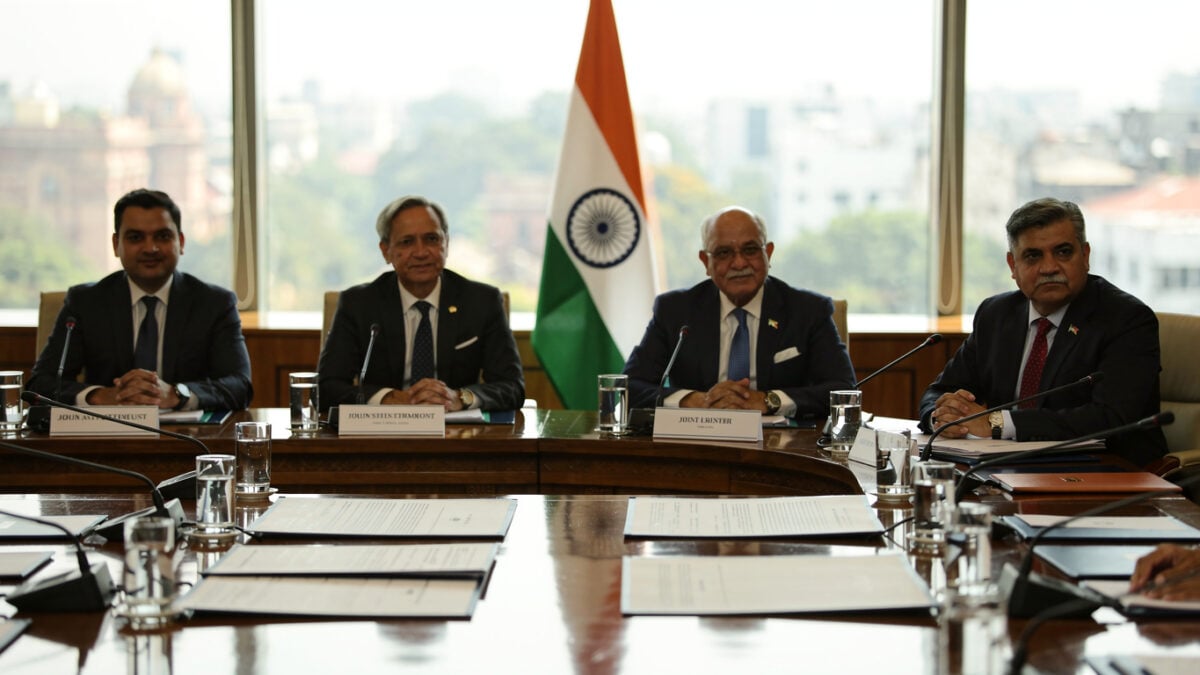
Quad foreign ministers from the United States, India, Japan, and Australia met in New Delhi on May 27, 2026, issuing a joint vision statement on Indo-Pacific maritime domain awareness, resilient critical mineral supply chains, and clean energy transition. Secretary of State Marco Rubio described the Quadrilateral Security Dialogue as “a lynchpin and a cornerstone of our global strategy,” the strongest public US endorsement of the forum in over a year.
The meeting comes after a planned leaders’ summit in India failed to materialise in 2025 amid a downturn in US-India relations. Whether a heads-of-government summit can be scheduled before the end of 2026 will determine whether this week’s momentum holds.
Fourteen months after a planned Quad leaders’ summit quietly collapsed — never announced as cancelled, simply never scheduled — the four foreign ministers arrived in New Delhi on May 27, 2026 with something to prove. Subrahmanyam Jaishankar, Yōko Kamikawa, Penny Wong, and Marco Rubio signed off on a joint vision statement covering three concrete domains: Indo-Pacific maritime surveillance, critical mineral supply chain resilience, and clean energy. The symbolism of holding the meeting in Delhi was deliberate; the substance was designed to answer critics who had begun writing the forum’s obituary.
What makes this week’s gathering more than a diplomatic photo opportunity is the specificity of its outputs. The Quad Critical Minerals Partnership — first outlined at the May 2022 Tokyo leaders’ summit — has been given renewed operational direction, identifying the United States and Australia as key producers and India and Japan as major downstream manufacturing hubs. A separate Indo-Pacific maritime surveillance cooperation initiative was also formalised. These are not declarations of intent. They are frameworks with named roles.
Beijing is watching, and not calmly.
RELATED

Two concrete frameworks, one unresolved question
The critical minerals dimension carries the most immediate economic weight. China currently refines approximately 60–70% of global lithium, 70% of cobalt, and around 90% of rare earth elements, according to data published by the International Energy Agency. The Quad frames its minerals cooperation as an economic security priority, not a trade issue — a distinction that matters for how participating governments justify domestic investment and export controls.
Tanvi Madan, Director of The India Project at the Brookings Institution, argues the Quad’s durability now depends less on summit symbolism and more on whether members can deliver practical initiatives in infrastructure, supply chains, and maritime domain awareness that smaller Indo-Pacific states actually value. The New Delhi meeting appears calibrated precisely to that standard.
Rory Medcalf, Head of the National Security College at the Australian National University, characterises the Quad as a “modern alignment” — stopping short of a military alliance but constraining Chinese coercion by signalling long-term coordination among four major maritime democracies. That framing matters: three of the four members (Australia, Japan, and the United States) hold formal alliance relationships with each other, while India does not, and New Delhi’s long-standing commitment to strategic autonomy means it will resist anything resembling a collective defence obligation.
A forum that keeps getting revived — and why that matters
The Quad has died before, or appeared to. Originally established in 2007 as the Quadrilateral Security Dialogue following the 2004 Indian Ocean tsunami relief effort, the forum was effectively dormant for nearly a decade before being revived under the first Trump administration in 2017. It was elevated to leaders’ level under the Biden administration in 2021. The pattern — collapse, revival, institutionalisation — has repeated often enough that the forum’s resilience is itself a data point worth taking seriously.
The US-India relationship is the variable that most complicates the picture. Washington and New Delhi are both independently pursuing diplomatic resets with Beijing, which dilutes the “India as counterweight to China” framing that animated earlier US enthusiasm for the Quad. Japan’s 2022 National Security Strategy remains the most explicit governmental text identifying the Quad as a key coordination framework, describing China’s posture as the “greatest strategic challenge” Tokyo faces. Australia’s position, reflected in Foreign Minister Wong’s presence in Delhi, is consistent support for the forum as a practical security mechanism rather than an ideological one.
The broader Indo-Pacific strategic competition that the Quad is navigating extends well beyond its four members — as Indonesia’s ongoing deliberations over US military overflight rights illustrate, the question of how smaller regional states align themselves is increasingly consequential for the forum’s operational reach.
Beyond the headline
The bigger picture
The Quad’s revival attempt is happening at a moment when US foreign policy is visibly torn between bilateral dealmaking and multilateral architecture. President Trump met President Xi Jinping earlier this month and spoke of a G2 dynamic; days later, his Secretary of State was in Delhi reaffirming a four-nation forum Beijing considers hostile. These are not necessarily contradictory positions in Washington’s current strategic logic — but they are in tension, and that tension will shape how seriously Quad partners invest in the forum’s institutional development over the next two years.
The reach
A Quad critical minerals framework that successfully diversifies lithium, cobalt, nickel, and rare earth refining away from China will not deliver results quickly — the infrastructure timelines run to a decade or more. But the regulatory and investment signals it sends are immediate. European and North American manufacturers sourcing battery materials, semiconductor inputs, and defence-grade metals will face new due-diligence requirements tied to these frameworks well before alternative supply chains are fully operational. The compliance burden arrives before the supply security does.
Our take
The Quad is not dying, but it is not yet what its most ambitious supporters claim it to be. The New Delhi meeting produced real frameworks with named roles — that is progress. What it has not produced is clarity on whether a leaders’ summit will happen in 2026, which remains the single most reliable indicator of whether Washington’s commitment is structural or seasonal. A forum that requires constant resuscitation is still a forum, but it is a fragile one, and fragility is exactly what Beijing is counting on.
What the Quad’s revival means for your decisions now
With the Quad’s ministerial meeting producing binding frameworks on critical minerals and maritime surveillance, the implications for investors, policymakers, and anyone operating in the Indo-Pacific are immediate — even if the full effects are years away.
-
Investors in critical minerals and clean energy
The Quad Critical Minerals Partnership formally identifies Australia and the United States as preferred producer nations and India and Japan as downstream manufacturing hubs. Companies with exposure to lithium, cobalt, nickel, or rare earth processing should monitor how US and Australian export frameworks align with this designation — preferential financing and offtake agreements are likely to follow the political signal. The IEA’s critical minerals data provides the baseline against which Quad supply diversification targets will be measured.
-
Western manufacturers with Indo-Pacific supply chains
Emerging EU and US supply-chain due-diligence rules are increasingly asking where inputs are sourced and under what standards. Quad frameworks will generate new audit categories and preferred-supplier designations. Companies that get ahead of this compliance shift — particularly in battery technology, semiconductors, and defence manufacturing — will face lower transition costs than those that wait for regulation to force the adjustment.
-
Policy watchers and diplomatic correspondents
Watch for two signals: first, whether a Quad leaders’ summit is scheduled before the end of 2026 — its absence last year was the single clearest indicator of the forum’s fragility; second, whether India’s independent diplomatic reset with Beijing accelerates or stalls, since New Delhi’s posture is the variable that most directly determines how substantive Quad coordination can become. Japan’s 2022 National Security Strategy remains the most useful policy text for understanding Tokyo’s red lines in this process.