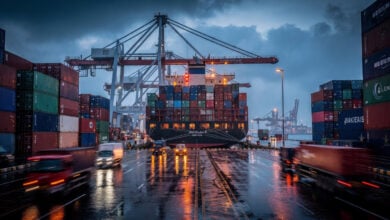
Wan Hai Lines will apply a rate restoration on Asia trades from June 1, 2026, charging USD 100 per 20-foot container and USD 200 per 40-foot and high-cube containers, citing rising operating costs linked to Red Sea disruptions. The move arrives as the Shanghai Containerized Freight Index (SCFI) composite hit 2,613 points on May 15, 2026 — up 47% from 1,783 points in mid-January — confirming that Wan Hai is not acting alone.
The carrier’s announcement is the visible tip of a broader freight rate rebaselining across intra-Asia and Asia–Europe corridors. For Western importers of apparel, electronics, and furniture sourced from Southeast Asia, the cost pressure is already arriving.
Taiwan-based Wan Hai Lines announced on May 22, 2026 that it will impose a rate restoration across applicable Asia trades beginning June 1, adding up to USD 200 per forty-foot equivalent unit to existing tariffs. The carrier attributed the adjustment to rising operating costs driven by ongoing Middle East disruptions — but the real signal is what surrounds the announcement, not the announcement itself.
Freight benchmarks across Asia-linked corridors have been climbing for months. Drewry’s World Container Index placed the Shanghai–Rotterdam spot rate at USD 3,460 per 40ft container as of mid-May 2026, up 16% from USD 3,983 the previous month. Global container trade in Q1 2026 reached approximately 48.5 million TEU, up 8% year-on-year according to Clarksons’ Container Intelligence Monthly published in April 2026 — demand growth that has handed carriers the pricing leverage they lacked through most of 2023 and 2024.
Wan Hai operates primarily on intra-Asia and trans-Pacific routes, making it a bellwether for regional freight conditions rather than a dominant setter of global rates. When a mid-tier carrier moves, it typically means the larger players have already established the floor.
RELATED
The rate restoration in full
Wan Hai’s new surcharge applies to all applicable Asia trade lanes from June 1. The structure is straightforward: USD 100 per TEU (twenty-foot container) and USD 200 per FEU (forty-foot and high-cube containers). The carrier framed the adjustment as necessary for service continuity, citing cost pressures across its Asia network without specifying individual trade lanes.
Bunker costs are a significant component of that pressure. Average very low sulphur fuel oil (VLSFO) prices in Singapore reached approximately USD 640 per tonne in April 2026, up from roughly USD 560 per tonne in January 2026, according to the International Energy Agency’s Oil Market Report published in May 2026. That USD 80-per-tonne increase over four months represents a meaningful cost shift for a carrier running dozens of weekly Asia services. The same fuel cost surge has rippled across the transport sector — Asian airlines have already raised fares and cut capacity in response to fuel price increases that have pushed operating costs to record levels.
Simon Heaney, Senior Manager of Container Research at Drewry, noted in April 2026 that Red Sea diversions combined with stronger-than-expected demand had given carriers “renewed pricing power,” and that further general rate increases and surcharges on Asia-related trades were likely through mid-2026. Lars Jensen, CEO of Vespucci Maritime, argued in a March 2026 commentary that persistent rerouting around the Cape of Good Hope — adding roughly ten to fourteen days to Asia–Europe voyages — creates “a structural floor under freight rates” that encourages lines to pursue restorations rather than compete on price.
| Metric | Mid-January 2026 | Mid-May 2026 | Change |
|---|---|---|---|
| SCFI composite (points) | 1,783 | 2,613 | +47% |
| Drewry WCI Shanghai–Rotterdam (USD/FEU) | ~USD 2,983 | USD 3,460 | +16% (month-on-month) |
| Drewry WCI Shanghai–Los Angeles (USD/FEU) | — | USD 3,285 | — |
| Singapore VLSFO bunker price (USD/tonne) | ~USD 560 | ~USD 640 (April) | +USD 80 |
| Global container trade, Q1 2026 (million TEU) | 48.5 million TEU | +8% YoY | |
Why carriers are regaining the upper hand
The structural backdrop matters here. Houthi attacks on commercial shipping in the Red Sea began in late 2023 and have never fully resolved. Ships rerouting around the Cape of Good Hope add roughly two weeks to Asia–Europe transit times, absorbing effective capacity without adding new vessels to the fleet. The US-led Operation Prosperity Guardian, launched in January 2024, continues to provide naval escort in the Red Sea and Gulf of Aden, but has not restored normal routing for the majority of container lines. The EU’s Operation Aspides, activated in March 2024, similarly provides protection but has not ended the diversion calculus.
The consequence is that the container shipping market has tightened without any formal capacity withdrawal by carriers. Regulatory conditions are also shifting. The EU’s Consortia Block Exemption Regulation (Regulation (EU) No 906/2009), which had shielded certain liner cooperation agreements from antitrust scrutiny, expired on April 25, 2024 and was not renewed — meaning carriers coordinating rate restorations on EU-related trades now face greater regulatory exposure. In the United States, the Ocean Shipping Reform Act of 2022 (Public Law 117-146) gave the Federal Maritime Commission expanded authority over carrier surcharges, and FMC rulemakings launched in 2024 and 2025 have put surcharge transparency under closer watch. Neither framework has stopped the current rate cycle, but both create legal risk for carriers that move in obvious concert.
Beyond the headline
The bigger picture
A mid-tier carrier edging up rates is part of a broader reset in container shipping after the post-pandemic slump. With Red Sea disruptions lengthening voyages and demand quietly recovering, freight costs are rebaselining above pre-crisis levels — shifting bargaining power back toward carriers and away from years of shipper-dominated rate negotiations.
The reach
For import-dependent markets in North America and Europe, higher Asia-origin freight rates squeeze retailer and manufacturer margins just as inventories normalise. Apparel, electronics, and furniture buyers relying on Southeast Asian sourcing must choose between absorbing the extra logistics cost, passing it to end-customers, or reconfiguring supply chains toward nearer-shore or multimodal options.
Our take
Wan Hai’s move looks less like opportunistic gouging and more like an early marker of a new pricing floor in container shipping. As long as Red Sea risks persist and Western governments focus on security rather than freight economics, carriers will keep testing the market with incremental increases. Shippers that still treat 2023’s ultra-low spot rates as normal risk being structurally caught off guard by this new cost baseline.
What this means for importers, investors, and logistics buyers
With the SCFI up 47% since January 2026 and further restorations signalled through mid-year, Western companies with Asia-sourced supply chains face a narrow window to reprice contracts or restructure logistics arrangements before Q3 rate announcements arrive.
- Track the SCFI weekly: The Shanghai Shipping Exchange publishes the SCFI composite every Friday. Sustained readings above 2,600 points indicate carriers retain pricing power; a drop below 2,200 would suggest competitive discounting is returning.
- Review open-account freight contracts: Importers with fixed-rate contracts expiring in Q3 2026 should engage forwarders now. Spot rates on Shanghai–Los Angeles already stand at USD 3,285 per FEU — contracts negotiated at 2024 lows will not hold at renewal.
- Monitor carrier earnings guidance: Q2 2026 earnings calls from COSCO Shipping Holdings, Evergreen Marine, and Yang Ming — expected July to August 2026 — will signal whether carriers intend to sustain higher contract rates or expect demand softness. Divergence between spot and contract rates is the key number to watch.
- Equity and fund exposure: Western investors in container-shipping ETFs or logistics-infrastructure funds with exposure to Orient Overseas International, COSCO, or Evergreen should note that rising SCFI and Drewry WCI readings historically lead revenue recovery by one to two quarters. Operators with modern, fuel-efficient fleets will outperform highly leveraged older-tonnage players as bunker costs remain elevated.
- Regulatory watch — US and EU: The Federal Maritime Commission’s ongoing surcharge rulemakings and the post-Consortia Block Exemption environment in the EU mean carriers face heightened scrutiny if rate restorations appear coordinated. US importers can file complaints directly with the FMC at fmc.gov; EU-based shippers can flag concerns to the European Commission’s Directorate-General for Competition.
FAQ
What is a rate restoration and how does it differ from a general rate increase?
A rate restoration (RR) is a carrier’s attempt to return freight rates to a previously higher level after market discounting has pushed them down. A general rate increase (GRI) is a blanket upward adjustment applied regardless of prior levels. In practice, the distinction is largely semantic — both add cost per container — but RRs carry an implicit argument that current rates are below sustainable operating levels, which carriers use to justify the move to shippers.
Which trade lanes does Wan Hai’s June 1 rate restoration apply to?
Wan Hai has described the restoration as applying to “applicable Asia trades” without specifying individual corridors. The carrier’s network covers intra-Asia routes — including services linking Taiwan, China, Japan, South Korea, Southeast Asia, and South Asia — as well as trans-Pacific services. Shippers should confirm with their freight forwarder or Wan Hai’s local offices which specific origin-destination pairs are affected before the June 1 implementation date.
Are other carriers likely to follow Wan Hai with similar increases?
Based on current market conditions, yes. Simon Heaney of Drewry stated in April 2026 that further surcharges on Asia-related trades were likely through mid-2026. When a regional specialist like Wan Hai moves first, larger carriers on overlapping corridors — including Maersk, MSC, and CMA CGM — typically apply matching adjustments within four to six weeks, using the precedent as market cover.
How long are Red Sea diversions expected to continue affecting freight costs?
No firm end date is publicly projected by Western governments or shipping analysts. The US-led Operation Prosperity Guardian and the EU’s Operation Aspides remain active as of May 2026, but neither has restored normal routing for commercial container lines. Lars Jensen of Vespucci Maritime described the Cape of Good Hope rerouting as creating a “structural floor” under rates — implying the cost impact is measured in years, not months, absent a resolution of the underlying Houthi threat.