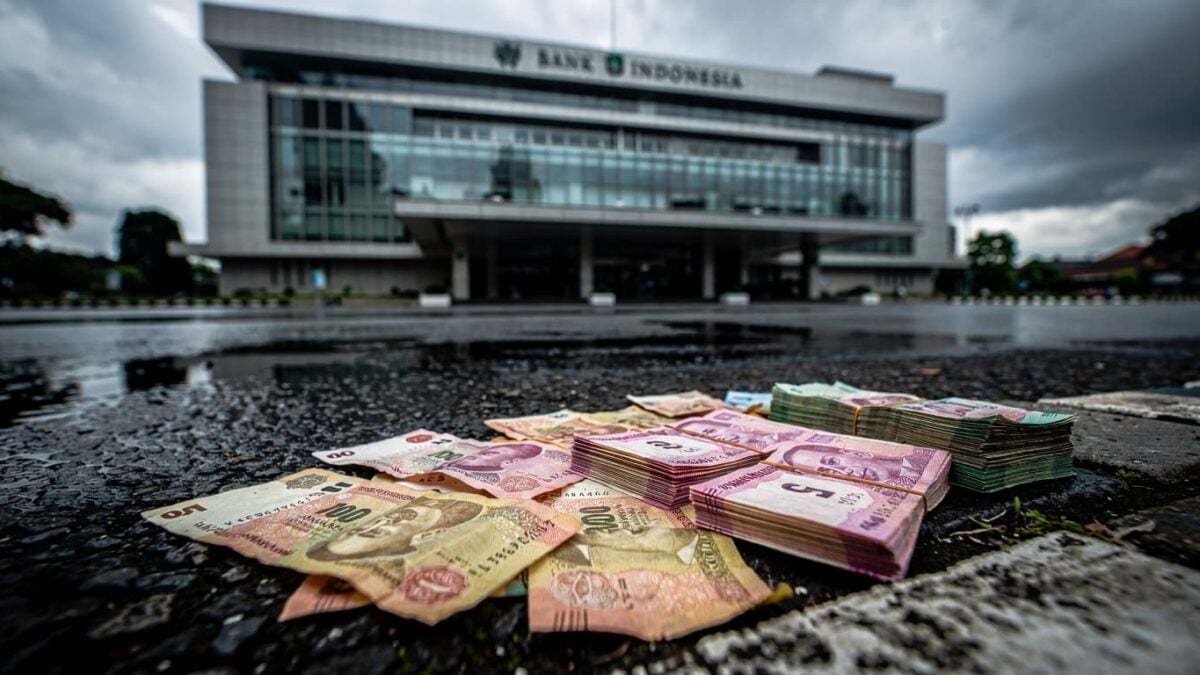
Bank Indonesia raised its benchmark 7-day reverse repo rate to 5.25% on May 21, 2026 — its first rate increase in two years — as the rupiah hit successive record lows, trading at IDR 17,600 per US dollar. Governor Perry Warjiyo cited uncertainty from the war on Iran as the trigger, but the deeper driver is a simultaneous repricing of Indonesia’s fiscal credibility, oil-subsidy exposure, and central-bank independence by foreign investors.
The rate hike has so far failed to stabilise the currency, which has depreciated approximately 5% year-to-date. Indonesia’s 10-year government bond yield stood at 6.89% as of May 22, 2026, reflecting elevated compensation for policy and currency risk.
The rupiah’s breach of IDR 17,000 per dollar was always going to land differently in Jakarta than in any other capital. That number carries the weight of 1998 — of inflation that erased savings overnight, banks that collapsed in a week, and a president who had ruled for thirty years losing power in months. The currency is now trading at IDR 17,600, well past that threshold, and Bank Indonesia’s decision on May 21 to raise its benchmark rate to 5.25% has done little to arrest the slide.
What has changed since 1998 is substantial: Indonesian banks are better capitalised, foreign reserves are healthier, and GDP growth has held above 5%. What has not changed is the market’s instinct to treat the exchange rate as a verdict on the entire policy framework the moment multiple pressure points converge at once.
Three forces have converged this month. Oil prices have risen sharply, threatening to inflate Indonesia’s fuel and electricity subsidy bill and widen the fiscal deficit. Investors are simultaneously questioning the direction of state influence over business and the independence of Bank Indonesia itself. And the second quarter’s structural dollar demand — dividends, coupon payments, imports — is adding mechanical pressure on top of the sentiment-driven selling.
RELATED



The details
Bank Indonesia’s rate decision on May 21 was framed explicitly as exchange-rate defence. Governor Perry Warjiyo confirmed the increase was intended to support the rupiah amid heightened uncertainty, signalling that currency stabilisation has reasserted itself as the bank’s operational priority over growth support. The benchmark instrument is the 7-day reverse repo rate, the main lever for open-market operations and rate signalling.
The market’s response was unambiguous: the rupiah kept falling. Erick Alexander, senior economist at DBS Group Research, said investors are focused on whether Indonesia’s authorities can preserve policy credibility if oil prices stay elevated, because that will determine the currency’s near-term risk premium. A single rate hike cannot answer that question.
Indonesia’s fiscal architecture makes oil-price shocks structurally dangerous. The government’s subsidy and compensation regime for fuel and electricity acts as a direct transmission channel between oil prices and the budget deficit — currency weakness is therefore a public-finance problem, not just a market one. Higher oil prices increase subsidy costs, weaken fiscal credibility, push bond yields higher, and reduce Bank Indonesia’s room to ease policy later. Indonesia’s 10-year government bond yield of 6.89% as of May 22 reflects that compressed room precisely.
The finance ministry has urged Indonesians to repatriate offshore assets within six months, without a tax amnesty. The measure could support domestic liquidity and ease some pressure on the rupiah, but analysts note that markets may read it as a signal that authorities are worried about capital flight or dollar shortages — which would itself damage sentiment. The counterintuitive risk is that a confidence-building measure becomes a confidence-eroding one.
| Indicator | Level | Context |
|---|---|---|
| Rupiah / USD spot rate | IDR 17,600 | Record low; down ~5% year-to-date |
| Bank Indonesia benchmark rate | 5.25% | First hike in two years, May 21, 2026 |
| 10-year government bond yield | 6.89% | Elevated policy and currency risk premium |
| Inexpensive restaurant meal, Jakarta | IDR 35,000 | Approx. USD 2.00 at current rate; USD 15 in New York |
| One-way local transport ticket, Jakarta | IDR 4,000 | Approx. USD 0.23; USD 3.50 in New York |
Why the 1998 comparison persists — and where it breaks down
The 1997–1998 Asian financial crisis is the market’s fixed reference point for Indonesian currency stress, and the rupiah’s breach of IDR 17,000 has revived it. During that episode, the rupiah’s collapse fed a cascade: inflation surged, banks failed, the International Monetary Fund imposed painful conditions, and President Suharto’s thirty-two-year rule ended within months. The episode reset Indonesia’s entire institutional framework and left a generation of investors with a visceral memory of what disorderly depreciation looks like.
The comparison does not hold structurally. Indonesia’s banking system is far better capitalised today. Unhedged corporate foreign debt — a key vulnerability in 1998 — is not a significant problem at current levels. External debt as a share of GDP is materially lower. Inflation remains contained. These are not trivial differences.
What the comparison does capture is the psychological dynamic: once a currency crosses a threshold that carries historical weight, the market starts pricing tail risk even when the fundamentals do not justify it. That premium is real, even if the scenario it prices is unlikely. The Garuda Indonesia crisis — a state carrier that posted a $323 million loss in 2025 despite a $1.4 billion government bailout — illustrated how quickly governance concerns can compound investor scepticism about Indonesian state management. The rupiah slide is a different story, but it lands in the same credibility conversation.
Beyond the headline
The bigger picture
This is another reminder that emerging-market currencies do not move on growth alone; they reprice when policy credibility, energy costs, and fiscal flexibility are all questioned simultaneously. In Indonesia, the market is treating the rupiah as a verdict on how much room policymakers have left to absorb external shocks without forcing a sharper policy trade-off. That is a harder problem to solve with a single rate hike than a straightforward balance-of-payments squeeze.
The reach
The immediate spillover is for portfolios holding Indonesian sovereign debt, local-currency credit, and consumer-facing equities that depend on imported inputs. A weaker rupiah also changes pricing assumptions for multinational firms with Indonesia exposure — particularly in energy, retail, and manufacturing supply chains tied to USD-denominated imports. Western fund managers with emerging-market allocations in Southeast Asia need to separate the Indonesia story from the broader regional picture right now.
Our take
Indonesia’s authorities are trying to defend confidence with a rate hike, but the market is looking for consistency, not symbolism. Once investors start pricing fiscal credibility and central-bank independence together, the exchange rate becomes a referendum on the whole policy mix. A June policy meeting that softens guidance prematurely would confirm the market’s worst read — and the rupiah would test levels that even the 1998 comparison cannot contain.
What this means for investors, expats, and multinationals with Indonesia exposure
With the rupiah at a record low and Bank Indonesia’s next scheduled rate decision due in June 2026, the next four to six weeks will determine whether the rate hike holds as a credible signal or is read as a one-off intervention.
- Monitor the June Bank Indonesia meeting closely. If the bank maintains a hawkish stance, it signals that currency stabilisation takes priority over growth support. If guidance softens or the bank pauses, expect markets to test the rupiah’s lower range and reassess central-bank tolerance for depreciation. The Bank Indonesia official communications page publishes rate decisions and governor statements in English.
- Track Indonesia’s 10-year bond yield as the primary stress indicator. The yield stood at 6.89% on May 22, 2026. A sustained move higher signals that the fiscal credibility concern is deepening, not stabilising. Institutional investors should use this as the lead indicator ahead of any currency or equity position adjustment.
- Reassess import-dependent supply chains. Multinational firms sourcing from Indonesia or selling into the domestic market with USD-denominated input costs face margin compression as the rupiah weakens. Sectors most exposed include energy, consumer retail, and electronics manufacturing. Model scenarios at IDR 18,000 to stress-test current contracts.
- Foreign-currency earners in Jakarta gain a short-term cost buffer. Numbeo’s May 2026 data shows an inexpensive meal in Jakarta at IDR 35,000 (approximately USD 2.00 at current rates) and a local transport ticket at IDR 4,000. That gap relative to Western cities is widening — but imported food and fuel costs are rising locally, so the buffer is uneven and will erode if depreciation continues.
- Watch the asset-repatriation deadline. The finance ministry’s six-month window for offshore asset repatriation without a tax amnesty is a live policy experiment. If inflows materialise at scale, it will ease liquidity pressure. If the deadline passes without significant uptake, it will be read as a confidence signal in the wrong direction.
FAQ
Why did Bank Indonesia raise rates if the rupiah kept falling anyway?
A rate hike raises the return on rupiah-denominated assets, which in theory attracts foreign capital and supports the currency. In practice, when investors are questioning fiscal credibility and central-bank independence simultaneously, a single hike cannot resolve the underlying risk premium. The market needs to see consistent policy behaviour over several meetings before confidence stabilises — one decision is a signal, not a solution.
How does higher oil price affect Indonesia’s government budget directly?
Indonesia maintains a subsidy and compensation regime for fuel and electricity. When oil prices rise, the cost of maintaining those subsidies rises with them, widening the fiscal deficit. A weaker rupiah compounds this because oil is priced in US dollars — the government pays more in rupiah terms for the same volume of fuel. This is why currency weakness is a public-finance problem in Indonesia, not just a market one.
Is Indonesia at risk of a repeat of the 1998 Asian financial crisis?
The structural conditions are materially different. Indonesian banks are better capitalised, unhedged corporate foreign debt is not a significant vulnerability, and external debt as a share of GDP is far lower than in 1998. Inflation remains contained. The 1998 comparison persists because IDR 17,000 carries psychological weight for investors, not because the fundamentals match. Most analysts treat the current episode as a credibility test, not a systemic crisis.
What does the rupiah slide mean for Western expats or remote workers living in Indonesia?
Foreign-currency earners gain a short-term cost advantage: Jakarta’s prices in dollar terms are now lower than they were six months ago. However, imported goods — fuel, electronics, certain foods — are repricing upward as domestic suppliers absorb the weaker currency. The benefit is real but uneven, and it narrows if the depreciation persists long enough to feed through into broader inflation.