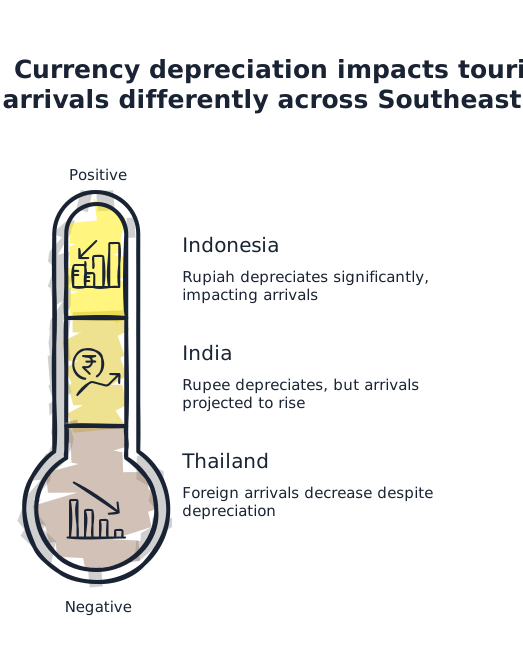
Thailand is deploying a weak baht, visa‑free entry for Indians and subsidised airfares to pull its tourism recovery forward. But foreign arrivals through July 18 stood at 17.3 million, down more than 3% year‑on‑year.
Analysts expect the policy package to lift demand from late 2026 into 2027. Near‑term seat bookings remain flat, and the key Indian visa rule has not yet been published in the Royal Gazette — leaving travellers and tour operators dangling.
By July 4, 16.2 million international travellers had already landed in Thailand this year. The spending they left behind — north of 780 billion baht — was a bump from just two weeks prior, when the tally sat at 15.4 million.
Then the Tourism Authority of Thailand released its July 18 update: 17.3 million arrivals so far, more than 3% below the same point in 2025. The early momentum was real. The broader direction was not.
The policy levers arrive before the passengers do
The second lever is visa policy. In July, the cabinet approved 30‑day visa‑free entry for Indian passport holders, scrapping the old 2,000‑baht visa‑on‑arrival fee, pending Royal Gazette publication. “The outlook for the Indian market remains positive following cabinet approval,” said Patsee Permvongsenee, TAT’s Executive Director for ASEAN, South Asia and South Pacific.
On the ground, the gap between announcement and border is already reshaping choices. Nattachit Oonsiam, who runs TAT’s Mumbai office, reports that some Indian incentive groups have switched to Vietnam’s Phu Quoc, where visa‑free entry is already in effect. For a corporate planner booking a Diwali trip, waiting is a cost.
The first lever is a baht that has dropped 5.9% year‑to‑date against the US dollar, according to the Kasikorn Research Center. Only the Indonesian rupiah and Indian rupee have fallen further in Asia. A cheaper currency makes everything from street‑food meals to five‑star suites more attractive for anyone changing euros, sterling or dollars.
According to Thailand’s Ministry of Tourism and Sports, by June 27, China had sent 2.65 million travellers and Malaysia 2.1 million — together supplying the lion’s share of arrivals. Even a small shift in Chinese or Malaysian demand would ripple through airline load factors and hotel earnings.
The third lever is direct stimulation of seats. The Fly Thai All the Feelings scheme offers 400–600 baht off domestic flights, targeting 200,000 travellers. The Thailand Air Connect programme aims for 600 charter flights carrying 87,000 visitors, plus 400,000 more on scheduled routes, from late 2026. But Cirium data shows Q4 seat capacity booked so far is only modestly ahead of last year. The planes exist. The demand has yet to catch up.
| Entity | Current rule | New rule | Effective date |
|---|---|---|---|
| Indian visa‑on‑arrival | Fee of 2,000 baht, max 15‑day stay | 30‑day visa‑free entry | Upon Royal Gazette publication |
| Fly Thai All the Feelings | No subsidy | Airfare discount of 400‑600 baht per trip (domestic) | June 2026 |
| Thailand Air Connect | No charter‑flight target | 600 charter flights, 87,000 visitors | Late 2026–early 2027 |
| Thais Help Thais Plus | No co‑payment | 60/40 government co‑payment on domestic spending | June 1–Sept 30, 2026 |
| Source: Tourism Authority of Thailand, Ministry of Tourism and Sports, Thai Government PR Department | |||
A recovery that runs on a few engines
Sirilak Konwai, an analyst at KGI Securities (Thailand), puts it bluntly. “We believe these trends support our view that Thailand’s tourism sector has passed its trough and entered a recovery phase, with momentum expected to strengthen from July,” she said, pointing to summer holiday travel from China and the Middle East.
Underneath the policy push, Thailand’s visitor economy remains heavily dependent on a handful of source markets. Even a small shift in Chinese or Malaysian demand would ripple through airline load factors and hotel earnings, a risk we examined in a recent look at Southeast Asian hotel margins.
For Western travellers, access remains straightforward. Daily flights from London, Frankfurt, Sydney and some US gateways, mostly on Thai Airways and partner carriers, typically price economy one‑way in the mid‑ to high‑hundreds of dollars. North American, European and Australian governments maintain routine safety advisories, not broad restrictions.
The forward picture hinges on two near‑term events. Publication of the Indian visa waiver in the Royal Gazette would unlock a market the TAT projects will deliver 2.55 million visitors this year and 2.7 million in 2027. The Q4 arrival figures, due early next year, will confirm whether the stimulus is working across multiple regions or merely propping up a few.
For now, the baht remains weak, the visa promise is on the table, and the airline seats are there. Whether they take off half‑empty or fully booked is a gap the next few weeks will begin to close.
Beyond the headline
The bigger picture
Thailand’s latest tourism push moves the region from volume‑driven growth toward resilience. By pairing a cheap currency with selective visa liberalisation and domestic co‑payment schemes, policymakers aim to insulate businesses from volatile long‑haul demand and geopolitical shocks.
The money trail
Public funds are flowing directly into airline seats, hotel rooms and regional campaigns most likely to attract high‑spending visitors. Co‑payment programmes and airfare subsidies effectively transfer budget into private‑sector balance sheets, with listed hotel groups and carriers the chief beneficiaries if occupancy and load factors rise.
The timing
The current stimulus arrives as a weak baht, uneven global demand and Middle East‑related fuel‑cost pressure converge. Launching subsidies ahead of the northern winter and India’s festive season positions Thailand to capture short‑notice bookings. The pending Indian visa waiver could materially alter Q4 and early 2027 arrival patterns — if it is operational before Diwali.
Four decisions the numbers push into view
With the baht cheap but arrival numbers soft, anyone holding a ticket, a portfolio or a tour catalogue has decisions to make now.
- Western tourist planning a trip to Thailand
Check the Royal Thai Embassy or Ministry of Foreign Affairs website for your passport to confirm the current visa‑exempt stay duration and any recent changes. The cheap baht means your euros, dollars or pounds buy more, but keep an eye on fuel‑driven airfare swings and book earlier for peak winter dates.
- US‑based investor with APAC emerging market exposure
Review holdings in Thai hotel operators, airlines and consumer‑facing sectors. Tourism revenue is concentrated in China and Malaysia; a dip there would hit earnings. The pending Indian visa waiver is a potential catalyst, but until the Royal Gazette publishes it, treat broker forecasts as indicative.
- European tour operator with Southeast Asia packages
Adjust Thailand pricing to reflect the weaker baht and any airfare subsidies that reduce seat costs. But watch for Indian groups switching to Vietnam — if your packages rely on volume, that diversion could compress margins. Consider whether your contracts lock in current rates.
- Indian national considering travel to Thailand
The cabinet has approved visa‑free entry, but until the rule appears in the Royal Gazette, the old visa‑on‑arrival fee still applies at the border. Monitor the official gazette site and embassy channels before booking. If you are travelling around Diwali, a delayed publication could mean paying the 2,000‑baht fee.
FAQ
How can Western travellers stay longer than 30 days in Thailand?
Beyond the 30‑day visa‑exempt entry, Thai consular services offer tourist visas and longer‑term options such as Special Tourist Visas or retirement visas. Each comes with distinct financial requirements, health insurance rules, and reporting obligations. Check the Royal Thai Embassy website and official e‑visa platform for current criteria — programmes can change with cabinet decisions.
Do Thailand’s domestic travel subsidies help foreign visitors?
Programmes like Thais Help Thais Plus and discounted airfares are aimed at residents, but foreign visitors can benefit indirectly through improved route connectivity, extended hotel and restaurant promotions, and more frequent regional flights. Timing a trip to coincide with these campaigns can mean lower prices or more services.
How can investors track the impact of tourism policy on Thai stocks?
Look at how monthly foreign‑arrival data feeds into quarterly earnings of listed hotel groups, airlines and hospitality REITs. Visa or subsidy programmes can alter forward guidance. Currency movements also affect dollar‑denominated returns. Exchange data, broker research on tourism‑linked stocks, and central bank briefings on tourism’s GDP contribution are useful starting points.
Explainer
- Kasikorn Research Center
- A Thai economic research unit operated by Kasikorn Bank, one of the country’s largest financial institutions. It publishes regular macroeconomic reports, including currency analysis, often cited by domestic and international investors. Its July 2026 note placed the baht as Asia’s third‑weakest currency year‑to‑date, underscoring Thailand’s improved price competitiveness for inbound travel.
- Royal Gazette
- Thailand’s official government journal where laws, cabinet resolutions and regulatory changes are published before taking effect. Publication in the Gazette is the trigger that makes a policy legally enforceable. Until then, even cabinet‑approved rules like the Indian visa waiver remain unenforceable at borders.
- Cirium
- An aviation data and analytics company that tracks global airline schedules, seat capacity, aircraft utilisation and demand forecasts. Its data is used by airlines, airports and investment analysts to gauge route performance and forward bookings. In this story, Cirium’s Q4 capacity figures show that booked seats are only modestly ahead of last year, a caution signal for the travel industry.
- Thailand’s official tourism marketing body, responsible for promoting the country as a destination and providing market intelligence. It manages promotional campaigns like Fly Thai All the Feelings and Thailand Air Connect and provides arrival projections. Its briefings in late July 2026 supplied the 17.3‑million arrival figure and the full‑year Indian visitor forecast.
- Thailand Air Connect
- A charter‑focused programme designed to bring 600 charter flights carrying 87,000 visitors plus 400,000 more on scheduled routes into Thailand between late 2026 and early 2027. It targets secondary cities and new source markets to spread tourism spending beyond Bangkok and Phuket.
RELATED STORIES