China’s State Council scheduled 11 national public holidays in its 2025 notice, but the country’s tiáo xiū system stretched these into longer breaks by converting adjacent weekends into official workdays. The 2025 Spring Festival ran from January 28 to February 3, requiring employees to work Sunday January 26 and Saturday February 8. Statutory paid annual leave starts at just five days for most workers — among the lowest minimums of any major economy.
The policy was built to engineer mass consumption, not to give workers rest. What it has produced instead is a slow-burning argument about who China’s calendar is actually for.
China does not let employers decide when their staff take holidays. The state does — and it does so to make people spend money.
That is the design principle behind tiáo xiū, the “adjusted rest” system that consolidates short public holidays into longer continuous breaks by reclassifying nearby weekends as compulsory workdays. The mechanism turned the 2025 Spring Festival into a seven-day window, but only by demanding labour on a Sunday and a Saturday that bracketed it. The result is a holiday that feels less like rest than a rescheduled workload.
Underneath the online grumbling about “fake holidays” sits a structural tension that matters far beyond China’s borders. The calendar is an instrument of consumption policy, designed to batch 9.5 billion travel movements into a few engineered weeks. For Western firms with China-based teams, suppliers, or tourism exposure, the system is not a curiosity — it is a planning constraint. The friction is now visible enough to register with policymakers.
ALSO WORTH READING

How Beijing turns the calendar into a spending lever
The State Council issues a formal notice every year fixing the exact dates of public holidays. Its 2025 holiday notice set 11 statutory days, then designated specific weekend dates as workdays to bridge gaps and create unbroken breaks. Those tiáo xiū days carry the same legal status as ordinary workdays for wage and overtime purposes — meaning a Sunday can legally become a Monday.
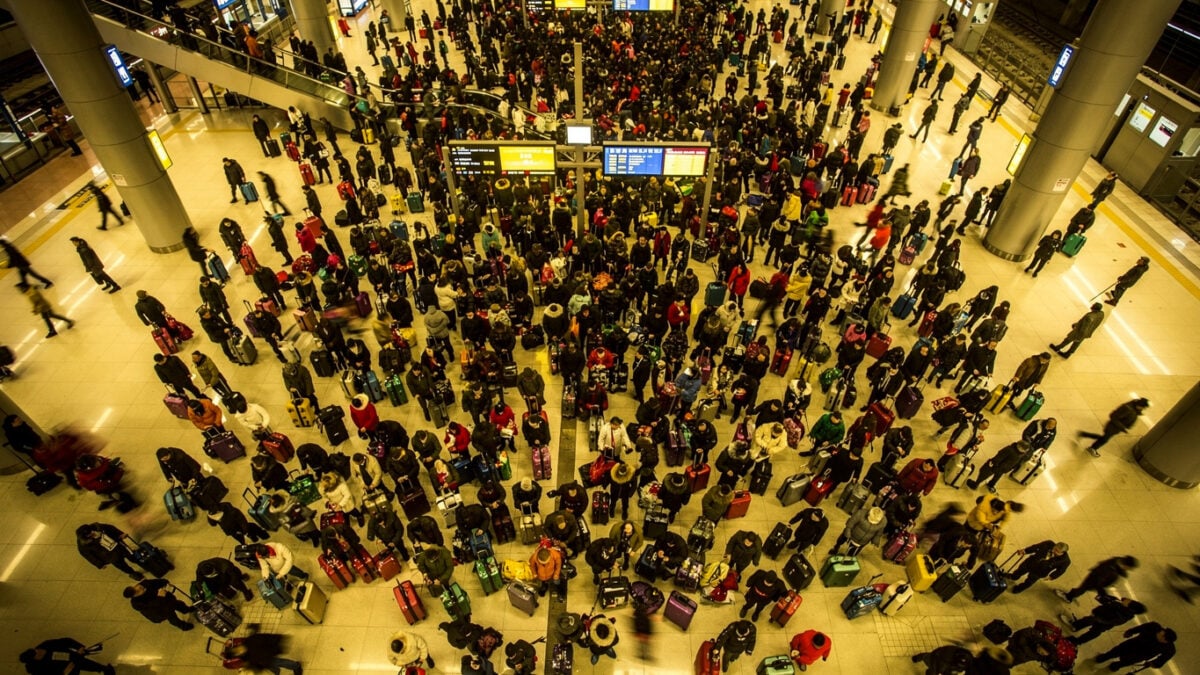
The headline figure for what this engineers is enormous. During the 2025 Chunyun travel rush between January 10 and February 19, the Ministry of Transport recorded 9.5 billion passenger trips, including roughly 480 million railway journeys and 88 million civil aviation trips. That is the policy working exactly as intended: leisure compressed into a national surge.
The other half of the picture is how little rest sits outside those bursts. Under the 2008 Regulations on Paid Annual Leave, employees with one to ten years of service receive five days; the entitlement rises to 10 days after a decade and 15 days after twenty years. Enforcement is the weak point. Zhang Xuegong, professor of labour law at the China University of Political Science and Law, noted in 2025 commentary that statutory leave is low by international standards and that many employees in private firms cannot fully take what they are legally owed.
This is where the official position and lived reality part company. On paper, workers have rights and breaks; in practice, the rest is rationed and synchronised. The state has nationalised the holiday and left the leave largely unenforced.
The gap between China’s statutory minimum and Western norms is stark when set side by side.
Why a decades-old policy is suddenly contentious
The tiáo xiū practice emerged in the late 1990s alongside the creation of week-long “Golden Week” holidays — a deliberately state-led strategy to manufacture mass leisure for domestic tourism and spending, rather than leaving time off to individual choice. It fits a long planning tradition. Citizens are accustomed to nationally synchronised rhythms of work, travel, and festival, set centrally rather than negotiated employer by employer.
What has changed is the economic backdrop, not the architecture.
The pressures converging now are specific. National Bureau of Statistics data put surveyed urban unemployment at 5.0% in April 2026, while the rate for those aged 16–24 stood at 14.7% under a new indicator series. With white-collar jobs more precarious and youth out of work, the trade-off between engineered consumption booms and individual well-being has become politically sensitive in a way it was not a decade ago.
Beyond the headline
The bigger picture
China’s holiday system shows how planned-economy logic still shapes everyday time: the state batches leisure into consumption-oriented surges while leaving routine rest relatively scarce. That trade-off exposes a deeper question about China’s next growth model — whether it will keep prioritising aggregate spending metrics over more diffuse gains in quality of life for its urban workforce.
The power behind it
Control over the calendar gives Beijing a quiet but potent lever: by shifting a few dates on the State Council notice, it can jolt tourism, retail, and transport. Employers and workers downstream have little formal say in this choreography, underscoring how decisions about time itself remain centralised even as the economy has otherwise marketised.
What isn’t being said
Debates about “fake holidays” rarely address who bears the unequal burden inside firms: lower-seniority staff, service workers, and migrants who often cannot refuse weekend shifts or take real annual leave. Focusing only on online white-collar frustration obscures the stratified reality of rest in China, where some groups effectively subsidise others’ ability to enjoy Golden Week travel at all.
What China’s holiday calendar means for your operations
With the State Council’s 2027 holiday notice expected in the final quarter of 2026, anyone with exposure to China should treat the calendar as a live planning variable rather than a fixed backdrop.
- Western business operator with China-based teams
Map your project timelines against the State Council’s official 2026 and 2027 holiday notices before committing to deadlines, since tiáo xiū workdays shift staff availability unpredictably. Benchmark your email-hours and leave expectations against position papers from the European and American chambers of commerce in China, both of which have flagged work-life balance as a retention risk in 2026.
- European tour operator with China travel packages
Build your pricing and capacity assumptions around the Spring Festival and Golden Week surges that concentrate billions of domestic trips into a handful of weeks. Expect peak congestion and price spikes during these windows, and steer clients toward the quieter gaps between engineered holidays.
- Western semiconductor procurement manager with Chinese suppliers
Ask each supplier directly which weekend dates they are converting into workdays and which Golden Weeks halt production, rather than assuming a fixed shutdown. Adjust your inventory buffers and shipping forecasts ahead of the 2027 schedule to absorb the slowdowns clustered around Spring Festival.
- US-based investor with APAC emerging market exposure
Track the 2027 State Council holiday notice for any reduction in make-up workdays as a signal of policy sensitivity to worker backlash. Weigh elevated youth unemployment and the “lying flat” sentiment against the consumption metrics that Golden Week travel data inflates each year.
Explainer
- Tiáo xiū
- The Chinese “adjusted rest” system that creates longer holiday breaks by reclassifying nearby weekend days as compulsory workdays. Introduced in the late 1990s, it was designed to consolidate scattered public holidays into continuous windows that concentrate travel and spending. Legally, these reassigned weekend days carry the same wage and overtime status as ordinary workdays, which is why critics describe the resulting breaks as borrowed rather than granted time.
- Golden Week
- The week-long national holiday periods, principally around Spring Festival and the October National Day, that anchor China’s domestic tourism economy. Created alongside tiáo xiū reforms to stimulate consumption after the 1997 Asian financial crisis, they synchronise the entire workforce’s leisure into the same days. The concentration drives extreme congestion and price surges, with the 2025 Spring Festival rush alone recording 9.5 billion passenger movements.
- Chunyun
- The annual Spring Festival travel period, the largest seasonal human migration on earth. In 2025 it ran from January 10 to February 19 and recorded roughly 480 million railway trips and 88 million civil aviation journeys. Because so much of the movement is people returning to home provinces rather than tourism, it stresses transport infrastructure in ways that ordinary leisure demand does not.
- 996 work culture
- The informal schedule of working 9am to 9pm, six days a week, associated with parts of China’s technology sector. Though courts have ruled the practice illegal, weak enforcement and high competition for jobs have kept it prevalent among younger employees. Its persistence has fuelled the “lying flat” counter-movement, in which workers publicly reject overwork as a form of quiet protest.