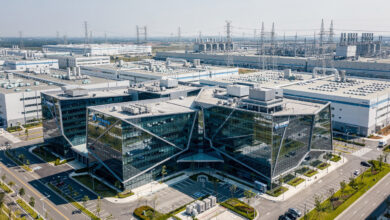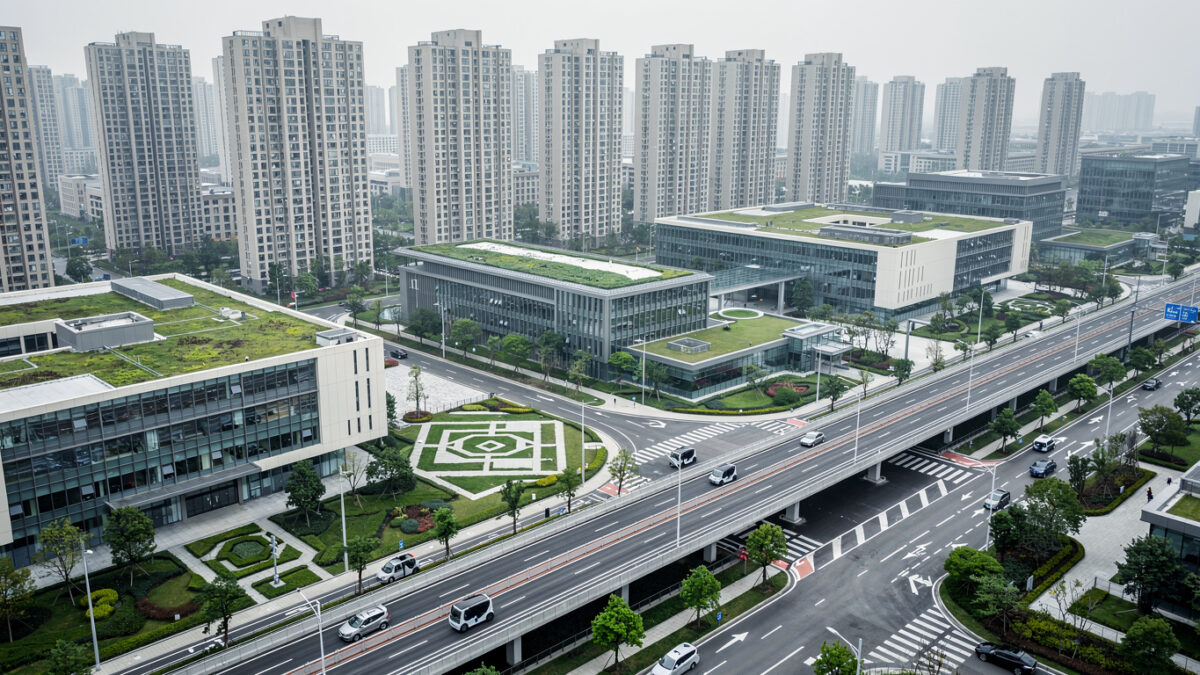
Tencent is constructing Penguin Island, a 809,000-square-metre headquarters campus on reclaimed land in Shenzhen’s Qianhai economic zone, designed to house up to 80,000 people and function as a self-contained district integrating R&D, staff housing, schools, autonomous transport, and public amenities. The project is a direct instrument of China’s 14th Five-Year Plan for scientific self-reliance, making it as much a state-strategic asset as a corporate headquarters. Tencent reported total revenues of RMB 660.27 billion in its 2025 annual results, providing the capital base for a buildout of this scale.
The campus is built on the premise that talent lock-in — not office space — is the decisive competitive variable. With 14,000 employees already on site and construction roughly 30% complete, the project remains years from its intended scale.
The most consequential thing about Tencent’s new headquarters in Shenzhen is not its size, though at 809,000 square metres it dwarfs most corporate campuses on earth. It is the logic behind it: that the only reliable way to win the global competition for engineering talent is to make leaving inconvenient.
Penguin Island, as the campus is internally branded, is being built on reclaimed land in the Qianhai district and is designed to provide everything a resident engineer might need — subsidised housing, schools, autonomous transport, a museum, and conference facilities capable of hosting international delegations — within a single managed environment. The buried story here is not the amenities. It is the alignment between Tencent’s construction timeline and China’s national strategy to achieve self-reliance in science and technology, a goal explicitly enshrined in the 14th Five-Year Plan and one that treats large corporate R&D compounds as strategic infrastructure rather than ordinary real estate.
Shenzhen has historically lacked the university prestige of Beijing or Shanghai, a structural disadvantage in the competition for top-tier researchers. Penguin Island is, in part, the municipal answer to that gap: collapse the distance between industry, housing, and academia into one site, and the city’s credential problem becomes less relevant. With roughly 14,000 employees already working on site and construction approximately 30% complete, the project is still years from its intended operational scale of 80,000 people.
ALSO WORTH READING



How Penguin Island works as a talent and policy instrument
The campus is divided into three functional zones — R&D, residential, and infrastructure — each occupying roughly equal footprint. Eleven blocks of staff dormitories anchor the residential component, with studio apartments reportedly offered at around 2,000 yuan (approximately USD 300) per month, roughly half the prevailing market rate for comparable units in Qianhai. R&D facilities, conference venues, a school, and a museum complete the civic layer. The three-zone structure becomes clearer when mapped against the campus’s stated ambition to function as a district rather than an office park.
China’s 14th Five-Year Plan for scientific and technological innovation, published in March 2021, explicitly calls for improving the national innovation system and enhancing original innovation capacity. That policy framing creates the conditions under which a campus like Penguin Island is treated as strategic infrastructure: municipal land allocation, talent subsidies, and industrial zoning can be aligned in ways that Western planning regimes — with their separation of commercial, residential, and civic functions — structurally cannot replicate.
Tencent’s 2025 annual results showed revenues of RMB 660.27 billion, confirming the company has the capital base to sustain a multi-year buildout. Zhang Yansheng, Chief Researcher at the China Center for International Economic Exchanges, has argued in 2025-2026 policy analysis that self-reliance policy and industrial clustering are designed to shorten the path from research to commercialisation by keeping talent, suppliers, and laboratories inside one ecosystem — precisely the model Penguin Island is built to demonstrate.
The Qianhai district’s cooperation-zone framework, covering the period 2021-2025, is designed to deepen Hong Kong-Shenzhen integration through business, talent, finance, and legal-service reforms. That makes the location a deliberate signal to international audiences, including the possibility of showcasing the campus to delegations during the upcoming APEC summit.
The wider race to build managed innovation districts
Penguin Island’s closest Western analogue is Apple Park in Cupertino, but the comparison breaks down quickly. Apple Park separates workplace from housing and civic life; Tencent’s model collapses all three into one managed ecosystem. That difference matters because it converts real estate into a retention mechanism — and retention, in a market where top engineers can choose between Shenzhen, Singapore, Seoul, and San Francisco, is the actual competitive variable. The dependency risk is real: an engineer who lives, commutes, and schools their children inside one employer’s infrastructure faces switching costs that go well beyond a resignation letter.
The broader APAC competition follows a similar logic. Tencent, Alibaba, Huawei, ByteDance, and state-linked city governments are all building or planning integrated innovation hubs designed to keep engineers, data, and capital inside one ecosystem. Li Luming, President of Tsinghua University, argued in 2026 policy commentary that deeper industry-academia integration is central to turning Shenzhen into a durable innovation engine rather than simply a manufacturing base — the kind of institutional endorsement that signals this model has policy momentum behind it, not just corporate ambition.
The regulatory environment amplifies the advantage. China can align municipal land allocation, talent subsidies, and industrial zoning within a single policy framework in ways that the EU’s fragmented planning regime or US zoning and disclosure constraints structurally cannot match. That is not a criticism; it is a structural fact that shapes the competitive calculus for any Western firm trying to build comparable density of talent and infrastructure.
Watch for Tencent’s next capex disclosure and Shenzhen municipal updates on Qianhai land-use approvals — expected in the next annual reporting cycle. If they show accelerated spending and confirmed land-use expansion, Penguin Island is moving from showcase project to operational hub. If they do not, expect it to remain a slow-burn strategic asset for several years yet. The project’s trajectory as a broader indicator of China’s premium business infrastructure ambitions will become clearer once construction crosses the halfway mark.
Beyond the headline
The power behind it
Penguin Island is best read as a policy instrument with a corporate logo, because the real leverage comes from how municipal land allocation, talent policy, and industrial strategy line up behind it. Tencent may be the builder, but the deeper control over what the project becomes sits with the state ecosystem that decides where capital, permits, and prestige flow.
The bigger picture
The campus reflects a shift from “company headquarters” to “managed innovation district,” where firms try to solve labour scarcity by bundling work, housing, logistics, and brand identity into one place. That model turns real estate into a competitive advantage in itself, which is why the most important asset is no longer office space but the ability to retain people inside a closed ecosystem.
The reach
For Western cloud and enterprise-software firms, the relevant lesson is that future competition may hinge less on product features than on how much of the user’s daily workflow a company can absorb into one environment. A campus that connects office life, transport, and services creates switching costs that are difficult for a software-only competitor to match.
What Penguin Island means for Western tech strategy and investment
With Penguin Island still under construction but already housing 14,000 employees, the model is operational enough to benchmark against — and the implications differ sharply depending on where you sit.
- Western tech executive with China operations
Your current talent acquisition and retention strategy in China is being benchmarked against subsidised housing at roughly USD 300 per month, autonomous on-site transport, and integrated schooling. Assess whether your own infrastructure and incentive package can compete, and if not, consider whether co-locating operations closer to Qianhai’s cooperation-zone benefits is a viable alternative. Review Tencent’s investor relations page for capex disclosures that signal how quickly the full 80,000-person capacity is being built out.
- US-based urban planner or smart city developer
Penguin Island offers the largest live test of fully integrated residential-commercial-civic smart infrastructure currently under construction anywhere. The operational data — on autonomous vehicle logistics, energy management, and maintenance robotics across a site of this density — will be more useful than any simulation. Monitor Qianhai’s official zone portal for published operational metrics and policy updates that may accompany the campus’s phased opening.
- Western investor with exposure to Chinese real estate or tech infrastructure
The strategic backing from China’s 14th Five-Year Plan and Qianhai’s cooperation-zone framework means this project carries lower policy-cancellation risk than a purely commercial real estate play. Track Tencent’s next annual capex disclosure and any Qianhai land-use announcements for confirmation that the buildout is accelerating rather than stalling. Those two signals will determine whether similar integrated campus models are being replicated across Shenzhen’s broader tech corridor.
- European cloud or enterprise software firm strategist
The managed innovation district model creates employer-side switching costs that pure software platforms cannot replicate. If your enterprise clients in China begin concentrating engineering teams inside environments like Penguin Island, your integration touchpoints — identity, productivity, communications — will face competition from Tencent’s own platform layer embedded in the same physical infrastructure. Evaluate your current platform stickiness in China against a scenario where the operating environment itself is Tencent-managed.
Explainer
- Qianhai
- Qianhai. The Qianhai Shenzhen-Hong Kong Modern Service Industry Cooperation Zone is a formally designated special economic area in western Shenzhen, established to deepen financial, legal, and business integration between Shenzhen and Hong Kong. Its current development plan covers 2021-2025 and provides preferential policies on taxation, cross-border talent, and land use for qualifying firms. For Tencent, locating Penguin Island inside Qianhai is a deliberate signal to international partners: the zone’s cross-border framework gives the campus a degree of regulatory openness that standard Shenzhen districts do not carry.
- 14th Five-Year Plan
- 14th Five-Year Plan. China’s 14th Five-Year Plan for scientific and technological innovation, published in March 2021, is a national blueprint covering 2021-2025 that sets binding priorities for R&D spending, self-reliance in key technologies, and the development of a national innovation system. It is one of a suite of sectoral plans that sit beneath the overarching economic Five-Year Plan, each with its own targets and ministry-level accountability. Its significance for Penguin Island is that it transforms large corporate R&D compounds from ordinary property projects into policy-aligned strategic assets, making state support — in land, subsidies, and permits — structurally available in ways it would not be for a purely commercial development.
- APEC
- APEC. The Asia-Pacific Economic Cooperation forum is a 21-member intergovernmental body that facilitates trade, investment, and economic policy dialogue across the Pacific Rim, including the United States, China, Japan, Australia, and Canada. It holds an annual Leaders’ Summit, which rotates among member economies and typically includes site visits and bilateral meetings on the summit host’s strategic priorities. China’s hosting of an upcoming APEC summit creates a direct incentive to use Penguin Island as a showcase for its technology and innovation model before an audience that includes senior Western government and business delegations.
- Smart city
- Smart city. A smart city — or in this context, a smart campus district — is an environment where physical infrastructure is connected to digital systems through sensors, software, and automation to manage services, logistics, and energy as a coordinated whole rather than as separate systems. The concept has been applied at city scale in Singapore, South Korea, and several Chinese municipalities, with varying degrees of integration and public transparency about data use. At Penguin Island, the smart-city layer is the operational backbone that makes a campus of 80,000 people manageable without proportional administrative overhead — and it is also the layer that generates the data flows Tencent can use to optimise, and potentially monetise, the environment itself.