Afghanistan has become the most repressive country in the world for women, according to a March 2024 UN Women assessment, with the Taliban having issued over 50 decrees restricting women’s rights since seizing power in August 2021. The bans cover education beyond grade six, employment across all professional sectors, and access to public spaces including parks. In March 2025, UN Special Rapporteur Richard Bennett told the Human Rights Council that these policies may constitute gender persecution under international law.
The Taliban’s position is not softening — it is hardening. As of March 6, 2026, the UN Secretary-General’s Special Representative for Afghanistan, Roza Otunbayeva, told the Security Council the exclusion of women is “not softening” and is actively undermining any prospect of international recognition.
Nearly five years into Taliban rule, the trajectory of women’s rights in Afghanistan is unambiguous: each year brings new restrictions, not fewer. What began in August 2021 as assurances of an “inclusive” government has produced more than 50 ministerial decrees stripping women from classrooms, workplaces, hospitals, and public parks. The Taliban’s deputy spokesman, Alhamdulillah Fitrat, confirmed to journalists in Kabul that women are being granted rights “according to Islamic law” — a formulation that, in practice, means no female doctors, no female nurses, no female professionals of any kind.
The real story is not simply a catalogue of prohibitions. It is that the Taliban’s systematic exclusion of half the population is functioning as a deliberate state-building choice — one that trades human capital and international legitimacy for ideological consolidation. The consequences are now structural, not reversible by a policy announcement.
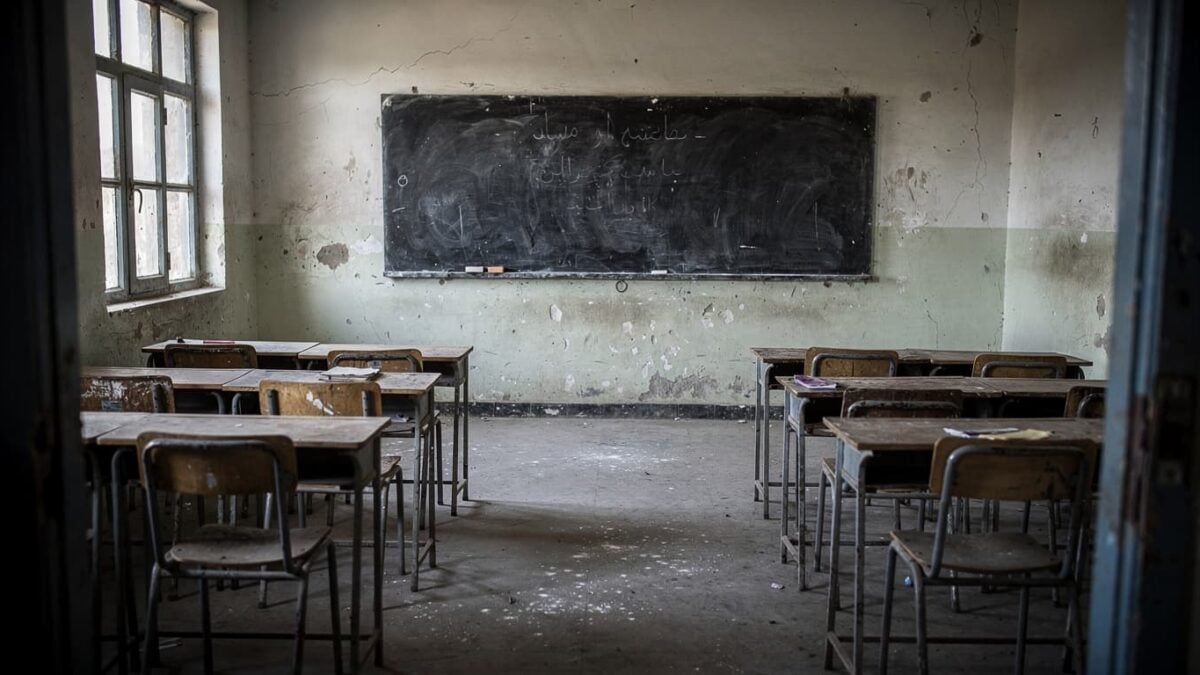
UNESCO estimated in 2023 that 1.1 million Afghan girls and young women had been barred from secondary school and higher education. The International Labour Organization found that by the fourth quarter of 2022, women’s employment had fallen 25% compared with pre-August 2021 levels, against a 7% decline for men. A generation of Afghan women is not waiting for a door to reopen — they have stopped believing it will.
RELATED

The details: decrees, data, and a legal threshold
The Taliban’s restrictions are enforced not through codified national law but through ministerial orders issued by the Ministry for the Propagation of Virtue and Prevention of Vice. A November 2022 directive required women to be accompanied by a mahram — a male guardian — for long-distance travel and banned their access to parks and gyms. On 27 December 2022, all NGOs were ordered to suspend female employees. By April 2023, that prohibition had been extended de facto to UN staff, prompting UN Security Council Resolution 2681, which condemned the ban and affirmed that women’s full participation is essential for sustainable peace in Afghanistan.
Richard Bennett, the UN Special Rapporteur on human rights in Afghanistan, delivered the sharpest legal framing to date. Speaking to the Human Rights Council in March 2025, he described Taliban policies as “the institutionalised, systematic oppression of women and girls” and said they may constitute gender persecution under international law — a threshold that, if formally determined, carries implications for criminal accountability and state recognition. The Taliban has not responded substantively to that characterisation.
By March 2024, UN Women had concluded that Afghanistan was the most repressive country in the world for women — a designation with no close competitor. UNESCO’s data shows that by 2023, 80% of school-aged Afghan girls were out of school, compared with around 40% before August 2021. In Kabul alone, women’s self-employment dropped 28% by late 2022, dismantling fragile gains built across two decades.
Why the restrictions are tightening, not loosening
The expected arc — that Taliban rule would moderate as the movement sought international legitimacy and economic relief — has not materialised. The opposite has occurred. The Taliban’s supreme leader has hardened his position on education in particular, overriding reported internal dissent from within the movement on the subject. What looks from outside like ideological stubbornness functions, from inside the regime, as a loyalty mechanism: the restrictions signal that the movement’s clerical core, not its technocrats or pragmatists, holds authority.
Western governments have responded with a combination of formal condemnation and continued humanitarian engagement. The EU renewed restrictive measures against Taliban leaders in March 2024, citing grave violations of women’s rights. The US State Department’s 2024 human rights report on Afghanistan used the phrase “gender apartheid.” The UK and Australia have maintained non-recognition of the Taliban, channelling aid through UN agencies and conditioning any political engagement on measurable reversals of bans affecting women and girls. None of these measures has produced a policy change in Kabul.
The forward signal to watch is the next mandate renewal for the UN Assistance Mission in Afghanistan (UNAMA), expected in late 2026. If the Security Council significantly toughens language on women’s rights or ties it to sanctions, it signals rising international impatience. If the mandate language remains unchanged while recognition discussions quietly advance, it will indicate that the international community is beginning to normalise Taliban rule despite ongoing gender persecution — a precedent with consequences well beyond Afghanistan.
Beyond the headline
The bigger picture
Afghanistan is becoming a test case for whether an armed movement can impose a closed gender order in a hyper-connected region without forfeiting basic state functionality. The systematic exclusion of half the population is less a cultural inevitability than a deliberate state-building choice that trades human capital and international legitimacy for ideological purity. The Taliban is also making a demographic bet: Afghanistan’s very young population is being socialised into a closed ideological order, limiting future pluralism and locking in dependence on a shrinking circle of loyalist male breadwinners tied to the movement.
The reach
For governments and NGOs funding humanitarian operations in Afghanistan, Taliban gender policies force a costly redesign of programmes around remote delivery and male intermediaries, reducing accountability and increasing the risk that aid reinforces rather than challenges the regime’s architecture. Diaspora communities in Europe, North America, and Australia face intensified asylum claims from Afghan women arguing gender persecution — pushing host states to clarify how far their refugee systems recognise gender-based oppression as a standalone ground for protection, a legal question with implications for asylum policy far beyond Afghanistan.
Our take
The Taliban’s treatment of women is not a temporary bargaining chip being held in reserve for a recognition deal — it is the core of their governing project. The pattern of escalating restrictions, not retreating ones, makes hopes of gradual moderation not just optimistic but analytically wrong. International actors that continue large-scale engagement while treating gender persecution as a regrettable side condition risk entrenching a regime whose stability depends structurally on keeping women invisible and powerless — a position that, as Callum Reid sees it on this beat, has been confirmed not by ideology but by five years of observable policy direction.
What this means for aid workers, diaspora communities, and Western governments
With the UNAMA mandate renewal approaching in late 2026 and no indication of Taliban policy movement, organisations and individuals with stakes in Afghanistan face decisions that cannot wait for diplomatic resolution.
- Humanitarian organisations operating in Afghanistan should audit whether current programme structures — including the use of male intermediaries mandated by Taliban rules — meet donor accountability standards. The EU and UK have both conditioned engagement on women’s rights progress; organisations should review compliance exposure now, not at the next funding cycle.
- Afghan women and girls seeking asylum in Europe, Australia, or North America should document Taliban-specific decrees affecting their individual circumstances, including the November 2022 mahram travel directive and the December 2022 NGO employment ban. The US State Department’s “gender apartheid” framing and the UN Special Rapporteur’s “gender persecution” language are legally significant precedents for asylum claims. Note that Australia and New Zealand provide no consular assistance in Afghanistan, meaning travel to or from the country carries no government safety net.
- Western governments and multilateral donors should treat the late-2026 UNAMA mandate renewal as a decision point, not a formality. Maintaining unchanged language after five years of documented escalation will be read in Kabul as a signal that gender persecution carries no meaningful international cost.
- Researchers and journalists tracking this story should monitor the Office of the UN High Commissioner for Human Rights for any formal determination on the gender persecution threshold raised by Richard Bennett in March 2025 — a finding that would shift the legal and diplomatic landscape significantly.