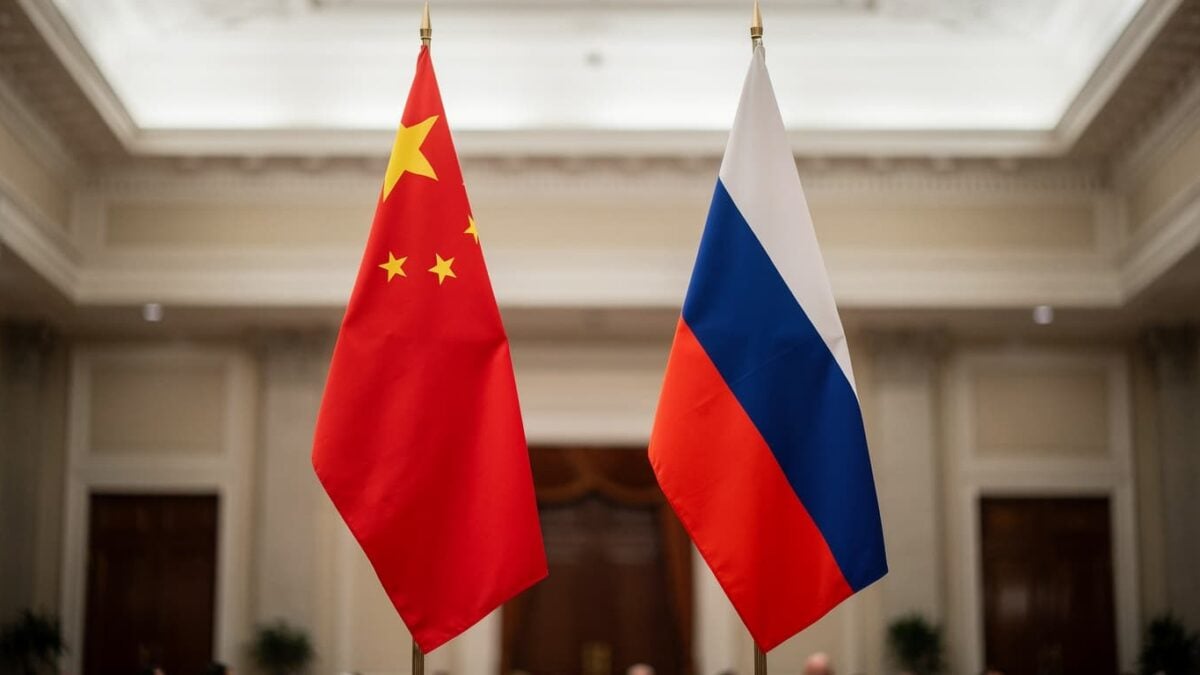
On May 16–17, 2026, Xi Jinping and Vladimir Putin signed two joint statements in Beijing — one deepening their comprehensive strategic partnership of coordination for a new era and a second strengthening the Treaty of Good-Neighborliness and Friendly Cooperation — alongside more than 20 bilateral cooperation documents spanning energy, trade, technology, and media. China–Russia bilateral trade reached a record US$240.1 billion in 2024, up from US$190.3 billion in 2022, providing the economic foundation beneath the political declarations.
The summit’s buried significance is not the symbolism but the structural lock-in: energy, financial, and defense coordination now knitted together in ways that will be difficult to unwind even if the Ukraine and Iran crises de-escalate. Both governments also agreed to extend mutual visa-free entry for stays of up to 15 days through the end of 2027.
Xi Jinping received Vladimir Putin in the Great Hall of the People on May 16 with a guard of honour, a state banquet, and a private tea — the same choreography Beijing deployed for Donald Trump just days earlier, but with a sharper geopolitical edge. The two leaders emerged with joint statements that did not merely reaffirm friendship; they laid out a framework for parallel institutions in energy, finance, technology, and security designed to reduce Moscow’s and Beijing’s exposure to Western economic pressure.
The more consequential story is not what was said but what was signed. Over 20 bilateral cooperation documents formalise cooperation across sectors that, taken together, represent a long-term architecture — not a reaction to any single crisis. Alexander Gabuev, Director of the Carnegie Russia Eurasia Center, argues that the summit demonstrates Moscow has definitively accepted a junior role in the partnership, trading growing dependence on Beijing for diplomatic cover and economic survival while locked in confrontation with the West.
For Western governments, the meeting arrives at a moment when the assumption that sanctions and isolation would fracture the relationship has been empirically tested and found wanting. Trade between the two countries has grown by more than 26 percent since Russia’s full-scale invasion of Ukraine in 2022. That number is the clearest answer to four years of Western pressure.
RELATED


What the summit actually produced
The two joint statements issued on May 17 carry distinct but reinforcing weight. The first deepens the comprehensive strategic partnership framework established over the past decade. The second extends and strengthens the Treaty of Good-Neighborliness and Friendly Cooperation, originally signed in July 2001 and previously renewed in 2021. Crucially, the treaty commits both sides to mutual support on core interests and regular high-level consultations but contains no mutual-defense clause — a distinction Western analysts consistently flag when the “alliance” framing is applied.
This matters because the February 2022 “no limits” joint statement, issued days before Russia’s full-scale invasion of Ukraine, also carried no formal collective-defense obligation. Beijing has consistently maintained that architecture by design, preserving diplomatic flexibility while deepening practical coordination. Bates Gill, Professor of Asia–Pacific Security at Macquarie University, describes the relationship as an entente built on converging interests in weakening US primacy, but constrained by structural asymmetry and mutual mistrust over the longer term.
The 20-plus cooperation documents signed during the visit span energy supply agreements, technology-sharing frameworks, and media cooperation protocols. Specific terms have not been made public, but official statements confirm that linking the GLONASS and BeiDou satellite navigation systems — Russia’s and China’s GPS equivalents — is among the areas of active technical integration. The Chinese government’s official summary of the visit describes the relationship as entering a “new stage.”
| Indicator | 2022 | 2024 | Change |
|---|---|---|---|
| Bilateral trade value | US$190.3 billion | US$240.1 billion | +26% |
| Bilateral cooperation documents signed (May 2026 summit) | — | — | 20+ |
| Visa-free stay extension | — | — | To end-2027 (15 days/trip) |
| Treaty of Good-Neighborliness renewals | — | — | 2021, 2026 |
How the West has responded — and what it is watching next
Western governments have not been silent, but their responses have remained largely in the rhetorical register. The US National Security Council characterised the Xi–Putin meeting as a “marriage of convenience” and committed to tightening export controls on technology that could aid Russia’s war in Ukraine. The European Council reiterated that Chinese support enabling Russian aggression would damage bilateral ties with Brussels. The UK foreign secretary told Parliament that London is expanding sanctions enforcement against entities facilitating Russia–China military cooperation. Australia has echoed US concerns and is accelerating work on outbound investment screening tied to sensitive Chinese sectors.
The gap between those statements and measurable action is the space Beijing and Moscow are operating in. China’s military exercises around Taiwan — which in December 2025 disrupted over 100,000 airline passengers in a single day, grounding 850 flights with just 24 hours’ notice — illustrate how Beijing uses coordinated pressure across multiple domains simultaneously, a pattern consistent with the broader posture on display in Beijing this week. The question of how China uses commercial and military instruments together is inseparable from understanding what this summit means for the Indo-Pacific.
Two specific signals will determine whether the summit produces durable integration or remains aspirational. First: whether Gazprom and China’s National Development and Reform Commission announce progress on the stalled Power of Siberia-2 pipeline before the end of 2026. That project, if completed, would lock in Russian energy dependence on Chinese demand for decades. Second: whether the G7 and NATO communiqués due in mid-2026 move beyond generic language on China–Russia coordination to include concrete joint measures on export controls, maritime patrols, or secondary sanctions. Generic language will be read in Beijing as permission to push further.
Beyond the headline
The bigger picture
This summit crystallises a shift from ad-hoc great-power deals toward more durable counter-institutions that sit alongside, and often against, the post-Cold War order. The meeting is less about symbolism than about knitting together energy, finance, and information systems into a parallel architecture where Washington has less veto power. The post-1991 assumption that economic integration would produce political convergence has not merely failed — it has produced its opposite.
The reach
For European defense budgets, US Indo-Pacific deployments, and global supply-chain planning, a tighter Moscow–Beijing axis means planning for simultaneous pressure in Europe and the Western Pacific, not sequential crises. Commodity traders and multinationals now have to treat sanctions, export controls, and shipping routes as variables shaped by this bloc’s decisions, not solely by Western policy. The cost of that recalibration is already visible in energy markets and dual-use technology restrictions.
Our take
The Xi–Putin meeting does not yet constitute a coherent new world order, but it does lock in a strategic convergence that Western capitals underestimated for too long. Treating Russia and China as separable problems — the approach that dominated Western strategy for most of the 2010s — is no longer viable. Mitigating this axis will require coordinated economic statecraft and realistic prioritisation, not nostalgia for a unipolar moment that the trade figures alone confirm has already passed.
What Western governments, investors, and companies should do now
With more than 20 cooperation documents signed and a treaty framework renewed in Beijing this week, the structural integration between Russia and China is advancing faster than Western policy is currently equipped to counter — creating immediate decisions for governments, businesses, and investors.
- Track the Power of Siberia-2 pipeline decision: An announcement from Gazprom or China’s National Development and Reform Commission before end-2026 would signal energy interdependence that bypasses European leverage permanently. Energy companies and LNG traders should model this scenario now rather than after the announcement.
- Read the G7 and NATO mid-2026 communiqués carefully: Concrete language on secondary sanctions, export controls, or joint maritime patrols signals coordinated Western containment. Generic language signals the opposite. The distinction will move markets and reshape corporate compliance obligations in dual-use technology sectors.
- Reassess dual-use technology supply chains: The UK, US, EU, and Australia are all tightening export controls on technology that could flow from China to Russia. Companies with exposure to Chinese manufacturing partners or Russian end-users should conduct compliance audits against current Export Administration Regulations and EU dual-use frameworks before the next round of controls takes effect.
- Recalibrate Indo-Pacific risk models: The summit’s explicit criticism of NATO’s Asia-Pacific role and Japan’s military expansion, combined with China’s demonstrated willingness to use airspace disruptions as political instruments, means corporate risk models treating European and Indo-Pacific tensions as separate variables are now structurally outdated.
- Monitor yuan-denominated trade expansion: As Russia and China increase bilateral settlement in yuan and rubles, dollar-denominated commodity benchmarks face longer-term competition. Institutional investors with commodity exposure should track the Shanghai International Energy Exchange and yuan-settled energy contracts as leading indicators of this structural shift.