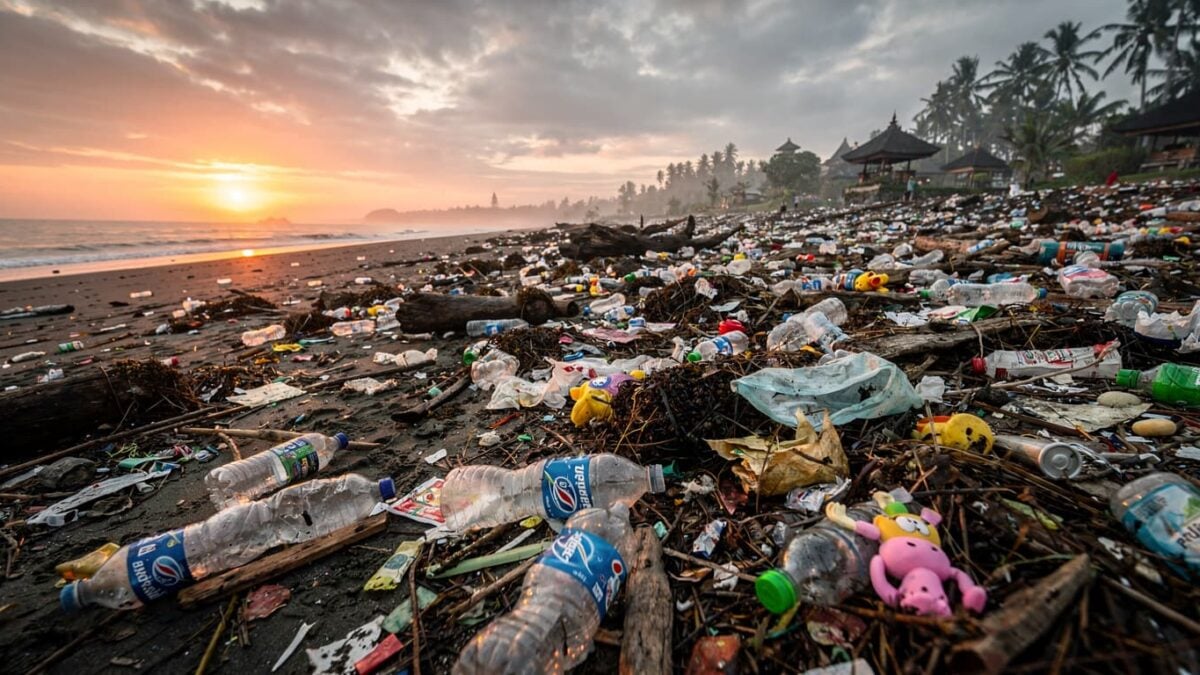
Bali generates an estimated 3,436 tonnes of waste per day — around 1.2 million tonnes annually — and approximately 40% of that waste is still burned or dumped illegally, according to Indonesia’s Environment and Forestry Ministry. The island’s primary landfill, Suwung, has reached capacity after more than 40 years of operation, forcing tighter restrictions on organic waste and pushing communities toward rivers and roadsides. Indonesia’s President Prabowo Subianto has publicly criticised Bali’s cleanliness, warning that the island’s reputation as a tourism destination is at stake.
Bali has enacted some of Indonesia’s toughest plastic regulations, including a ban on single-use plastic bottles under one litre, with full enforcement for malls and hotels planned by January 2026. Whether authorities will actually sanction non-compliant businesses is the question that will determine whether the rules mean anything.
Bali’s waste crisis has crossed a threshold. The Suwung landfill serving the Denpasar region — the island’s main dump for over four decades — has reached capacity and begun restricting organic waste intake, leaving residents and businesses with nowhere legal to send their rubbish. The result is visible: illegal dumping into rivers, open burning in residential areas, and beaches that fill with plastic every monsoon season as onshore winds push debris from Java and beyond onto Bali’s coastline.
Indonesia’s central government issued a mandate in 2013 requiring all provincial landfills to transition away from conventional dumping within five years. Thirteen years later, Suwung is still operating — and still overwhelmed. In November 2025, Bali’s governor instructed residents to manage their own organic waste at home. The instruction, by most accounts, has not been widely understood or followed.
The buried story here is not just about dirty beaches. Bali is now the site of Indonesia’s most aggressive experiment in plastic and waste regulation, a test that will shape national policy and the economics of mass tourism across the archipelago. If the island fails, the template fails with it.
RELATED



The details
Bali’s regulatory framework is, on paper, among the most ambitious in Southeast Asia. Gubernatorial Regulation No. 97 of 2018 (Pergub 97/2018) bans single-use plastic bags, polystyrene packaging and plastic straws, with the stated goal of cutting marine plastic waste by 70%. The regulation survived a legal challenge from business groups and was upheld by Indonesia’s Supreme Court. Then, in 2025, Circular Letter No. 9 of 2025 extended the ban to single-use plastic bottled drinking water in containers under one litre, with full enforcement for malls and hotels planned by January 2026 as part of the Bali Clean Waste Movement — a programme targeting a waste-free island by 2027.
Enforcement, however, is uneven by design and by default. Convenience stores in Bali have stopped providing free plastic bags. Traditional markets, fish markets and small food stalls continue distributing them without penalty. Gary Bencheghib, co-founder of river conservation group Sungai Watch, argues that without systemic upstream intervention — intercepting plastic at rivers before it reaches the sea — beach clean-ups will remain a permanent response to a permanent inflow. His organisation removes 2,000 to 3,000 kilograms of plastic from Bali’s beaches in a single day, only for equivalent volumes to return the following morning.
Gede Hendrawan, Head of the Centre for Remote Sensing and Ocean Sciences at Udayana University in Bali, identifies the core failure as structural rather than behavioural: Indonesia lacks effective collection and processing infrastructure, and Bali has only recently begun reorganising its waste management systems. The regulation exists; the machinery to implement it does not. Official data confirms the gap — details on Bali’s waste generation, landfill restrictions and regulatory framework are documented in Ocean Gardener’s 2025 update on Bali’s plastic crisis.
| Metric / Policy | Figure or commitment | Status as of 2025 |
|---|---|---|
| Bali daily waste generation | 3,436 tonnes per day | Ongoing; landfill at capacity |
| Bali waste improperly managed | ~40% burned or dumped | Confirmed by Environment Ministry |
| Indonesia marine plastic reduction target (2017 pledge) | 70% cut by 2025; US$1 billion investment | Only ~11% of target reached by 2020 |
| Pergub 97/2018 (plastic bag, polystyrene, straw ban) | 70% marine plastic reduction goal | Partial compliance; enforcement uneven |
| Circular Letter 9/2025 (sub-1-litre plastic bottle ban) | Full enforcement for malls and hotels | Planned January 2026; outcome pending |
| Bali Clean Waste Movement target | Waste-free island by 2027 | Widely regarded as aspirational |
Why the rules keep failing
Indonesia is estimated to leak approximately 620,000 tonnes of plastic into the ocean each year, making it the world’s second-largest source of marine plastic pollution after China, according to a joint World Bank and Indonesian environment ministry assessment published in 2021. The International Union for Conservation of Nature estimates that between 4.8 and 12.7 million tonnes of plastic enter the world’s oceans annually from all sources. Bali’s beaches sit at the receiving end of both local waste streams and upstream debris carried by the Indonesian Throughflow current from Java and other islands.
Indonesia’s national government pledged in 2017 to invest up to US$1 billion to cut marine plastic debris by 70% by 2025 and eliminate plastic pollution by 2040, including extended producer responsibility schemes and improved collection infrastructure. By 2020, the environment ministry acknowledged that only around 11% of the 2025 reduction target had been achieved. Funding competition has sharpened the problem: local government leaders interviewed by Bencheghib during his 1,200-kilometre run from Bali to Jakarta in 2025 described waste management budgets being redirected to Indonesia’s national free school meals programme, forcing district leaders to choose between feeding children and collecting rubbish.
Only around 40% of Indonesia’s population has access to formal waste collection services, meaning the infrastructure gap is not a Bali-specific failure — it is a national one that Bali, because of its visibility, is simply the first to be held accountable for. Bencheghib points to Banyumas in Central Java as a working model of local waste management, evidence that the problem is solvable at the district level when political will and funding align.
Beyond the headline
The bigger picture
Bali’s rubbish crisis is less about careless tourists and more about the collision of mass consumption with underbuilt public services. The island is exposing the limits of a development model that relies on ever-rising visitor numbers without matching investment in infrastructure, regulation and enforcement. What washes up on its beaches is effectively Southeast Asia’s waste-management deficit made visible.
The reach
The state of Bali’s beaches is a leading indicator for how other tropical resort economies will cope as travel rebounds and plastic use rises. If Bali cannot stabilise its waste system, international tour operators, insurers and eco-conscious travellers may divert business to destinations with cleaner reputations, pressuring global hotel chains and Western brands to shoulder more of the environmental cost of their tourism-driven sales.
Our take
Bali’s leaders are right to push unusually tough plastic and organic waste rules, but these measures will fail without matching investment in collection, composting and recycling that treats rubbish as infrastructure, not an afterthought. Western tourism and multinational brands have clearly benefited from Bali’s allure; a credible response now requires them to help fund and comply with the island’s waste overhaul rather than treating plastic-strewn beaches as someone else’s problem.
What this means for travellers and businesses heading to Bali
With Bali’s sub-1-litre plastic bottle ban entering enforcement for commercial premises by January 2026 and President Prabowo applying direct political pressure on local governments, the regulatory environment for tourism businesses and visitors is tightening faster than most operators have prepared for.
- Expect visible enforcement at hotels and malls from January 2026: Bali’s Circular Letter No. 9 of 2025 targets commercial premises first. Travellers should carry reusable water bottles; hotels and tour operators should audit their beverage supply chains now to avoid sanctions and reputational exposure.
- Monitor beach conditions before booking: Monsoon season (roughly November to March) brings the heaviest plastic inflows from Java. Travel during this window carries a higher probability of encountering polluted beaches, particularly on Bali’s southern and eastern coasts. Check current conditions through operators with on-the-ground presence.
- Western brands face growing audit risk: Sungai Watch river audits regularly identify international beverage and snack brands — many headquartered in Europe and North America — among Bali’s top plastic polluters. Companies with significant Indonesia exposure should review extended producer responsibility obligations under Pergub 97/2018 and anticipated national policy updates.
- Track Indonesia’s 2025 marine plastic review: The Indonesian government’s assessment of progress against its 2017 pledge — which had reached only 11% of its 2025 target by 2020 — will signal whether national policy tightens or stalls. Follow updates from Indonesia’s Ministry of Environment and Forestry for regulatory developments affecting tourism and manufacturing sectors.
- If you are planning travel around Bali’s cultural calendar: Note that Ngurah Rai International Airport closes entirely for Nyepi, the Balinese Day of Silence — a total shutdown with no arrivals or departures and strict movement restrictions island-wide. Plan itineraries accordingly.
FAQ
Is it safe to swim at Bali’s beaches given the waste crisis?
Beach conditions vary significantly by location and season. Southern beaches near Kuta and Seminyak face the heaviest plastic accumulation during monsoon months (November to March), when onshore winds push debris from Java onto the shore. Northern and western beaches such as Lovina and Pemuteran are generally cleaner. Checking with local operators before arrival and avoiding swimming near river outflows is advisable year-round.
What exactly does Bali’s plastic bottle ban cover, and does it apply to tourists?
Circular Letter No. 9 of 2025 prohibits the production, distribution and sale of single-use plastic bottled drinking water in containers under one litre. Full enforcement for malls and hotels was planned by January 2026. The ban applies to businesses, not individual travellers, but in practice visitors will find smaller plastic water bottles increasingly unavailable at commercial premises. Carrying a reusable bottle is the practical response.
How much of Bali’s waste problem comes from tourists versus local sources?
Tourism areas generate significantly more waste per person than local villages, with audits of river rubbish regularly identifying international beverage and snack brands among the top polluters. However, the majority of Bali’s 1.2 million tonnes of annual waste comes from resident consumption and inadequate collection infrastructure, not tourists directly. Domestic Indonesian tourism, including tour groups using cheap packages, contributes substantially alongside international visitors.
What is Sungai Watch and what has it actually achieved?
Sungai Watch, co-founded by Gary Bencheghib and his siblings, focuses on intercepting plastic at rivers before it reaches the sea — sungai means river in Indonesian. The organisation installs river barriers and conducts clean-up operations, removing 2,000 to 3,000 kilograms of plastic from beaches in a single day. It has expanded operations from Bali to Java and documents corporate brand pollution through river audits. Despite six years of intensive work, Bencheghib describes the inflows as unrelenting without systemic policy change.
Is the “ten new Balis” plan a realistic alternative to reducing pressure on the island?
The initiative, launched under President Jokowi in 2016, aimed to develop ten alternative tourist destinations including Mount Bromo, Lake Toba and the Komodo Islands. A decade later, none has come close to matching Bali’s international draw, hampered by limited direct international flight connections and insufficient investor interest. Bali’s established infrastructure — international airport, resort accommodation, cultural recognition — remains a structural advantage that policy alone cannot replicate elsewhere quickly.