American Airlines removes passenger for no-headphone audio, signaling industry-wide policy shift

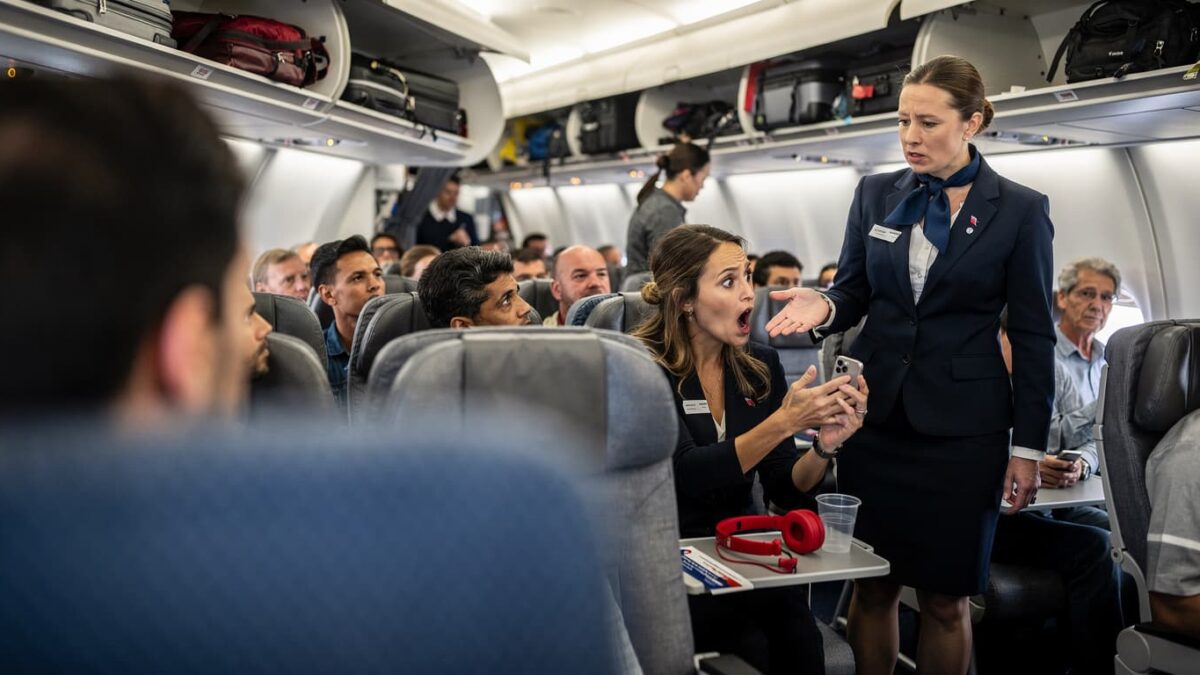
An American Airlines passenger was removed from a Miami–Tampa flight on March 9, 2026, after refusing crew requests to use headphones for cellphone video audio, invoking “free speech” and arguing she “paid money” before police escorted her off as other passengers applauded. United Airlines updated its contract of carriage on February 27, 2026, to mandate headphones for all personal device audio, allowing removal or permanent bans for violations — a policy shift now spreading across US carriers.
The ejection highlights a zero-tolerance turn in cabin etiquette enforcement. Delta Air Lines requests headphone use but doesn’t contractually require it, while Southwest states headphones are required but omits the rule from its contract — leaving American and United as the only majors with teeth behind the policy.
A routine 50-minute domestic hop turned into a public spectacle when American Airlines crew invoked the carrier’s “Quiet Cabin” policy to remove a passenger who refused to stop playing video audio through her phone’s speaker. The March 9 incident on flight AA1234 from Miami to Tampa ended with police intervention and applause from fellow travelers — a visceral signal that passenger tolerance for shared-space disruption has collapsed.
The passenger’s defense — that she had paid for her ticket and enjoyed free speech rights — failed to override the airline’s authority under its contract of carriage, which prohibits audible device speakers to maintain cabin comfort. Crew made multiple requests before escalating to law enforcement, a sequence now standard across US majors as carriers codify headphone requirements into enforceable policy.
United Airlines moved first, updating its contract on February 27 to explicitly require headphones for all audio and video on personal devices, with violations triggering removal or permanent bans. The carrier offers free basic earbuds from crew if passengers forget their own — a safety net American and other majors have not matched.
How the policy diverges across carriers
American Airlines enforces its Quiet Cabin standard through crew discretion, backed by removal authority but without the contractual explicitness United now employs. The Miami–Tampa ejection demonstrates that enforcement is real — crew will call police, passengers will lose their seats, and refunds are not guaranteed when behavior is deemed disruptive.
Delta requests headphone use in its onboard announcements but stops short of contractual language, relying on social pressure and crew judgment. Southwest states headphones are required for audio but omits the rule from its contract of carriage, creating ambiguity about enforcement consequences. Only United has closed the loop with explicit contract terms, free backup earbuds, and a clear removal pathway.
The divergence matters because contracts define what airlines can legally enforce without passenger consent. A “request” can be ignored; a contract violation cannot. United’s February update signals the industry direction — expect American, Delta, and Southwest to follow with formal policy within six months.
| Carrier | Policy status | Enforcement mechanism | Free earbuds offered |
|---|---|---|---|
| United Airlines | Contract requirement (Feb 27, 2026) | Removal or permanent ban | Yes |
| American Airlines | Quiet Cabin policy (crew discretion) | Removal via police | No |
| Delta Air Lines | Request only (no contract clause) | Crew judgment | No |
| Southwest Airlines | Stated requirement (not in contract) | Unclear | No |
Why airlines are drawing the line now
The crackdown reflects a post-pandemic recalibration of cabin norms. Passenger complaints about noise disruption doubled between 2023 and 2025, according to US Department of Transportation data, as travelers returned to flying with looser expectations around shared-space etiquette. Airlines initially relied on crew announcements and peer pressure, but the Miami incident — where the passenger argued constitutional rights on a private aircraft — shows that soft enforcement no longer works.
United’s February contract update was the first formal response, embedding headphone use into the same legal framework that governs smoking bans and seatbelt compliance. The move followed a 2019 Spirit Airlines case where a passenger was removed for playing audio without headphones, leading to a crew-police intervention and flight delay but no permanent ban. That incident settled quietly, but it established the precedent that carriers could act — they simply chose not to codify it until now.
The shift also aligns with the rise of noise-cancelling technology and the expectation that personal audio remains personal. What was tolerated in 2015 — a passenger watching a sitcom at low volume — is now grounds for removal in 2026. The social contract has moved, and airlines are catching up with policy.
What to do before your next US domestic flight
The Miami ejection proves that refusal to comply with crew headphone requests now carries immediate consequences — removal, police involvement, and potential no-fly list entry. These steps protect your boarding pass.
- Pack wired earbuds in your carry-on — Bluetooth can fail or run out of battery mid-flight, and crew won’t accept “my AirPods died” as an excuse. A $5 backup pair avoids a $500 rebooking.
- Check your airline’s contract of carriage — United’s is explicit; American’s is enforced but vague. Know what you’re agreeing to when you book.
- If traveling with kids, bring child-sized headphones — Tablet audio is the most common trigger for crew intervention with families. Volume-limited models prevent accidental bleed-through.
- On United flights, ask for free earbuds if you forget yours — Crew carry basic wired buds for this exact scenario. Other carriers do not offer this safety net.
- Avoid arguing constitutional rights with crew — Airlines are private entities; the First Amendment does not apply to cabin policies. Compliance is the only path to keeping your seat.
Watch: Delta and Southwest contract updates by Q3 2026 — if they formalize headphone requirements, the policy becomes industry-standard with no exceptions.
Can I be permanently banned for not using headphones?
Yes — United Airlines’ updated contract of carriage explicitly allows permanent bans for passengers who refuse to use headphones after crew requests. American Airlines has removal authority but has not publicly confirmed permanent ban policy for this specific violation.
Do I get a refund if I’m removed for not using headphones?
Not automatically. If the airline deems your behavior disruptive under its contract of carriage, you forfeit the ticket value. Refunds are case-by-case and typically require proving the removal was unjustified — a high bar when crew made multiple requests.
Which airlines provide free headphones if I forget mine?
United Airlines offers free basic wired earbuds from crew if passengers forget their own. American, Delta, and Southwest do not provide free headphones — you must purchase onboard ($10–15) or risk removal if playing audio without them.
Does this policy apply to phone calls on planes with Wi-Fi calling?
Most US carriers prohibit voice calls entirely, regardless of headphone use, under separate policies. The headphone requirement applies to video, music, and game audio — not phone conversations, which remain banned on American, United, Delta, and Southwest.