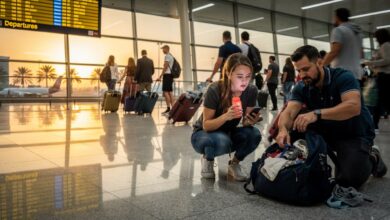
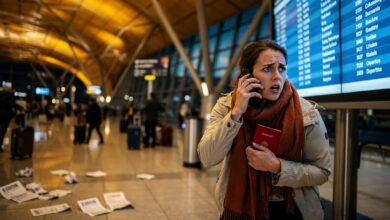
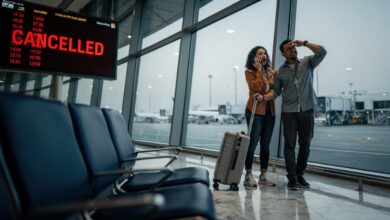
Dubai International Airport (DXB) and Al Maktoum International (DWC) suspended all flight operations on February 28, 2026, following US-Israel strikes on Iran and retaliatory Iranian airstrikes that damaged DXB infrastructure. Emirates halted all Dubai flights until 15:00 UAE time (13:00 GMT) on March 2, while Etihad suspended Abu Dhabi operations until 02:00 UAE time March 2. Over 20,200 passengers are stranded across UAE airports, with regional airspace closures extending through March 7 in Israel, Lebanon, Jordan, Iraq, Qatar, and Iran.
Airlines offer free rebooking (up to 20 days for Emirates, March 15 for Etihad) or full refunds for tickets issued before March 3-5. The UAE government is providing free temporary accommodation and meals to stranded passengers at airports.
Dubai’s two airports shut down completely on February 28 after Iranian retaliatory strikes hit the UAE in response to coordinated US-Israel attacks on Iranian targets. The closures strand tens of thousands of travelers worldwide who rely on Dubai as a connection point between Asia-Pacific, Europe, and North America.
Travelers with bookings through March 2 must act within 24-48 hours to rebook or claim refunds directly through airline websites or booking agents. Do not go to the airport — terminals remain closed to new arrivals.
The suspension affects all flights at Dubai International (DXB), the world’s busiest airport for international traffic, and Dubai World Central – Al Maktoum International (DWC). Passengers traveling from Bali, Sydney, London, New York, and dozens of other cities face cancellations or diversions to Rome, Paris, and Istanbul.
What happened and when flights resume
Early on February 28, 2026, US and Israeli forces launched strikes on Iranian military sites. Iran responded with airstrikes targeting Gulf states, including the UAE, causing damage to DXB’s infrastructure and forcing immediate airspace closures across the region.
Emirates suspended all Dubai operations until 15:00 UAE time (13:00 GMT) on March 2. The airline is offering free rebooking for travel up to 20 days after the original departure date or full refunds for tickets issued before March 5, 2026. Passengers who booked directly with Emirates can manage changes at Emirates.com under “Manage Your Booking”; those who used third-party agents must contact the agent.


Etihad Airways halted Abu Dhabi flights until 02:00 UAE time on March 2, with free rebooking through March 15 or full refunds for tickets issued for travel through March 3.
Qatar Airways suspended all operations with an update expected March 2. Lufthansa Group extended regional suspensions to March 8. Airspace closures remain in effect until March 7 in Israel, Lebanon, Jordan, Iraq, Qatar, and Iran, with UAE airspace restrictions lasting at least through March 1 for some carriers.
The UAE General Civil Aviation Authority (GCAA) reports handling over 20,200 affected passengers, providing free temporary accommodation, meals, and rebooking assistance at airport terminals.
Why this matters beyond Dubai
Dubai International processes more international connecting passengers than any other airport globally. Emirates alone operates over 3,600 weekly flights, linking Asia-Pacific cities like Singapore, Bangkok, and Sydney to Europe and North America. The closure creates a cascading effect: passengers booked on multi-leg itineraries face missed connections in London, Frankfurt, and New York even if their origin airport remains open.
Regional airspace closures compound the disruption. Flights that would normally route over Iraq, Iran, or Qatar must detour thousands of miles, adding 2-4 hours to journey times and forcing fuel stops. Airlines are diverting long-haul flights to secondary hubs in Turkey, Italy, and France, where ground handling capacity is strained.
This is not a localized event — it’s a breakdown of the Middle East’s primary air corridor during an active military conflict with no clear end date.
What to do if you’re affected
- Check your booking status immediately on Emirates.com, Etihad.com, or your airline’s app. Request rebooking (up to 20 days for Emirates, March 15 for Etihad) or a full refund if you booked directly with the airline. If you used a third-party agent, contact them within 24 hours.
- If you’re stranded in the UAE, go to airport GCAA desks for free government-provided accommodation and meals. Do not leave the airport without confirming your rebooking — slots fill quickly.
- Monitor resumption updates via the Dubai Airports app or DXB’s official website before heading to terminals. Airlines will not accept walk-ins until operations officially restart.
- Avoid rebooking through Dubai until March 7 unless you have no alternative. Regional airspace closures make connections unreliable even after DXB reopens.
How Dubai became the world’s busiest international airport
Dubai International overtook London Heathrow in 2014 as the world’s busiest airport for international passengers, handling 88.8 million travelers in 2024. Its dominance stems from Emirates’ hub-and-spoke model, which connects six continents through a single transfer point. Unlike US or European hubs that rely on domestic traffic, DXB processes almost exclusively international connections — making it uniquely vulnerable to regional airspace closures.
Can I get compensation for the flight cancellation?
No. Force majeure events like military strikes exempt airlines from EU261 or similar compensation rules. You are entitled to rebooking or a refund, but not cash compensation for delays or cancellations caused by airspace closures.
What if I booked a package holiday that includes Dubai?
Contact your tour operator immediately. Package holidays fall under different consumer protection rules in the EU, UK, and Australia, which may require the operator to arrange alternative travel or issue a full refund if the destination becomes unsafe.
Are flights to Abu Dhabi a safe alternative?
Not until March 2 at the earliest. Etihad suspended Abu Dhabi operations until 02:00 UAE time March 2, and regional airspace closures remain in effect through March 7. Rebooking through Doha or other Gulf hubs carries similar risks until the conflict de-escalates.
Will travel insurance cover this?
Only if you purchased a policy before the strikes began on February 28. Standard policies exclude “known events” — if you buy insurance after the closure, claims related to this conflict will be denied. Check your policy’s force majeure and civil unrest clauses.