China has reduced its officially reported U.S. Treasury holdings from a peak of $1.316 trillion in November 2013 to $693.3 billion by February 2026 — a liquidation of more than $620 billion — without triggering the bond market collapse that analysts spent a decade warning about. The reason: roughly 81% of the $39 trillion U.S. national debt is held by domestic entities, and allied nations absorbed China’s exit almost entirely, pushing total foreign holdings to a record $9.487 trillion.
The more consequential story is what Beijing is doing with the proceeds. A custody sleight-of-hand, a 17-month gold buying streak, and a landmark iron ore deal in Western Australia suggest this is portfolio statecraft, not a fire sale.
The financial doomsday scenario never arrived. Since November 2013, Beijing has systematically unwound more than $620 billion of its U.S. Treasury position — the precise selloff that geopolitical analysts spent years treating as a potential weapon against the American economy. Bond yields did not spike. The dollar did not collapse. Japan stepped in with $1.239 trillion in holdings. The United Kingdom absorbed nearly $900 billion. Canada added to its position opportunistically. The vacuum closed before most markets noticed it had opened.
But the absence of a crisis is not the same as the absence of a strategy. Beneath the orderly surface of Treasury auction data, Beijing has been executing what amounts to a multi-year repositioning of its sovereign balance sheet — moving custody of dollar assets offshore, accumulating physical gold at a pace unseen in modern central banking, and forcing a top-tier Western mining company to accept yuan settlement for iron ore. The buried story here is not the sell-off. It is what China is building in its place.
The details
The starting point is a reporting anomaly. The U.S. Treasury’s Treasury International Capital (TIC) system — the official monthly benchmark for foreign holdings of U.S. sovereign debt — tracks the geographic location of the custodian holding a security, not the identity of the ultimate beneficial owner. When the People’s Bank of China (PBOC) transfers custody of its Treasury bonds from the Federal Reserve Bank of New York to a European clearing house such as Euroclear in Belgium or Clearstream in Luxembourg, the TIC data records a Chinese divestment and a Belgian accumulation simultaneously.
RELATED


The result: Belgium officially holds $454.7 billion in U.S. Treasuries according to the latest 2026 TIC release — a figure that exceeds the entire Belgian GDP of approximately $600 billion. Forensic analysis incorporating that anomalous Belgian position suggests Beijing’s true dollar exposure likely sits between $1.16 trillion and $1.25 trillion, not the $693.3 billion the headline figure implies. China did not sell the house. It placed the house in a blind trust.
The motivation for this custody migration hardened on a specific date. In February 2022, the United States and its G7 partners froze approximately $300 billion in sovereign reserves held by the Russian Central Bank following the invasion of Ukraine. For Chinese reserve managers, that event reframed the risk calculus entirely: dollar-denominated assets held within Western custodial frameworks now carried a credible risk of instantaneous confiscation during geopolitical conflict. The response was structural acceleration, not panic selling.
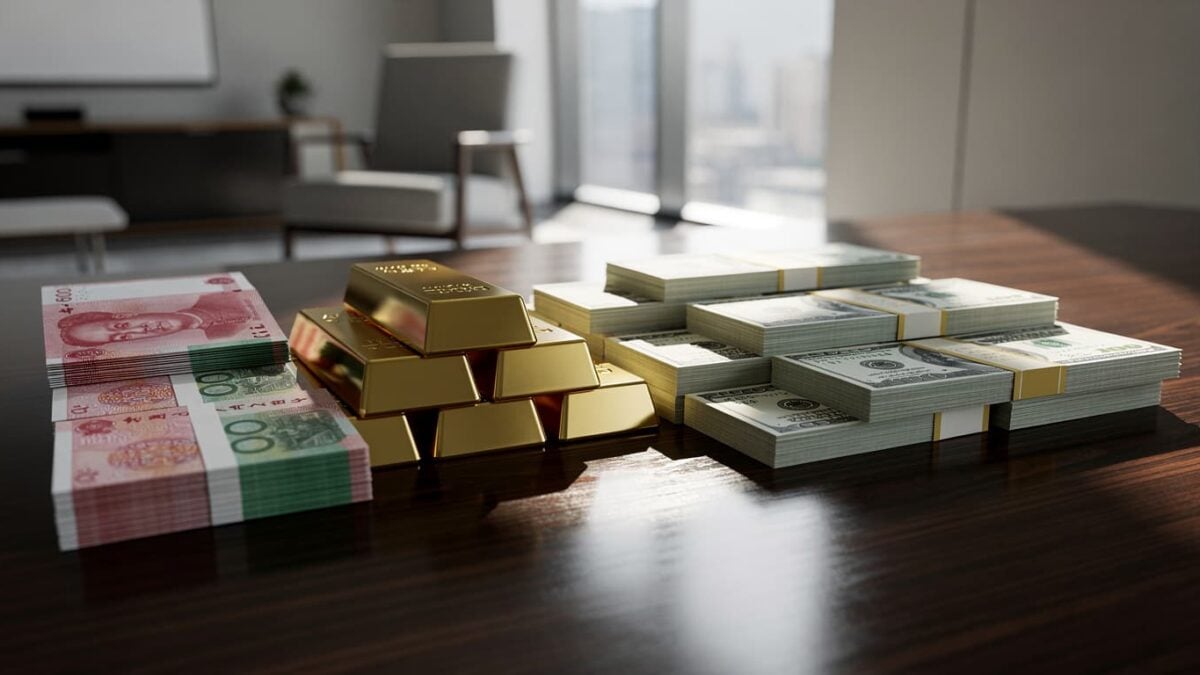
Parallel to the custody restructuring, the PBOC executed an unprecedented gold accumulation campaign. By the first quarter of 2026, the central bank had completed a 17-month consecutive purchasing streak, lifting total physical gold holdings to a record 2,313 tonnes. Spot gold has traded above USD 3,000 per troy ounce throughout 2026 — a level that reserve managers treat as a psychological threshold. The PBOC bought through every price point regardless. A decade ago, Beijing held roughly 10 cents of gold for every dollar of U.S. Treasuries it owned; by early 2026, that ratio had expanded to approximately 57 cents. This is not a hedge. It is a structural rebalancing.
Caroline Freund, Dean of the School of Global Policy and Strategy at the University of California San Diego, has argued that sanctions risk is now a primary driver of central bank reserve decisions, pushing institutions globally toward gold and away from dollar assets. Robin Brooks, Senior Fellow at the Brookings Institution, frames the shift as incremental rather than explosive — dollar dominance is durable but not invulnerable, especially when geopolitical fragmentation gives institutions a structural reason to diversify.
| Metric | Peak / Baseline | As of early 2026 | Change |
|---|---|---|---|
| China official U.S. Treasury holdings | $1.316 trillion (Nov 2013) | $693.3 billion (Feb 2026) | −$622.7 billion |
| Belgium reported U.S. Treasury holdings | Rounding error pre-2014 | $454.7 billion (2026 TIC data) | Structural surge |
| PBOC gold reserves | ~1,850 tonnes (approx. 2022) | 2,313 tonnes (Q1 2026) | +17-month buying streak |
| Gold-to-Treasury ratio (PBOC) | ~$0.10 per $1.00 (c. 2013) | ~$0.57 per $1.00 (early 2026) | Near-sixfold expansion |
| Total foreign U.S. Treasury holdings | Record low post-China exit fears | $9.487 trillion (Feb 2026) | Record high |
Why China bought so much U.S. debt in the first place
The accumulation was never a choice. Beijing pegged the renminbi to the U.S. dollar at 8.28 yuan per dollar in 1994, a fixed rate designed to guarantee export competitiveness. When Chinese factories received dollar payments for goods, strict capital controls required them to exchange those dollars at the PBOC. The central bank absorbed hundreds of billions of dollars annually, printing new renminbi in return. To prevent that currency injection from triggering hyperinflation, it issued sterilisation bonds — draining the excess cash back out of the domestic economy. That left Beijing sitting on an enormous idle dollar reserve with only one market on earth deep enough to absorb it without distortion: U.S. Treasuries.
The 1997 Asian financial crisis cemented the logic. Beijing watched Indonesia, South Korea, and Thailand see their currencies collapse as capital fled. The lesson was unambiguous: massive, unassailable foreign exchange reserves were a matter of national security. By November 2000, China held just $58.9 billion in U.S. debt. Following its accession to the World Trade Organization in December 2001, that figure went supernova alongside China’s export-led manufacturing boom, reaching the $1.316 trillion peak thirteen years later.
The structural cost was borne by Chinese consumers. Export earnings funnelled into low-yielding foreign government bonds rather than domestic infrastructure or household transfers kept savings rates artificially high and suppressed organic consumption-led growth. The everyday Chinese consumer was the ultimate loser in the arrangement — and that calculation has not changed under the new reserve architecture.
The offensive dimension of the repositioning moved beyond custody and gold in the fourth quarter of 2025. The China Mineral Resources Group, a state-backed procurement entity, reached a landmark supply agreement with BHP under which 30% of BHP’s spot iron ore volume supplied to China must be settled in Chinese yuan — approximately $10 billion annually bypassing U.S. dollar clearing entirely. Pricing for a significant portion of that volume is now anchored to the Corex portside index, a renminbi-denominated benchmark tracking transactions at Chinese docks rather than the traditional dollar-denominated seaborne indices. BHP received a 1.8% vessel rebate as an incentive. Beijing effectively traded a margin concession for a structural wedge in dollar pricing dominance — which is exactly how reserve systems begin to change at the edges.
Beyond the headline
The bigger picture
This story is really about the slow fragmentation of the world’s reserve system. What looks like one country trimming another’s debt is better understood as a broader move toward multiple collateral pools — gold, custody intermediaries, and offshore booking centres are all doing work that Treasuries once handled almost alone. In early 2026, the aggregate value of physical gold held by global central banks officially surpassed their combined U.S. Treasury holdings for the first time since 1996: approximately $5 trillion in gold against roughly $3.9 trillion in sovereign debt. That inversion is the structural signal, not China’s headline number.
The reach
For capital markets, the practical issue is whether reserve diversification changes the marginal buyer of U.S. debt. If it does, the effects appear first in auction demand, term premium, and the valuation of dollar-linked assets — not in any dramatic currency crisis. That matters directly for Western banks, sovereign wealth funds, commodity markets, and any institution pricing risk against U.S. rates. Western mining conglomerates operating in Australia and elsewhere now face a harder negotiating environment: Beijing has demonstrated it can force yuan settlement on a counterparty as large as BHP, and that precedent does not disappear.
Our take
The market has been right to dismiss apocalyptic talk of an immediate Treasury collapse. But it has been too relaxed about the strategic meaning of China’s behaviour: this is not noise, it is portfolio statecraft. Beijing is treating gold reserves and custody structure as instruments of financial sovereignty, and that is precisely how reserve systems begin to change — not with a detonation, but with a decade of quiet, purposeful repositioning that looks unremarkable until it isn’t.
What this means for investors and businesses watching China’s financial strategy
With China’s reserve repositioning now confirmed across multiple data series and the BHP yuan-settlement deal establishing a commercial precedent, Western investors and companies with China exposure face several concrete decisions in the months ahead.
- Track the next TIC release: The U.S. Treasury publishes its Treasury International Capital data monthly with approximately an eight-week lag; the release expected in late June 2026 will show whether China-linked custody patterns in Belgium and Luxembourg are continuing to rise or have stabilised. Stabilisation would suggest the current repositioning cycle is largely complete.
- Watch the Treasury term premium: The Federal Reserve’s H.10 dollar index and 10-year Treasury auction bid-to-cover ratios are the earliest indicators of whether official-sector diversification is translating into reduced demand. A sustained rise in term premium — not a spike in headline yields — is the signal that matters.
- Reassess gold exposure: Central banks globally purchased over 1,000 tonnes of gold annually in recent years, and the PBOC’s price-agnostic buying has created a structural demand floor. Gold producers and bullion instruments are direct beneficiaries; this is no longer a purely speculative trade.
- Mining and commodities companies should model yuan settlement risk: The BHP precedent means any Western resource company with China as its dominant buyer should stress-test contracts for currency mismatch exposure. The 1.8% vessel rebate BHP accepted is a baseline for what Beijing considers a fair switching cost.
- Business travellers to China should note the broader context: The financial decoupling dynamic has a regulatory corollary — companies involved in disputes with Chinese state entities face elevated legal risk. Indoneo’s coverage of China exit bans and the risk for business travelers from North America is essential reading for anyone whose work intersects with Chinese state-backed counterparties.