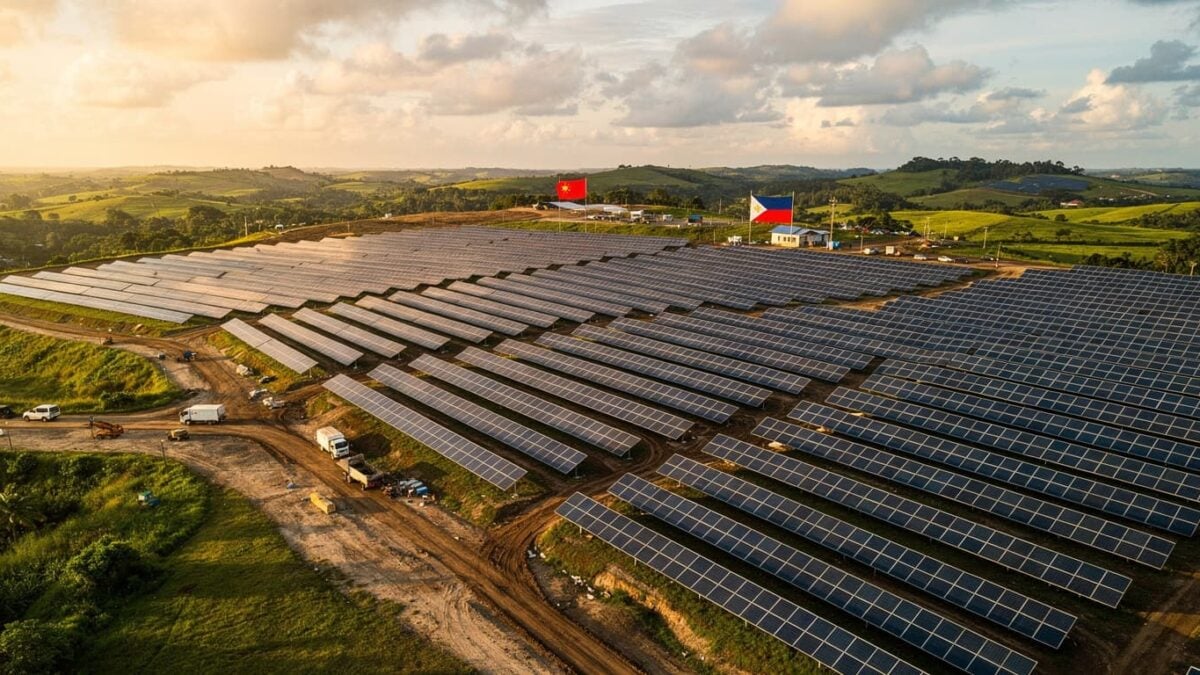
HSBC has launched a $4-billion Sustainability and Transition Credit Facility to finance mainland Chinese clean energy companies expanding into Southeast Asia, with the Philippines identified as a primary destination. The facility targets firms in solar, battery technology, transport electrification, artificial intelligence infrastructure, and data centres — sectors where China already controls roughly 47% of global clean tech exports and approximately two-thirds of global solar and battery production.
The announcement arrives as the Philippines pursues a 35% renewables target by 2030 and has opened its renewable energy sector to full foreign ownership. The convergence of Chinese technology, Western banking capital, and Philippine grid ambition is the story beneath the headline.
What HSBC is calling a financing facility is, in structural terms, something more consequential: an attempt to route Chinese green technology into one of Southeast Asia’s fastest-growing power markets using Western capital as the conduit. The bank’s $4-billion Sustainability and Transition Credit Facility, announced in May 2026, will extend credit lines and tailored financing to mainland Chinese firms in clean power, battery storage, and data centre infrastructure as they expand abroad — with the Philippines positioned as a key landing zone.
The timing is not incidental. Manila has amended its Renewable Energy Act of 2008 (Republic Act No. 9513) to permit 100% foreign ownership in solar, wind, hydro, and tidal projects — a regulatory shift that transforms the investment calculus for Chinese equipment manufacturers and project developers who previously faced equity caps. Nearly 7,000 energy projects are already in the pipeline.
Underneath the corporate announcement is a more uncomfortable question: who shapes the Philippines’ power grid for the next three decades, and on whose terms?
RELATED
The details: capital, technology, and a grid in transition
The Philippines generated 114,788 GWh of electricity in 2023, according to the Department of Energy’s Power Situation Report. Coal supplied 60.1% of that total. Renewables — geothermal, hydro, solar, wind, and biomass combined — contributed 21.1%. The gap between the current mix and the government’s 2030 target of 35% renewables is the commercial opportunity HSBC is financing.
Installed on-grid renewable capacity reached 8,706 MW by end-2023, representing 29.3% of total installed capacity — up from 7,914 MW the previous year. The incremental growth is real but insufficient at current pace to meet the 2030 ambition, which is why international capital and technology transfer are being treated as structural necessities rather than optional supplements.
The facility’s scope reflects the scale of Chinese manufacturing dominance. HSBC cited China’s 47% share of global clean tech exports and its control of approximately two-thirds of global solar and battery exports as the industrial logic for the programme. Electric vehicle sales are projected to reach 26 million units globally in 2026; data centre electricity consumption may nearly double by 2030 as artificial intelligence adoption accelerates. The Philippines’ own data centre market is expected to grow from $735 million in 2025 to $2.48 billion by 2031 — a tripling that implies significant baseload power demand from facilities seeking clean energy credentials.
HSBC Philippines CEO Sandeep Uppal framed it plainly: the Philippines’ combination of renewable targets and openness to foreign investment creates “exactly the conditions where HSBC’s new facility can make a real difference.”
| Metric | Figure | Source | Reference year |
|---|---|---|---|
| Total gross generation | 114,788 GWh | Philippines DOE | 2023 |
| Coal share of generation | 60.1% | Philippines DOE | 2023 |
| Renewables share of generation | 21.1% | Philippines DOE | 2023 |
| Installed renewable capacity (on-grid) | 8,706 MW (29.3% of total) | Philippines DOE | End-2023 |
| Energy-related CO₂ emissions | 158.3 million tonnes | IEA | 2022 |
| Renewables target | 35% of generation mix | Philippines DOE | By 2030 |
How Chinese technology and Western capital converged here
The policy architecture enabling this moment took years to build. The Philippines’ updated Nationally Determined Contribution, submitted to the UNFCCC in April 2021, pledged a projected 75% greenhouse gas emissions reduction and avoidance for 2020–2030 relative to a business-as-usual scenario. The critical qualifier: only 2.71% is unconditional. The remaining 72.29% depends entirely on international financial and technical support — which is precisely what the HSBC facility is structured to provide.
The geopolitical scaffolding is also in place. At the recent ASEAN Summit held in the Philippines, regional leaders renewed commitments to the ASEAN Power Grid initiative — a cross-border electricity network currently comprising 8 operational interconnection projects with 7,722 MW of combined capacity, with a further 13 projects in development across the bloc as of 2024. The upgraded ASEAN-China Free Trade Area 3.0 agreement, signed in 2025, expanded cooperation into the green economy and supply chain connectivity, providing the trade framework that makes Chinese technology deployment in Philippine infrastructure less politically exposed than it might otherwise appear.
IEA Deputy Executive Director Dave Turk has argued that mobilising international capital through blended finance and de-risking mechanisms is essential if countries like the Philippines are to exit coal while keeping electricity affordable — which is the precise gap the HSBC facility is designed to fill. IEA analysts project electricity demand across Southeast Asia will grow by around 60% between 2023 and 2040, with data centre and digital economy growth adding significant baseload pressure that will test both grid reliability and the pace of clean investment.
Beyond the headline
The bigger picture
This story illustrates how the global energy transition is increasingly being decided in mid-income, fast-growing economies where digitalisation, geopolitics, and climate policy intersect. The Philippines is becoming a test case for whether cross-border finance and technology can decarbonise power systems without sacrificing growth or locking in new dependencies. The outcome here will be studied in Jakarta, Hanoi, and Dhaka — cities facing nearly identical structural pressures.
The reach
For banks, utilities, and tech firms in Europe and North America, the way capital and technology flow into the Philippine grid will shape equipment standards, project pipelines, and carbon footprints across global supply chains. If Southeast Asian demand centres plug into cleaner power, Scope 2 emissions for multinationals operating in the region fall measurably. If the Philippines instead doubles down on coal and imported LNG — as the fuel price volatility already straining Southeast Asian transport sectors makes tempting — net-zero strategies and investor climate commitments become significantly harder to defend.
Our take
The $4-billion facility is less a climate altruism move than a calculated play to anchor Chinese technology in a critical regional grid, with Western finance providing the de-risking that makes it palatable to Manila. Unless Philippine regulators hard-wire transparency, competition, and just-transition support into project selection criteria, the transition risks entrenching new monopolies and strategic vulnerabilities even as it reduces emissions. Done well, though, this could be one of the few places where climate ambition, investor returns, and energy security genuinely align — and that possibility is worth taking seriously.
What this means for investors, operators, and policymakers watching the Philippines
With the HSBC facility operational and the Philippines’ foreign ownership rules now fully open, the next 18 to 24 months will determine which companies and structures dominate the country’s clean energy buildout for a generation — making this an active decision point, not a watch-and-wait situation.
- Track the DOE’s 2026 power development plan update: The Philippines Department of Energy is expected to release a comprehensive plan update in late 2026. If it sharply raises renewable capacity targets and shelves coal retirements, it signals confidence in facilities like HSBC’s. A delay in coal phase-outs or heavy reliance on imported LNG would indicate slower emissions cuts and weaker NDC alignment. Monitor announcements at doe.gov.ph.
- Assess Scope 2 exposure in Philippine operations: Multinationals with manufacturing, data centre, or back-office operations in the Philippines should model how a shift from 60% coal to 35% renewables by 2030 affects their reported Scope 2 emissions — and whether green energy offtake agreements are available from incoming Chinese developers.
- Monitor project selection criteria: The HSBC facility provides financing to eligible Chinese firms, but Philippine regulators control project approvals. Western investors and competitors should watch whether procurement processes include open bidding or favour incumbent Chinese developers, which would signal the degree of market competition available to non-Chinese entrants.
- Evaluate the ASEAN Power Grid timeline: With 13 cross-border interconnection projects in development across the bloc, regional grid integration could create new electricity trading opportunities — and new dependencies. Companies with regional footprints should assess which interconnection corridors are most advanced and what that means for energy sourcing strategy.
- Watch just-transition risk: Projects that displace coal without credible community transition programmes carry reputational and regulatory risk. ESG-focused investors should require disclosure of just-transition commitments before financing projects under the facility’s umbrella.