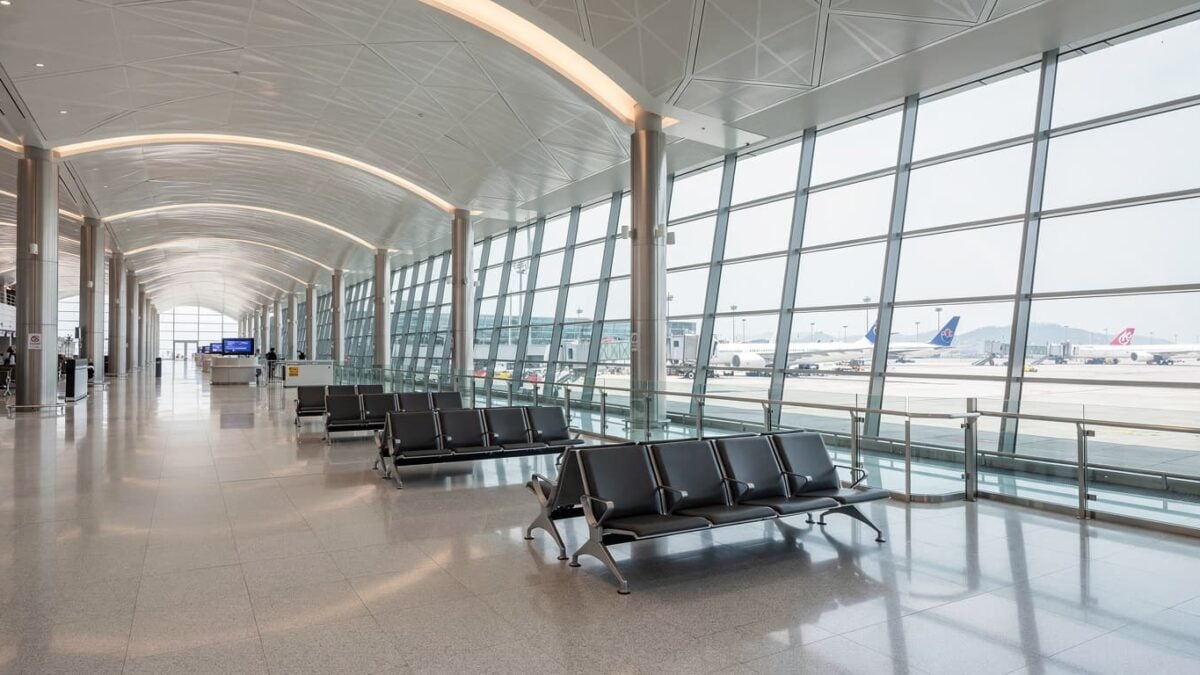
Hong Kong International Airport handled 5.74 million passengers in March 2026, a +19.6% year-on-year increase, driven by a sharp rise in transfer and transit traffic as Middle East airspace disruptions pushed Europe–Asia routes through the city. Flight movements rose +2.7% to 34,100. First-quarter 2026 passenger traffic reached 16.67 million, up +14.3% year-on-year, with the rolling 12-month total hitting 63.05 million — a +14.8% gain. Four of the airport’s international routes now rank in OAG‘s global top-ten busiest, with Hong Kong–Taipei holding the number-one position as of April 2026.
The buried story is not the traffic jump — it is Hong Kong’s rapid return to top-tier global hub status. Whether Middle East rerouting has permanently rewired Europe–Asia flows, or merely produced a one-quarter spike, will be answered by April and May traffic figures due in June.
Hong Kong’s airport has quietly become one of the biggest beneficiaries of the Middle East’s airspace crisis. When Iranian missile threats and regional conflict disrupted Gulf routing in early 2026, airlines and passengers rerouted Europe–Asia traffic through Hong Kong — and the numbers show it landed with force. The +19.6% passenger surge in March was not organic demand recovery. It was a structural redirect.
That distinction matters. A recovery figure is temporary. A routing shift — if it holds — changes which hub captures the premium-cabin passengers, the airport retail spend, and the alliance codeshare decisions that follow long-haul traffic. Hong Kong is betting the shift is structural.
Fred Lam Tin-fuk, Chief Executive Officer of Airport Authority Hong Kong, said in January 2026 that steady growth in transfer and transit passengers, alongside strong traffic to and from mainland China, Southeast Asia, and North America, showed the airport was “on track to resume its role as an international aviation hub.” March’s data suggests that trajectory has accelerated faster than even that cautious framing implied.
The +14.3% first-quarter gain, the four top-ten global route rankings confirmed in April, and the rolling 12-month total of 63.05 million passengers collectively describe an airport that is no longer recovering — it is competing.
How the March numbers break down — and what the route rankings reveal
The headline passenger figure of 5.74 million in March 2026 was carried largely by transfer and transit volumes, not origin-and-destination travel. Flight movements, by contrast, rose a more modest +2.7% to 34,100 — meaning more passengers per flight, consistent with heavier widebody utilisation on rerouted long-haul services. The gap between those two growth rates is the clearest signal that this was a routing story, not simply a demand story.
The route-ranking confirmation is the more durable data point. Official Airport Authority Hong Kong figures released in April 2026 confirmed that four of the airport’s international routes ranked in OAG’s global top-ten busiest, with Hong Kong–Taipei at number one. That ranking reflects scheduled seat capacity, not just passenger counts — it signals that airlines have committed widebody assets to Hong Kong routes, not merely filled existing ones.
Cargo held pace alongside passengers. Hong Kong handled 1.21 million tonnes of cargo in the first quarter of 2026, a slight year-on-year increase — relevant for Western logistics operators who use the airport as a transhipment point for manufactured goods moving between mainland China and European markets.
The comparison with Heathrow is instructive. Middle East passenger traffic at London Heathrow collapsed 51.1% in March 2026, dropping from 600,000 passengers in March 2025 to 294,000, as Gulf route disruptions forced airlines to redeploy capacity. Hong Kong captured some of what London lost — the same airspace crisis, two very different outcomes.
The Three-Runway System project, overseen by Airport Authority Hong Kong under the Airport Authority Ordinance (Cap. 483), targets annual passenger capacity of around 100 million upon full commissioning, scheduled for the end of the 2024–2025 period. At 63.05 million on a rolling 12-month basis, the airport has room to absorb further rerouting volume without hitting infrastructure constraints — a meaningful operational advantage over congested rivals.
Why Hong Kong’s hub position had further to recover than the headline numbers suggest
The airport’s pre-2019 peak is the baseline that makes current growth rates legible. In the 12 months to March 2025, Hong Kong handled 54.94 million passengers on 373,050 flight movements — already a significant rebound from pandemic lows, but still well below the airport’s pre-protest, pre-COVID trajectory. The jump to 63.05 million on a rolling basis by March 2026 represents a +14.8% gain in a single year: the fastest recovery pace since the airport began rebuilding post-2022.
What changed structurally is the transfer and transit mix. Hong Kong’s geographic position — sitting between mainland China and the North Pacific on one axis, and between Southeast Asia and Europe on another — makes it a natural waypoint when Gulf corridors become unreliable. Singapore Changi and Bangkok Suvarnabhumi have long competed for that same transfer traffic, and both are expanding. But Hong Kong’s direct connectivity to mainland Chinese cities gives it a transfer product that neither Bangkok nor Singapore can fully replicate for passengers originating in China’s interior.
Callum Reid has covered enough hub competition cycles to know that route rankings are a lagging indicator — airlines commit seats months in advance, and OAG’s top-ten placement reflects decisions made before March’s traffic spike was even visible. The fact that four Hong Kong routes were already in the global top ten before the rerouting surge accelerated suggests the airport’s recovery was real before geopolitics gave it a boost.
Travel access for Western visitors remains straightforward. US, Canadian, EU/Schengen, Australian, and New Zealand passport holders can enter Hong Kong visa-free for 90 days. Cathay Pacific, United, British Airways, and Qantas operate nonstop services from New York, London, and Sydney, with typical economy return fares in the USD 900–1,500 range depending on season. The US State Department currently rates Hong Kong at Level 2: Exercise Increased Caution, citing concerns related to the National Security Law — a designation unchanged by the airport’s traffic recovery.
Beyond the headline
The bigger picture
Hong Kong’s rebound as a high-volume transfer hub demonstrates how quickly global air networks can be rewired when geopolitical shocks disrupt established corridors. Rather than simply recovering from pandemic-era collapse, the city is reasserting its pre-2019 position by becoming a flexible alternative to Gulf hubs when Middle Eastern airspace turns unreliable. The speed of that repositioning — visible in a single quarter’s data — is the story beneath the passenger numbers.
The reach
Shifts in long-haul routing are already reshaping which hubs capture European–Asian premium travellers and the airport retail and hospitality spend that follows them. Airlines in Europe and North America weighing schedules into East Asia now have to factor Hong Kong’s renewed pull alongside Singapore, Doha, and Dubai — with direct implications for alliance dynamics, codeshare agreements, and where scarce widebody capacity gets deployed through 2027. Western business travellers on Europe–China routes may find Hong Kong connections faster and more frequent than they were 18 months ago.
Our take
Hong Kong has turned a geopolitical headache in the Middle East into an opportunity to reassert its relevance in global aviation. If Airport Authority Hong Kong keeps pairing operational reliability with competitive transit products — and if the Three-Runway System delivers on its 100-million-capacity promise — the city can lock in a structural share of Europe–Asia flows even after airspace tensions ease. That would be a rare and durable post-pandemic win in a sub-region crowded with aggressively expanding rivals.
What Western travellers and aviation watchers should do now
With Hong Kong’s transfer volumes elevated and April–June data still pending, the next two months will determine whether this is a durable routing shift or a one-quarter anomaly — and that has direct implications for booking strategy, route availability, and competitive hub dynamics.
- Monitor April and May 2026 traffic releases from Airport Authority Hong Kong: Monthly statistics are typically published in the third to fourth week of the following month. Sustained transfer and transit growth above +15% year-on-year would confirm structural rerouting. A sharp normalisation would signal that Singapore Changi and Bangkok Suvarnabhumi remain the primary long-term beneficiaries of Europe–Asia flows. Check releases at Airport Authority Hong Kong’s media centre.
- Book Hong Kong connections on Europe–China or Europe–Southeast Asia routes sooner rather than later: Elevated demand on rerouted services is tightening premium cabin availability. Cathay Pacific’s Hong Kong hub is the primary beneficiary — check schedules and fares directly, noting that economy returns from London or Sydney currently sit in the USD 900–1,500 range.
- Factor the US State Department Level 2 advisory into corporate travel risk assessments: The National Security Law concerns that underpin the Level 2 rating are unchanged by the airport’s traffic recovery. Companies sending employees through Hong Kong should review their duty-of-care protocols and check the current advisory at travel.state.gov.
- Watch OAG’s next quarterly busiest-routes update: If Hong Kong–European city pairs enter the global top-ten rankings — currently absent — it would signal that airlines have made multi-season capacity commitments, not merely tactical reroutings. That would materially affect where alliance partners deploy widebody assets through 2027.
- Track the Three-Runway System commissioning timeline: Airport Authority Hong Kong’s target of full commissioning by end of the 2024–2025 period, raising annual capacity to around 100 million passengers, is the infrastructure constraint to watch. Any delay would cap Hong Kong’s ability to hold rerouted volume against expanding rivals in Singapore and Bangkok.