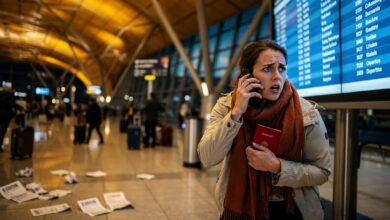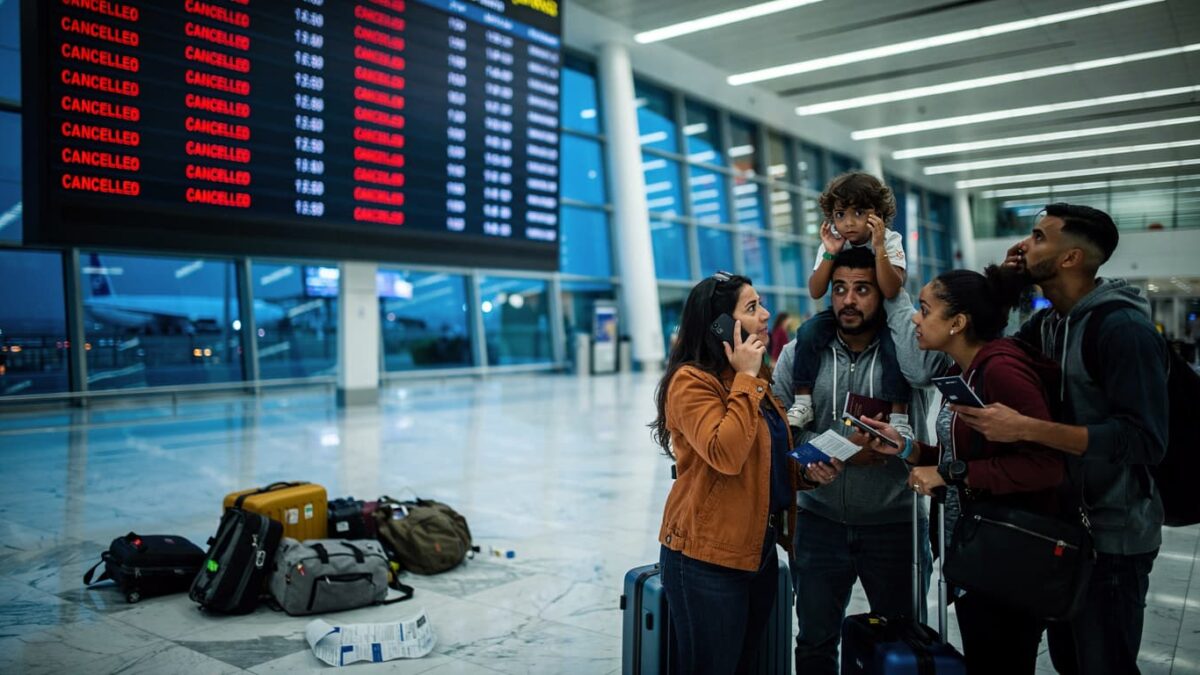
Gulf airspace closures entering their fourth day have grounded over 2,000 flights across the Middle East as of March 1, 2026, stranding 115,000 Australians and canceling 350 Indian flights in a single day. Major hubs Dubai, Abu Dhabi, and Doha remain shut following February 28 Israeli-US airstrikes on Iran and subsequent Iranian retaliation targeting US bases, forcing Asia-Europe routes into 4-6 hour detours that have spiked fares 20-50% on affected long-haul legs.
The European Union Aviation Safety Agency extended its no-fly advisory through March 6 covering Iran, Iraq, Israel, Qatar, Bahrain, Kuwait, and partial UAE-Saudi airspace. This article covers which airlines remain grounded, how reroutes are driving fare surges, and immediate steps to rebook or claim refunds before the March 4 Qatar Airways resumption decision.
Travelers booked on Asia-Europe routes via Gulf hubs face immediate disruption as airspace closures over Iran, Iraq, Israel, Qatar, Bahrain, Kuwait, and Syria enter their fourth consecutive day. Emirates, Etihad, and Qatar Airways have suspended most services, with only limited repatriation flights operating from Dubai and Abu Dhabi.
Check your booking status within the next 24-48 hours. Airlines are rebooking passengers onto alternative carriers or issuing refunds, but availability is vanishing as demand shifts to unaffected routes.
The closures affect travelers from India, China, Australia, and Thailand connecting through Gulf hubs to the UK and Europe. Gulf hubs handle over 30% of Asia-Europe traffic—their shutdown eliminates the fastest overflights and forces carriers into fuel-intensive detours via the Caucasus-Afghanistan corridor or Egypt-Saudi-Oman routes.
Which airlines are grounded and when they might resume
Cirium data shows 2,000+ Middle East cancellations on March 1 alone, representing 50% of scheduled operations. Emirates and Etihad paused all commercial services except skeleton repatriation flights. Qatar Airways suspended Doha operations pending a March 4 update from the Qatar Civil Aviation Authority.
Lufthansa Group halted regional operations through March 8. Singapore Airlines and Scoot canceled Middle East flights through March 7. Air France and KLM paused Gulf routes indefinitely.
The airspace closures stem from February 28 Israeli-US airstrikes on Iranian targets and Iran’s missile retaliation against US bases in Iraq and Syria. The European Union Aviation Safety Agency extended its advisory through March 6, citing ongoing missile risks across the region.
No carrier has announced firm resumption dates beyond Qatar Airways’ pending March 4 decision. Travelers should assume disruptions will extend at least through the weekend.
Why Asia-Europe fares are spiking 20-50%
Reroutes via the Caucasus-Afghanistan corridor or Egypt-Saudi-Oman add 4-6 hours to Asia-Europe flights. The detours increase fuel burn by 20-30%, adding over $1,000 per passenger in operating costs during peak demand.
Carriers flying unaffected routes—Turkish Airlines via Istanbul, Air India direct India-UK—are absorbing stranded passengers at premium prices. Fare tracking shows economy seats from Delhi to London jumping from $800 to $1,200+ on available inventory.
The closures eliminate the direct overflights that made Gulf hubs competitive. Without access to Iranian, Iraqi, and Gulf airspace, Asia-Europe routing reverts to pre-2000s geography: longer, slower, more expensive.
The Russia factor doubles the pain
European carriers already avoid Russian airspace due to 2022 Ukraine war sanctions, forcing them south through Central Asia. The Gulf closures now block that southern corridor too, leaving only narrow flight paths over Turkey-Caucasus or Egypt-Saudi that add 2-3 hours even before the Gulf detour. Asian carriers like Air China and China Southern still use Russian airspace westbound but face the same Gulf blockage eastbound to Europe.
What to do in the next 48 hours
- Check Flightradar24 or FlightAware for real-time airspace status and verify your booking on Emirates.com, Etihad.com, or QatarAirways.com for cancellation notices.
- Rebook via alternative carriers: Turkish Airlines (via Istanbul), Air India (direct India-UK), or Finnair (via Helsinki) if your Gulf carrier cancels.
- Claim EU261 or UK261 compensation for cancellations or delays over 3 hours using AirHelp or airline apps—Gulf closures qualify as extraordinary circumstances for refunds but not compensation.
- Monitor EASA notams for March 4-6 updates before booking new Gulf-routed tickets; the advisory currently runs through March 6 with no guarantee of extension or lifting.
Can I get a refund if my Gulf carrier flight was canceled?
Yes. Airlines must offer full refunds for canceled flights under EU261, UK261, and US DOT rules. Request via the airline’s website or app within 7 days. Airspace closures qualify as extraordinary circumstances, so you get the refund but not the €250-600 compensation for cancellations.
Are flights via Istanbul or Delhi affected by the Gulf closures?
No. Turkish Airlines routes via Istanbul and Air India direct India-UK flights avoid Gulf airspace entirely. They’re absorbing stranded passengers but charging premium fares due to high demand. Check availability immediately if rebooking.
Will fares drop once Gulf airspace reopens?
Not immediately. Airlines will need 3-5 days to clear the backlog of stranded passengers and repositioned aircraft. Fares typically normalize 7-10 days after airspace reopens, assuming no further escalation. The March 6 EASA advisory expiration is the earliest potential reopening date.
Should I cancel my April trip through Dubai or Doha?
Not yet. The current closures stem from active military operations that may de-escalate within 7-14 days. Monitor the March 4 Qatar Airways update and EASA advisories through mid-March. If closures extend past March 15, consider rebooking via alternative hubs for April travel.