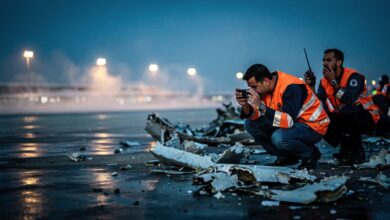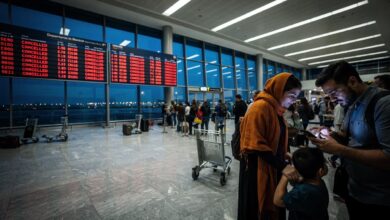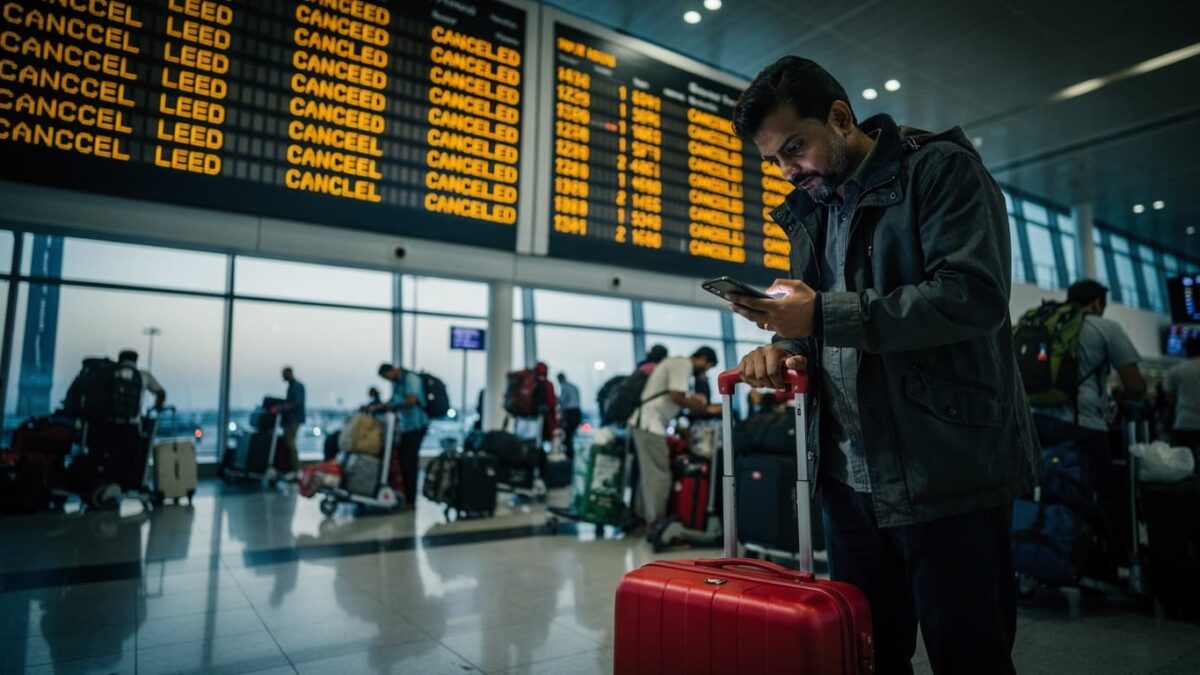
Air India, IndiGo, and Air India Express have suspended all flights to Middle East destinations and routes using Middle East airspace until at least 23:59 IST March 2, 2026, following Iranian counterstrikes on Dubai and Kuwait airports. Over 850 flights canceled since February 28, affecting thousands of travelers including Indians stranded in Dubai. Passengers with bookings before February 28 can claim full refunds or free rebooking until March 7 via airline apps.
Dubai Airport — the world’s busiest international hub — remains partially closed, compounding delays for connecting passengers. This article covers which airlines suspended operations, exact suspension timelines, refund procedures, and alternative routing options for stranded travelers.
US-Israel strikes on Iran triggered Iranian counterstrikes hitting Dubai and Kuwait airports on February 28, forcing India’s three largest carriers to halt Middle East operations within hours. Air India canceled all flights to Dubai, Doha, and Riyadh until 23:59 IST March 1, then extended the ban to routes using Middle East airspace — including Europe-bound flights — until 23:59 IST March 2.
IndiGo grounded 72 flights on March 1 alone, suspending service to Dubai, Doha, Kuwait, and international routes via Middle East airspace (London, Istanbul) until 23:59 IST March 2. Air India Express canceled 55 Gulf flights through March 1. India’s Ministry of Civil Aviation reports 410 flights canceled February 28, with 444 projected for March 1.
The suspensions affect travelers on direct Middle East routes and those connecting through Gulf hubs to Europe, Africa, or onward Asia destinations. Over 9 million Indian expats work in the Gulf region, making these routes critical for business and family travel.
Which airlines suspended flights and until when
Air India: All Middle East flights suspended until 23:59 IST March 1, 2026. Flights using Middle East airspace (e.g., Delhi-London via Iranian airspace) suspended until 23:59 IST March 2. Passengers can rebook or request full refunds via the Air India app.
IndiGo: Middle East destinations (Dubai, Doha, Kuwait, Riyadh) and select international routes (London, Istanbul) halted until 23:59 IST March 2. Initially announced suspension to 18:00 IST March 1, then extended. Free date changes or refunds apply to bookings made before February 28 for travel until March 7.


Air India Express: All Gulf flights suspended until 23:59 IST March 1. Fifty-five flights canceled. Free date changes or full refunds for bookings through March 5.
Other carriers affected include Pakistan International Airlines (suspended UAE, Bahrain, Doha, Kuwait), Cathay Pacific (halted Dubai and Riyadh), Emirates (38% of flights canceled), Qatar Airways (41% from Doha), and Etihad (30% canceled). Khaleej Times confirmed the exact suspension timelines and passenger waiver policies.
Dubai Airport’s partial closure compounds the crisis. The hub handles 89 million passengers annually, and its shutdown stranded thousands of connecting passengers, including Indians transiting to Europe or onward Asian cities.
Why this disruption is unprecedented for India-Middle East routes
The 850+ cancellations in 72 hours mark the worst India-Middle East flight disruption since the 2020 pandemic grounded global aviation. Unlike COVID-19’s gradual shutdowns, this crisis erupted in hours after Iranian strikes closed Gulf airspace with no advance warning.
India-Middle East routes carry 30% of India’s international traffic, serving 9 million Indian expats in the Gulf and connecting passengers to Europe via Dubai, Doha, and Abu Dhabi hubs. Air India and IndiGo operate 200+ weekly flights to the region under normal conditions. The sudden halt leaves business travelers, families visiting relatives, and tourists scrambling for alternatives with limited seat inventory on unaffected routes.
Airspace closures also force rerouting for flights to Europe. Air India’s Delhi-London service normally transits Iranian airspace, shaving 90 minutes off flight time compared to routes avoiding the Middle East. The March 2 extension means Europe-bound passengers face longer flights via Central Asian corridors or cancellations if aircraft can’t be repositioned in time.
What to do if your flight is affected
- Check your flight status immediately via the Air India app, IndiGo app, or Air India Express website. Airlines are not proactively notifying all passengers — you must verify.
- Request a full refund or free rebooking before March 7 for IndiGo (bookings before Feb 28), March 5 for Air India Express, or per Air India’s waiver policy. Use airline apps to avoid call center wait times exceeding 2 hours.
- If stranded in Dubai, monitor Dubai Airport’s reopening via Flightradar24 for real-time airspace status. Rebook via Singapore, Bangkok, or Kuala Lumpur on carriers avoiding Middle East airspace (Singapore Airlines, Scoot, Thai Airways).
- For Europe-bound travelers, consider direct flights from Delhi or Mumbai to Frankfurt, Paris, or Amsterdam on Lufthansa, Air France, or KLM — these avoid Middle East airspace entirely but cost 40-60% more than Gulf hub connections.
The Dubai Airport chokepoint
Dubai International Airport (DXB) is the world’s busiest international airport by passenger volume, handling 89 million travelers in 2024. Its closure doesn’t just affect UAE-bound passengers — it strands connecting traffic to 260 destinations across six continents. Emirates alone operates 3,600 weekly flights from DXB, meaning a 24-hour closure cascades into days of rebooking chaos as aircraft and crews sit out of position.
Can I get a refund if I booked through a third-party site like Expedia?
Yes, but you must contact the airline directly, not the booking site. Air India, IndiGo, and Air India Express honor refunds for canceled flights regardless of where you purchased the ticket. Use the airline’s app or website with your booking reference (PNR). Third-party sites often delay refunds by 30-60 days, while direct airline requests process in 7-14 days.
Will travel insurance cover this disruption?
Standard travel insurance excludes war and civil unrest unless you purchased a “cancel for any reason” (CFAR) policy before the conflict escalated. Most policies cover only mechanical failures or weather delays. Check your policy’s force majeure clause — some insurers classify airspace closures as covered events, but Iranian strikes likely fall under war exclusions.
How long will Middle East airspace remain closed?
No official timeline exists. Dubai Airport partially reopened March 1 for select carriers, but Iranian airspace remains restricted. India’s Directorate General of Civil Aviation (DGCA) reviews airspace safety daily. Historical precedent suggests 3-7 days for localized conflicts, but escalation could extend closures indefinitely. Monitor the Ministry of Civil Aviation portal for updates.
Are flights to other Asian destinations affected?
Only if they use Middle East airspace. Delhi-Singapore, Mumbai-Bangkok, and Chennai-Kuala Lumpur routes operate normally because they avoid the conflict zone. Delhi-London and Mumbai-Frankfurt flights face cancellations or rerouting via Central Asia, adding 90-120 minutes to flight time. Check your specific route on Flightradar24 to see if it transits Iranian or Gulf airspace.