American and Air Canada jets nearly collide at JFK, triggering FAA investigation into 350-foot separation

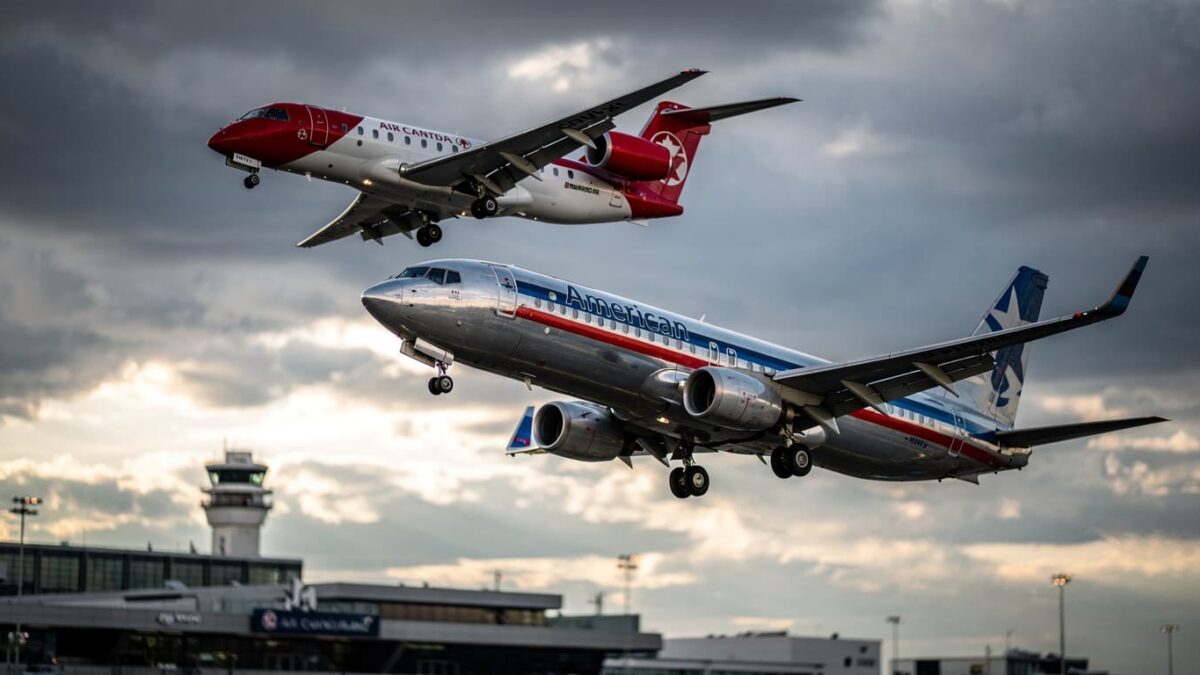
An American Airlines jet and an Air Canada Jazz flight came within approximately 350 feet vertically at John F. Kennedy International Airport on Monday, April 21, 2026, around 2:30 p.m. — half the FAA’s minimum separation standard. The Federal Aviation Administration is investigating the runway incursion after air traffic control instructed the Air Canada flight to climb to 3,000 feet following a collision warning, with the National Transportation Safety Board notified for potential full investigation.
The incident occurred when the American jet was cleared for takeoff on an intersecting runway while the Air Canada flight was on landing approach. Passengers on both carriers at JFK should monitor flight status closely — enhanced FAA inspections could trigger operational delays through the end of April.
Close call triggers federal probe at nation’s busiest international gateway
Federal authorities opened an investigation within hours of a near-collision between two commercial jets at JFK on Monday afternoon. The American Airlines aircraft had been cleared for takeoff on a runway that intersected with the Air Canada Jazz flight’s landing path.
Air traffic control recordings captured the moment controllers issued an urgent climb instruction to the Air Canada pilots after a Traffic Collision Avoidance System alert. At their closest point, the aircraft were separated by approximately 350 feet vertically — 650 feet below the FAA’s required 1,000-foot minimum during terminal operations.
The FAA classifies the event as a runway incursion, a category that includes any unauthorized aircraft, vehicle, or person on a protected runway surface. When vertical separation drops below 1,000 feet or horizontal separation falls under 5,000 feet, the NTSB receives notification for potential accident investigation.
JFK handled over 62 million passengers in 2025, making it the primary international gateway for the northeastern United States. Delta Air Lines operates approximately 500 daily flights from the airport, while American maintains over 200 daily departures from Terminal 8. Air Canada operates seven daily flights to Toronto and Montreal from the same terminal.
The incident follows a fatal collision at nearby LaGuardia Airport on March 22, 2026, when an Air Canada CRJ-900 struck a Port Authority fire truck on an active runway shortly after landing. That accident shut down LaGuardia for 14 hours and triggered a comprehensive NTSB investigation into ground vehicle protocols at New York-area airports.
The FAA’s investigation will focus on controller communications and runway assignment procedures. Federal runway safety standards require controllers to maintain positive separation between all aircraft operating in terminal airspace, with specific protocols for intersecting runway operations during simultaneous approaches and departures.
| Time | Event | Aircraft separation |
|---|---|---|
| 2:28 p.m. | American jet cleared for takeoff | Normal ops |
| 2:29 p.m. | Air Canada on final approach | Converging paths |
| 2:30 p.m. | TCAS alert, climb instruction issued | ~350 feet vertical |
| 2:31 p.m. | Separation restored | 3,000+ feet vertical |
How runway incursions escalate to federal investigations
The FAA categorizes runway incursions on a four-tier scale, with Category A representing the most severe — situations where collision is narrowly avoided. Monday’s incident likely qualifies as Category A based on the 350-foot vertical separation, which falls well below the 1,000-foot standard and triggered immediate NTSB notification.
When the NTSB opens a formal investigation, the process typically spans 90 days from initial data collection to probable cause determination. Investigators pull cockpit voice recordings, air traffic control tapes, and radar data within 48 hours. Controller work schedules, training records, and recent performance evaluations become part of the evidentiary file.
JFK’s complex runway configuration — four active runways handling simultaneous arrivals and departures — requires precise coordination between multiple controller positions. The airport’s Terminal 8 serves as American’s primary hub and Air Canada’s US gateway, with aircraft movements peaking between 2 p.m. and 4 p.m. daily.
A similar near-miss at Nashville International Airport on April 18, 2026, involved two Southwest Airlines jets that passed within 500 feet vertically after an air traffic control error directed one aircraft into another’s departure path. That incident also triggered an FAA investigation and highlighted ongoing concerns about controller workload at major US hubs.
What to do if you have JFK connections this week
Enhanced FAA inspections and operational reviews at JFK will likely reduce available runway capacity through the end of April, creating ripple effects across American and Air Canada networks.
- Monitor flight status starting 24 hours before departure — airlines will proactively cancel or delay flights if FAA imposes temporary slot restrictions. Check aa.com or aircanada.com directly rather than relying on third-party apps.
- Add 90 minutes to your connection buffer at JFK — if your itinerary includes a JFK transfer before April 30, assume ground delays of 1–2 hours. Minimum connection times published by airlines do not account for investigation-related slowdowns.
- Request same-day flight changes without fees — both American and Air Canada have waived change fees for JFK-originating flights through April 25. If your departure shows delays exceeding 2 hours, ask gate agents about earlier or later alternatives on the same day.
- Consider Newark as an alternative — Newark Liberty International Airport sits 30 minutes from JFK and serves as a United hub with comparable international connectivity. If rebooking becomes necessary, Newark may offer faster routing to your final destination.
Watch: The FAA typically releases preliminary findings within 72 hours of a runway incursion investigation. If the report confirms controller error or procedural violations, expect temporary capacity reductions at JFK lasting 10–14 days while corrective training occurs.
Will this incident affect my American or Air Canada flight at JFK this week?
Flights operating through JFK between April 22–30 face higher risk of delays due to enhanced FAA oversight and potential runway restrictions during the investigation. Monitor your flight status starting 24 hours before departure and allow an extra 90 minutes for connections.
What is a runway incursion and how common are they?
A runway incursion occurs when an aircraft, vehicle, or person enters a protected runway surface without authorization. The FAA recorded 1,732 runway incursions in 2025, with approximately 15% classified as serious (Category A or B). Most involve ground vehicles or taxiing aircraft rather than airborne near-misses.
Can I get compensation if my flight is delayed due to this investigation?
US airlines are not required to compensate passengers for delays caused by safety investigations or air traffic control issues. However, both American and Air Canada have waived change fees for JFK flights through April 25, allowing free rebooking to alternative flights or dates.
How does this compare to the LaGuardia incident last month?
The March 22 LaGuardia collision involved an Air Canada aircraft striking a fire truck on the runway after landing, resulting in fatalities and a 14-hour airport closure. Monday’s JFK incident was an airborne near-miss with no contact between aircraft, but the 350-foot separation still represents a serious safety violation requiring federal investigation.