

Southwest 737s avoid mid-air collision by 500 feet after Nashville ATC error

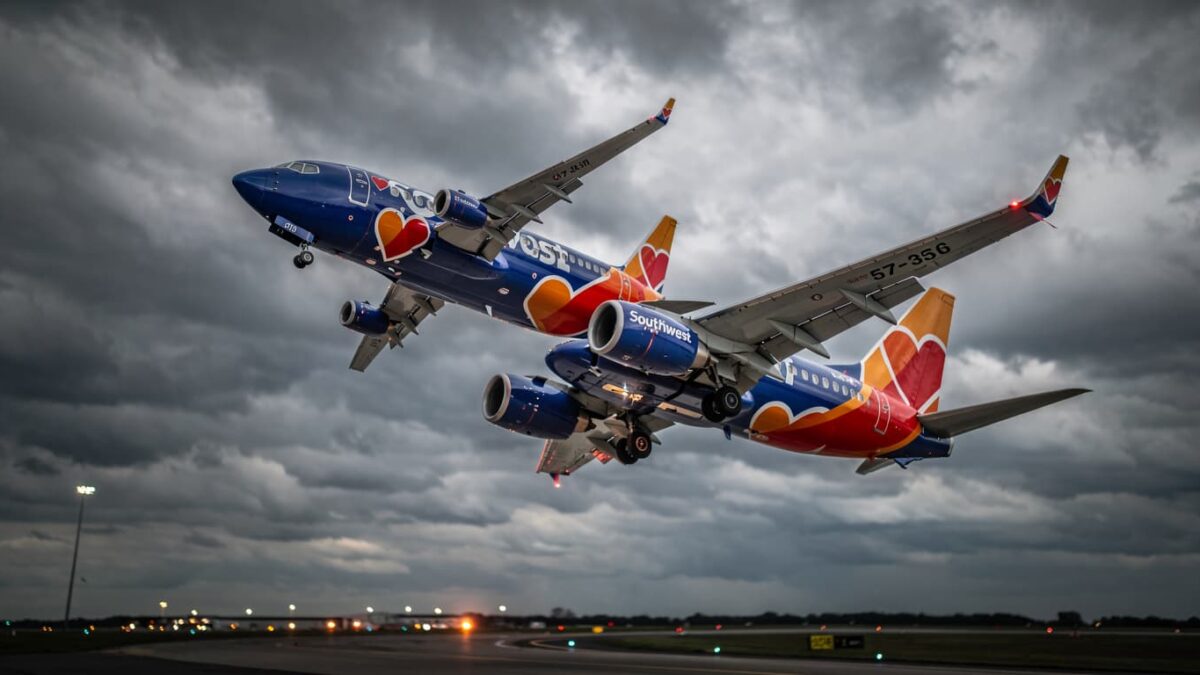
Two Southwest Airlines Boeing 737s came within 500 feet of each other near Nashville International Airport on April 18, 2026, after air traffic control directed an inbound flight performing a go-around into the path of a departing aircraft. Flight WN-507 from Myrtle Beach was cleared to turn right at 2,000 feet altitude during gusty conditions, placing it directly below WN-1152 departing for Knoxville from an adjacent runway. Cockpit collision avoidance systems intervened, and both aircraft landed safely with no injuries reported.
The FAA has launched an investigation into the incident, which occurred at 5:45 p.m. local time. A prior incident at BNA in 2024 involved Southwest and Alaska Airlines, where ATC cleared a runway crossing during takeoff, forcing an abrupt stop that deflated tires on the Alaska jet.
ATC error places two jets on collision course during go-around
An air traffic control clearance error nearly caused a mid-air collision between two commercial jets at Nashville International Airport on Saturday evening. Southwest Airlines flight WN-507, a Boeing 737 MAX-8 arriving from Myrtle Beach, initiated a precautionary go-around due to gusty crosswinds as it approached Runway 2L. Controllers then directed the aircraft to turn right at 2,000 feet — directly into the departure path of WN-1152, which was simultaneously taking off from the parallel runway bound for Knoxville.
Flight tracking data from Flightradar24 confirms the two aircraft passed within 500 feet of each other vertically, a separation distance that triggered cockpit collision avoidance warnings. The Traffic Alert and Collision Avoidance System (TCAS) — a last-resort automated warning independent of ground control — alerted both flight crews to the conflict. Pilots on both aircraft took corrective action, and WN-507 completed its go-around successfully on the second landing attempt. No passengers or crew were injured, likely because all occupants were secured in their seats during the critical phase of flight.
Southwest Airlines confirmed the incident in a statement: “We are engaged with the FAA as part of the investigation. Southwest appreciates the professionalism of its Pilots and Flight Crews in responding to the event.” The airline emphasized that safety remains its top operational priority. The FAA has opened a formal investigation, with preliminary findings expected within 30 to 45 days under standard near-miss protocols.
| Flight | Route | Aircraft | Altitude | Action |
|---|---|---|---|---|
| WN-507 | Myrtle Beach to Nashville | Boeing 737 MAX-8 | 2,000 ft | Go-around, right turn cleared |
| WN-1152 | Nashville to Knoxville | Boeing 737 | Climbing departure | Takeoff from Runway 2L |
| Separation | — | — | 500 ft vertical | TCAS alert triggered |
The incident bears similarities to a prior runway conflict at Nashville in 2024, when controllers cleared a Southwest aircraft to cross Runway 13 while Alaska Airlines flight AS367 was accelerating for takeoff. The Alaska crew aborted at 104 knots, deflating tires and stranding over 176 passengers who required rebooking. The NTSB investigation faulted ATC assumptions about aircraft positioning — a systemic issue that appears to have resurfaced in this latest event.
How parallel runway operations amplify controller workload
Nashville International Airport operates two parallel runways — 2L and 2R — that handle simultaneous arrivals and departures during peak traffic periods. This configuration increases airport capacity but demands precise coordination from controllers managing aircraft on converging flight paths. Go-arounds add complexity: an aircraft that aborts landing must be immediately sequenced back into the departure flow, often while other planes are already airborne.
The FAA certifies all US air traffic control facilities under 14 CFR Part 65 and Part 71, with quarterly audits conducted through the Air Traffic Safety Oversight program. Near-misses classified as Level 1 — high-risk events where collision was narrowly avoided — trigger immediate reporting to NASA’s Aviation Safety Reporting System and a formal FAA investigation within 24 hours. Preliminary findings typically emerge within 30 to 45 days, with final reports issued six to twelve months later.
Recent FAA initiatives have targeted controller staffing and technology gaps. The agency hired 1,800 new controllers in 2025–2026 to address chronic understaffing, and NextGen ADS-B (Automatic Dependent Surveillance-Broadcast) upgrades at more than 400 towers have reduced mid-air conflict rates by 37% according to agency data. Nashville’s tower received ADS-B certification in Q1 2026 and passed its most recent compliance audit.
Despite these improvements, high-density airports like Nashville — which handled 22 million passengers in 2025 — remain vulnerable during weather events that force go-arounds. Gusty crosswinds, the trigger for WN-507’s aborted landing, are common in spring months across Tennessee. Controllers must balance runway throughput with separation standards, and a single miscommunication can compress safety margins to dangerous levels within seconds.
What to do if you have Nashville flights booked
The FAA investigation may result in temporary operational changes at Nashville International Airport, including modified departure procedures or reduced runway capacity during peak hours.
- Check flight status proactively: Monitor southwest.com/air/flight-status or your carrier’s app for real-time updates. Delays of 20–60 minutes are possible during the investigation period, particularly for flights using Runway 2L.
- Review FAA NOTAMs: Visit notams.aim.faa.gov and search for BNA to identify any runway restrictions or procedural changes issued after April 18. NOTAMs provide advance notice of operational limitations that may affect your departure or arrival.
- Build connection buffers: If connecting through Nashville, allow a minimum of 90 minutes between flights — 45 minutes longer than the standard minimum connection time. Investigation-related delays can cascade through the day’s schedule.
- Know your rebooking rights: US DOT rules require airlines to rebook passengers on the next available flight at no charge if delays exceed 2–12 hours depending on route length. If your flight is canceled due to operational restrictions, request a full refund if rebooking doesn’t meet your needs.
- Consider alternative airports: Birmingham International Airport (BHM), 150 miles south, offers lower-cost parking and less congestion. If flexibility allows, routing through BHM may avoid Nashville-specific delays during the investigation window.
Watch: The FAA’s preliminary report, expected by mid-May 2026, will reveal whether mandatory controller retraining or frequency reductions on Runway 2L are required.
What is TCAS and how did it prevent this collision?
TCAS (Traffic Alert and Collision Avoidance System) is an automated cockpit warning system that operates independently of ground control. It monitors nearby aircraft using transponder signals and issues two types of alerts: traffic advisories (TA) when another plane is nearby, and resolution advisories (RA) when collision risk is imminent. In this incident, TCAS likely issued RAs to both flight crews, directing one aircraft to climb and the other to descend or maintain altitude, creating immediate vertical separation.
How common are near-miss incidents at US airports?
The FAA classifies near-misses into severity levels A through D, with Level A representing the highest collision risk. Approximately 300–400 runway incursions and airspace conflicts occur annually across the US National Airspace System, though fewer than 5% reach Level A or B severity. Automation systems like TCAS and ground-based conflict alerts prevent the vast majority from progressing to actual collisions — the last fatal mid-air collision involving commercial airliners in US airspace occurred in 1978.
Will this incident affect Southwest’s safety rating?
No. The incident resulted from an air traffic control clearance error, not airline operational failure. Southwest’s pilots followed ATC instructions and responded appropriately to TCAS alerts. The FAA investigation focuses on tower procedures at Nashville International Airport, not the airline’s safety practices. Southwest maintains a strong safety record and holds full FAA certification with no current operational restrictions.
Should I avoid flying through Nashville until the investigation concludes?
No. The incident was isolated and did not result in damage or injury. Nashville International Airport remains fully operational with normal safety protocols in place. The FAA investigation may lead to procedural refinements, but these improve safety margins rather than indicate ongoing risk. If you have concerns about specific flights, monitor NOTAMs for any temporary runway restrictions, but there is no safety-based reason to avoid the airport.