
Emirates flights from Australia diverted after drone strike near Dubai International Airport

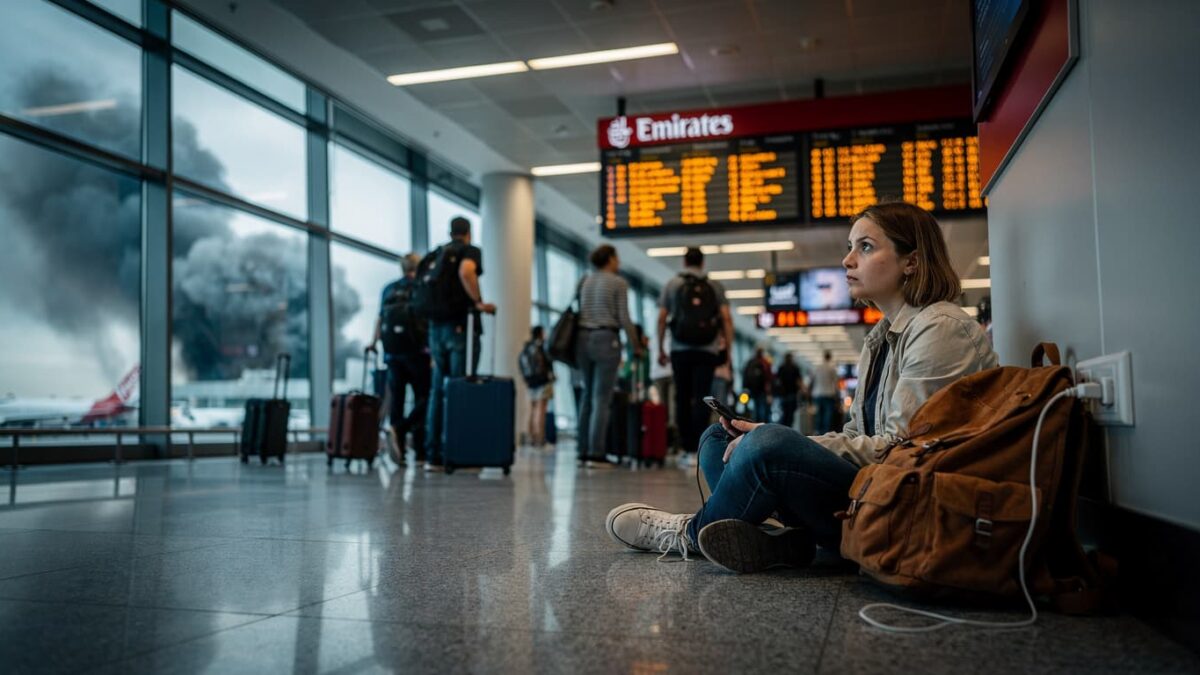
A suspected Iranian drone strike ignited a fuel tank near Dubai International Airport on March 16, 2026, forcing Emirates flights from Sydney, Melbourne, and Perth to divert mid-approach. This marks the third attack on Gulf hubs since February 28, with over 3,000 flights canceled region-wide and DXB operations disrupted through at least March 17.
Australian travelers on affected Emirates flights qualify for full refunds or rebooking under Australian Consumer Law. The attack follows earlier strikes that damaged Terminal 3 and caused fires at the Burj Al Arab, stranding 10,000+ passengers across multiple incidents.
Smoke plumes from a burning fuel depot forced Emirates pilots to abort landings at Dubai International on Sunday morning, diverting flights carrying Australian passengers to Muscat and other Gulf alternates. The Dubai Media Office confirmed Civil Defence crews contained the fire, which erupted after a suspected Iranian drone strike hit infrastructure near the airport’s eastern perimeter.
Flight EK414 from Sydney and EK406 from Melbourne were among the diverted aircraft.
This is the third Iranian attack targeting Gulf aviation hubs since late February, following strikes on March 3 that damaged DXB’s Terminal 3 concourse and injured ground staff. The February 28 salvo temporarily shut Emirates operations entirely, grounding the carrier’s 270-aircraft fleet for 48 hours. Australian travelers now face cascading delays on connections through Dubai to Europe, Africa, and South Asia — routes that funnel 60% of Emirates’ long-haul traffic through the DXB hub.
What happened at Dubai International
The fuel tank fire erupted at approximately 6:20 AM local time on March 16, sending black smoke across DXB’s southern approach path. Air traffic control issued immediate holding instructions to inbound aircraft, with at least six Emirates flights — including services from Australia, India, and the UK — entering circling patterns over the Gulf of Oman while crews assessed diversion options.
The General Civil Aviation Authority approved emergency landings at Muscat International, which absorbed the bulk of diverted traffic, and Al Maktoum International, Dubai’s secondary airport 37 kilometers south of DXB. Passengers reported delays of 4–7 hours before ground transport could shuttle them to their original destination.
This follows a March 3 missile salvo that struck Terminal 3’s western concourse, forcing flight EK501 from Mumbai and EK500 from Bangalore to divert mid-descent — a pattern now repeating with Australian services. The earlier attack also ignited fires at the Burj Al Arab, injuring hotel staff and grounding Emirates for two days while damage assessments cleared runways of debris.
| Date | Target | Impact | Flights affected |
|---|---|---|---|
| Feb 28 | DXB airspace | 48-hour suspension | 270+ aircraft grounded |
| Mar 3 | Terminal 3, Burj Al Arab | Concourse damage, staff injuries | EK500, EK501 diverted |
| Mar 16 | Fuel depot near DXB | Fire, holding patterns | EK414, EK406, 4+ others diverted |
Economy return fares from Sydney to Dubai currently sit at AUD 1,820 for late March travel, though Australian travelers considering Gulf routing now face material operational risk through at least mid-April as Iranian strikes show no pattern of de-escalation.
How this affects Australian connections
Emirates operates 42 weekly flights from Australia — 21 from Sydney, 14 from Melbourne, 7 from Perth — making it the dominant carrier for Australians traveling to Europe, the Middle East, and Africa via DXB. The March 16 diversions severed onward connections for passengers booked on same-day services to London, Paris, and Frankfurt, with rebooking queues at Muscat stretching past midnight as ground staff processed 800+ stranded travelers.
Australian Consumer Law mandates full refunds or alternative transport when a carrier cannot deliver the purchased service, giving affected passengers stronger protection than US or EU travelers on the same flights. Emirates has waived change fees for bookings through March 31, but the carrier’s DXB-centric network offers limited rerouting options — unlike Qatar Airways or Singapore Airlines, which maintain hub redundancy through Doha and Singapore.
For context, over 3,000 flights have been canceled across the Middle East since late February, with Emirates suspending operations twice and Etihad Airways diverting Abu Dhabi services to Muscat on multiple occasions. The cumulative effect mirrors Russia airspace closures in 2022, where geopolitical events forced sudden network recalibrations — except this time, the disruption sits at the hub itself, not the routing around it.
Rebooking and refund process
Emirates has not resumed normal DXB operations as of March 17, 06:00 UTC — check flight status before airport departure.
- Immediate action: Open the Emirates app or visit emirates.com/au/english/track-flight/ to confirm your flight status. If diverted or canceled, request rebooking via the app’s “Manage Booking” function or call 1800 700 199 (Australia toll-free). Hold times exceed 90 minutes during peak disruption.
- Refund eligibility: Australian Consumer Law guarantees a full refund if Emirates cannot provide the service within a reasonable timeframe. Request via the app under “Refund Request” — processing takes 7–10 business days to the original payment method.
- Alternate routing: Qantas codeshares via Singapore and Doha remain operational, though availability is constrained. Singapore Airlines and Qatar Airways have opened additional inventory for stranded Emirates passengers, with fare differences waived if booked within 48 hours of the original departure.
- Travel insurance: Policies covering “civil unrest” or “acts of war” may reimburse accommodation and rebooking costs. File claims with receipts for hotel stays in Muscat or alternate cities — most insurers require documentation within 30 days.
- Monitor advisories: Australia’s Smart Traveller has elevated the UAE to “reconsider your need to travel” (Level 3). If you proceed, register your trip at smartraveller.gov.au for consular updates.
Watch: Emirates’ April schedule filing, due March 20, will reveal whether the carrier reduces DXB frequencies or shifts capacity to Al Maktoum International as a contingency hub.
Are Emirates flights from Australia still operating?
As of March 17, 2026, Emirates has not confirmed full resumption of DXB operations. Flights are operating on a case-by-case basis with potential diversions to Muscat or Al Maktoum International. Check your specific flight status via the Emirates app before heading to the airport — do not assume scheduled departures will proceed as filed.
Can I switch my Emirates booking to Qatar Airways or Singapore Airlines?
Yes, if Emirates cannot accommodate you within 24 hours of your original departure. Contact Emirates directly to request an interline transfer — both Qatar Airways and Singapore Airlines have opened limited inventory for stranded passengers. Expect fare differences to be waived only if the rebooking occurs within 48 hours of the disruption and you provide proof of the canceled Emirates flight.
Does travel insurance cover drone strikes?
It depends on your policy’s “civil unrest” or “acts of war” clauses. Standard trip interruption coverage typically excludes military action, but some comprehensive policies include civil unrest provisions that may apply. Review your policy document or contact your insurer directly — provide the March 16 incident date and Emirates flight numbers as reference. Claims require receipts for accommodation, meals, and rebooking costs incurred due to the diversion.
Is it safe to fly through Dubai right now?
The UAE General Civil Aviation Authority has not issued a blanket flight ban, but operations remain disrupted and unpredictable. Australia’s Smart Traveller advisory recommends reconsidering travel to the UAE due to the heightened threat of missile and drone attacks. If you must travel, monitor real-time flight tracking via Flightradar24 and maintain flexible rebooking options — rigid itineraries carry significant risk of multi-day delays.
