Middle East conflict costs tourism €515 million daily, rerouting 526,000 passengers from Gulf hubs

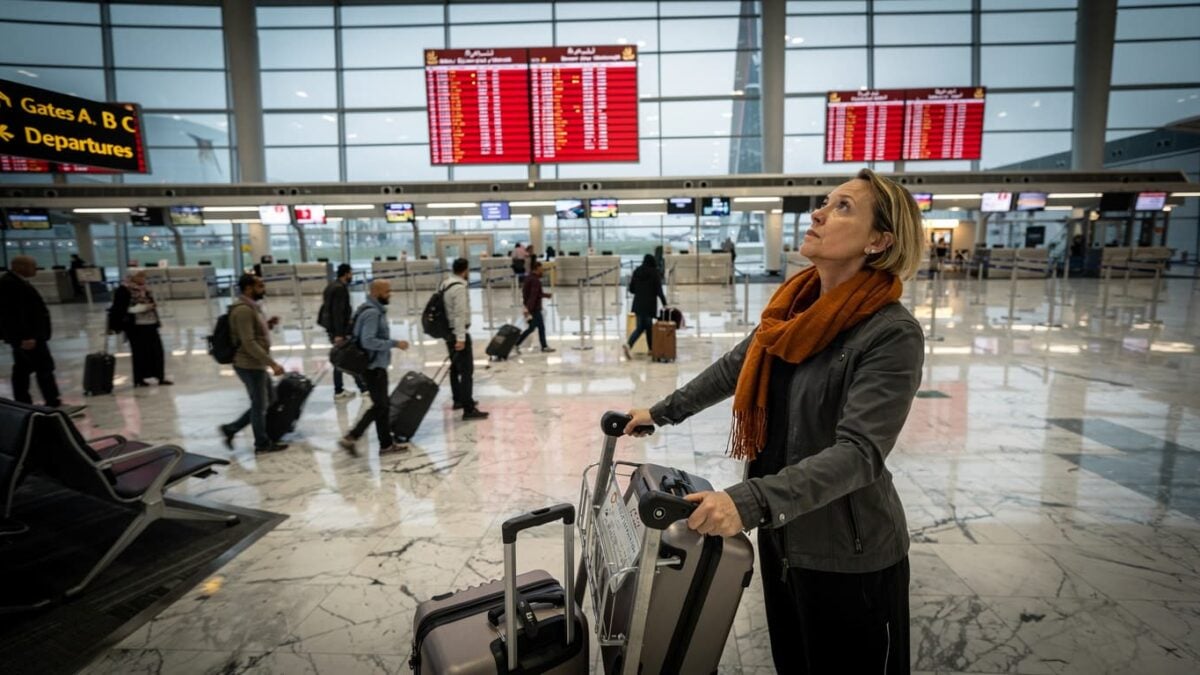
The Iran-US conflict is costing Middle East tourism €515 million per day in lost visitor spending, with Gulf hub cancellations pushing travelers from Australia, North America, and Europe toward direct Asia and Europe routes instead. Airlines including Qantas and Cathay Pacific report rising bookings for Thailand, Indonesia, and European destinations as passengers reroute around Dubai, Abu Dhabi, and Doha — hubs that normally process 526,000 passengers daily but saw over 5,000 flight cancellations in the conflict’s first 48 hours.
The shift is voluntary — no government travel bans are in place for Gulf transits — but the disruption window remains open through at least mid-March as airspace restrictions continue. Southeast Asia faces a secondary hit: fewer European travelers using Middle East hubs to reach Bangkok or Bali means reduced inbound traffic for the region’s tourism-dependent economies.
Travelers at Sydney International Airport are canceling Dubai connections and rebooking direct flights to Bangkok, Singapore, and European cities, according to passenger interviews and airline booking data. The pattern mirrors behavior across departure cities in North America and Europe, where the Iran conflict’s disruption to Gulf aviation hubs is reshaping route preferences for the next 60–90 days.
Qantas, Cathay Pacific, and Lufthansa confirm increased demand for non-Gulf routes. The World Travel & Tourism Council estimates the Middle East will lose 23 to 38 million visitors in 2026 — an 11–27% decline year-over-year — with total spending losses reaching $34–56 billion depending on conflict duration.
Gulf hubs handle 14% of global international transit traffic. When Dubai, Abu Dhabi, and Doha close or reduce operations, the ripple extends to Europe-Asia flows that depend on those connection points. Australian travelers bound for Europe via Emirates now face either a Southeast Asia stopover or a longer nonstop to London. North American passengers lose one-stop access to South Asia through Doha.
How the conflict disrupted the Gulf transit model
The GCC nations — UAE, Saudi Arabia, Qatar, Bahrain — rely almost entirely on air arrivals for inbound tourism, unlike countries with land borders that can absorb visitor shifts. When airspace restrictions began on March 9, over 5,000 flights were canceled within 48 hours across Dubai, Abu Dhabi, and Doha. Stranded passengers and evacuation priorities took precedence over leisure connections, leaving codeshare routes between Europe and Asia-Pacific without their usual hub capacity.
Oxford Economics projects the conflict will cut Middle East inbound arrivals by a minimum of 23 million visitors if resolved within weeks, or 38 million if it extends through Q2. That’s worse than prior regional security incidents — including 2024 tensions — because this time the disruption hit all three major GCC hubs simultaneously, not just one city or carrier.
For context: the 2024 Middle East tensions saw tourism recover within two months due to government repatriation support and limited geographic scope. This conflict’s wider footprint means recovery timelines are less predictable, though WTTC notes the region’s tourism infrastructure remains intact — the issue is access, not capacity.
Australian travelers shifting from Emirates Dubai connections to direct flights from Australia to Thailand or Indonesia are part of a broader recalibration. European passengers face similar choices: a nonstop to Singapore via Singapore Airlines, or a longer Europe-Asia leg without the Gulf stopover that previously broke the journey.
| Scenario | Visitor decline | Spending loss | Daily cost |
|---|---|---|---|
| Short conflict (weeks) | 23 million (11%) | $34 billion | €515 million |
| Extended conflict (Q2) | 38 million (27%) | $56 billion | €515 million |
| Pre-conflict forecast | — | $207 billion | — |
The secondary hit to Southeast Asia
Thailand, Cambodia, and Indonesia face an indirect tourism dip. European travelers who previously flew London–Dubai–Bangkok now either book a nonstop to Bangkok (if available and affordable) or choose a closer European destination instead. The Gulf hubs acted as fare-competitive gateways to Southeast Asia — when those hubs close, the economics shift.
Thai Airways and Singapore Airlines report increased European bookings for direct services, but the volume doesn’t fully replace the connecting traffic that Gulf carriers funneled into the region. A London–Bangkok nonstop costs more than a one-stop via Dubai, and not every European city has nonstop Asia service. The gap shows up as reduced hotel occupancy in Phuket and Bali — destinations that depend on European winter escapees.
For Australian travelers, the shift is less painful. Sydney already has nonstop options to Bangkok, Singapore, and Jakarta via Qantas, Jetstar, and Singapore Airlines. The Dubai route was a preference, not a necessity. North American travelers lose more: the Doha hub provided efficient one-stop access to India and Southeast Asia that now requires either a longer Pacific routing or a European connection.
Rerouting your trip around Gulf hubs
Gulf connections remain operationally possible — airlines are flying, just with reduced frequency and higher cancellation risk. The decision to reroute is about risk tolerance, not government mandate.
- Check direct options first. Sydney–Bangkok, London–Singapore, and Los Angeles–Tokyo nonstops avoid the Gulf entirely. Fares are higher, but the disruption risk is zero.
- Use airline apps for real-time alerts. Emirates, Etihad, and Qatar Airways push notifications for schedule changes. Enable them if you have a Gulf connection booked.
- Consider Southeast Asia stopovers. A Sydney–London trip via Singapore or Bangkok adds a day but eliminates Middle East exposure. Airspace closures already force some carriers to reroute south — a deliberate stopover turns that into an advantage.
- Monitor government travel advisories. Australia’s Smartraveller, the US State Department, and UK FCDO update Gulf hub guidance daily. No current bans exist, but that can change.
Watch: If Gulf carriers don’t restore full April schedules by March 20, expect fare increases on Europe-Asia nonstops as demand concentrates on non-Gulf routes.
Are Gulf hub transits currently banned for travelers?
No government has banned Gulf transits. Airlines are operating Dubai, Abu Dhabi, and Doha connections with reduced frequency and higher cancellation risk due to airspace restrictions. The decision to avoid Gulf hubs is passenger preference, not regulatory requirement.
Will fares on direct Asia routes increase due to this shift?
Yes, when demand concentrates on fewer routes, fares rise. Europe-Asia nonstops that bypass the Gulf are already seeing higher load factors. If Gulf disruptions extend past March, expect sustained fare increases on direct services as airlines recognize the demand shift is structural, not temporary.
How does this affect frequent flyer award availability?
Gulf carrier award seats — particularly Emirates and Qatar Airways — are easier to find right now due to reduced leisure demand. But if you’re avoiding Gulf hubs, nonstop award space on Singapore Airlines, Cathay Pacific, and Qantas is tighter than usual as travelers rebook onto those carriers.