
Over 100,000 Australians stranded in Middle East after 27,000 flight cancellations

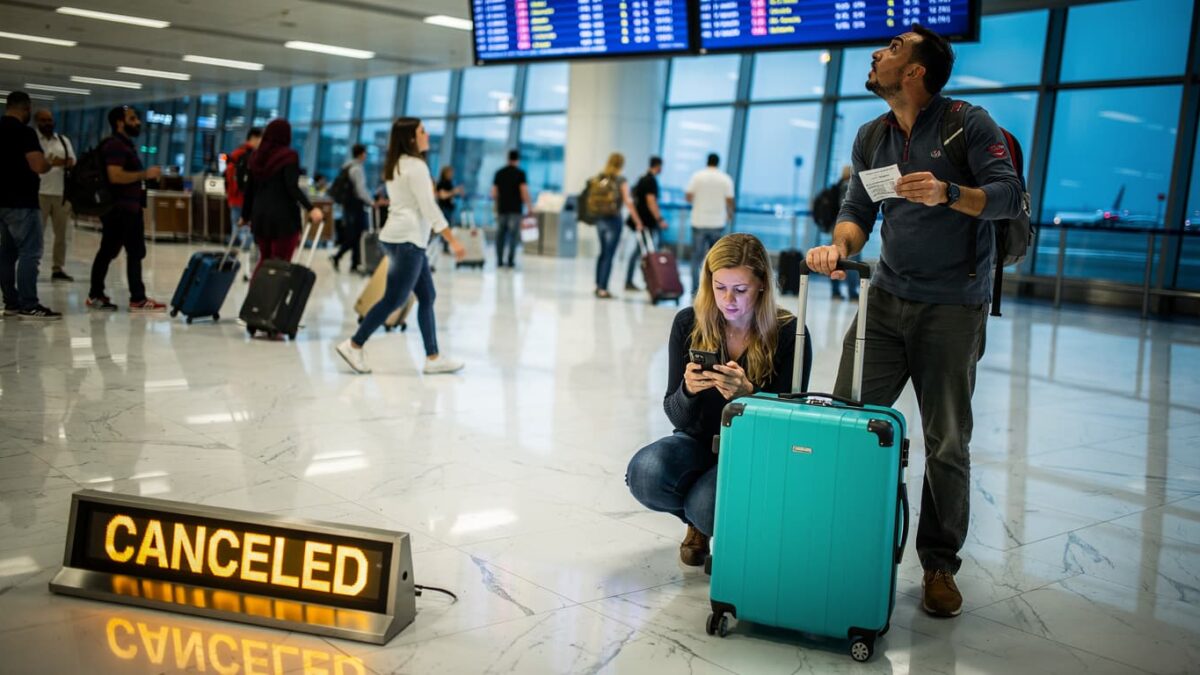
Over 100,000 Australians remain stranded across the Middle East as of March 9, 2026, following 27,000+ flight cancellations triggered by US-Israeli-Iranian conflict that closed Gulf airspace on February 28. Prime Minister Anthony Albanese issued an urgent directive for stranded citizens to board any available commercial flight from Dubai, Doha, or Riyadh — even half-empty ones — as limited repatriation operations face uneven demand and seats are filling unpredictably.
Eight flights have departed since March 4 carrying 2,600+ Australians home, but some returned half-full despite thousands still waiting. DFAT is coordinating bus transits to Riyadh and funding accommodation, but the window to secure seats is narrowing as Qatar’s airspace reopens partially with no guarantee of sustained operations.
Australian citizens trapped in the Middle East since late February face a shrinking evacuation window as the federal government scrambles to fill commercial flights departing Dubai and Riyadh. The plea from Canberra is blunt: take the seat offered, even if the flight appears under-booked.
The crisis began when Iranian missile strikes on Israeli targets triggered retaliatory US airstrikes, forcing the closure of airspace over Qatar, the UAE, and Bahrain. Major hubs like Dubai International and Hamad International in Doha — critical connection points for Australian travelers — went dark overnight. Qantas and Emirates suspended services through the Gulf, leaving passengers stranded mid-journey or unable to return home from holidays and business trips.
Since March 4, eight commercial flights have carried Australians out of the region, but the Department of Foreign Affairs and Trade reports uneven uptake. Some flights departed with empty rows despite thousands registered on the Crisis Portal. The mismatch stems from travelers scattered across multiple countries, visa complications, and the logistical challenge of reaching departure cities like Riyadh, which requires overland transit from Qatar or the UAE.
How the repatriation is unfolding
DFAT is directing Australians toward Riyadh for the highest likelihood of securing a seat. A bus transit from Doha to the Saudi capital carried 92 passengers last week, while another 68 flew from Doha to Europe for onward connections to Australia. The government is covering accommodation costs in Riyadh for those awaiting flights, but the offer hinges on travelers reaching the city first.
Qatar’s partial airspace reopening has allowed limited commercial departures from Doha, but the operational environment remains fragile. Airlines are prioritizing commercial flights over military evacuations to avoid shoot-down risks in contested airspace — a lesson learned from the 2022 Russia-Ukraine war, when civilian aircraft faced heightened danger in conflict zones. The strategy keeps costs lower and avoids diplomatic complications, but it also means capacity is constrained by what carriers are willing to risk.
| Departure city | Flights operated | Passengers returned | Key challenge |
|---|---|---|---|
| Dubai | 3 | ~980 | Half-empty flights despite demand |
| Riyadh | 3 | ~920 | Overland transit required from Qatar/UAE |
| Doha | 2 | ~700 | Airspace partially closed, limited slots |
Between the lines
The half-empty flights point to a coordination gap that’s common in rapid-onset crises. Australians registered on the Crisis Portal receive SMS alerts about available seats, but the 24–48 hour window to reach the departure city often proves too tight for those in Bahrain, Kuwait, or Lebanon. DFAT’s bus transits help, but they require advance booking and can’t accommodate travelers with mobility issues or large families on short notice.
The government’s insistence on commercial over military flights also reflects cost containment — a chartered evacuation flight can run AUD 2–3 million, while subsidizing commercial seats costs a fraction. But it leaves travelers vulnerable to airline pricing: some have reported fares as high as AUD 15,000 for economy seats, prompting Canberra to pressure carriers on gouging.
Cross-border taxi services have emerged as an alternative for those unable to wait for government-coordinated transports. Drivers report increased demand for trips to Oman or UAE border crossings, where travelers can catch flights from Muscat or Abu Dhabi. However, restrictions prevent taxis from entering Saudi Arabia, forcing passengers to arrange separate transport once across the border.
Why this crisis is worse than 2022’s airspace closures
The current Gulf shutdown eclipses the 2022 Russia-Ukraine war’s impact on Middle East aviation. When Russian airspace closed to Western carriers in early 2022, airlines rerouted flights over the Middle East and Central Asia, adding 2–4 hours to Europe-Australia journeys and raising fuel costs. But the closures were partial and predictable — carriers adjusted schedules within weeks, and Russian airspace partially reopened by mid-2023.
The US-Israeli-Iranian conflict offers no such clarity. Airspace over Qatar, the UAE, and Bahrain remains contested, with no timeline for full reopening. The 27,000+ flight cancellations since February 28 dwarf the 2022 disruptions, which affected specific routes rather than entire hub operations. Dubai International alone handles 1,200+ daily flights in normal conditions; its near-total shutdown has cascading effects across Asia-Pacific connectivity.
For Australian travelers, the Gulf hubs are irreplaceable. Qantas and Emirates operate a joint venture that funnels most Europe-bound traffic through Dubai, while Qatar Airways serves as the primary carrier for Doha connections. Alternative routings via Singapore, Bangkok, or Hong Kong add 6–10 hours and often require positioning flights within Australia to reach the right departure city. The government’s “do not travel” advisories now cover 11 Middle Eastern countries, triggering stronger consular obligations than equivalent US State Department warnings — but also limiting future travel options as insurers exclude conflict zones.
What to do if you’re still in the region
Register immediately on the DFAT Crisis Portal for Bahrain, Kuwait, Lebanon, Iran, Israel, Qatar, or the UAE. Call +61 2 6261 3305 for assistance reaching Riyadh or Doha. Registration triggers SMS alerts when seats become available, but response time is critical — flights can fill within hours of notification.
Maintain all existing bookings and accept any seat offered on Qantas or commercial repatriation flights, even if the flight appears under-booked. The government’s plea reflects genuine concern that travelers are waiting for “better” options that may not materialize. Half-empty flights suggest some are holding out for direct routings or lower fares, but the operational window is narrowing.
Consider overland transit to Riyadh if you’re in Qatar or the UAE. DFAT is coordinating bus services and covering accommodation costs in the Saudi capital, where flight availability is higher than Dubai or Doha. Verify eligibility for accommodation support before departing — the program prioritizes families and those with medical needs.
Monitor real-time flight status on FlightAware for departures from Muscat, Abu Dhabi, and Riyadh. If you’re considering a cross-border taxi to Oman or the UAE, confirm the driver can reach the border crossing and arrange onward transport in advance. Restrictions prevent Saudi entry by taxi, requiring separate coordination once you cross.
Watch: Qatar Airways’ schedule filings for the next 72 hours will signal whether Doha operations are stabilizing or remain ad hoc. A return to regular frequency on the Doha–Sydney route would indicate the worst of the airspace closures has passed.
Can I get a refund if I paid for a flight that was cancelled due to the conflict?
Airlines are required to refund cancelled flights under Australian Consumer Law, but processing times can stretch 4–8 weeks during mass disruption events. If you rebooked on an alternative carrier at a higher fare, keep receipts — you may be able to claim the difference from your original airline, though success depends on the carrier’s force majeure policy. Travel insurance policies that exclude “acts of war” will not cover conflict-related cancellations unless you purchased a specific conflict coverage rider before the war began.
What if I’m in a country not listed in the DFAT Crisis Portal registration?
The Crisis Portal currently covers Bahrain, Kuwait, Lebanon, Iran, Israel, Qatar, and the UAE. If you’re stranded in a neighboring country like Oman or Jordan, call the 24-hour Consular Emergency Centre at +61 2 6261 3305 to register manually. DFAT can coordinate assistance even outside formal crisis zones, but response times may be longer and accommodation support is not guaranteed.
Are there any flights operating normally from the Middle East to Australia?
No direct flights from Gulf hubs are operating at normal frequency as of March 9, 2026. Limited commercial departures from Doha and Riyadh are the only options, with most requiring connections through Europe or Asia. Singapore Airlines and Thai Airways are maintaining services from their home hubs, but reaching Singapore or Bangkok from the Middle East requires overland transit or positioning flights through secondary cities like Muscat or Amman.
How long will the airspace closures last?
No official timeline exists. The 2022 Russia-Ukraine war saw partial airspace reopenings within 6–8 months, but the current conflict involves active missile exchanges and no ceasefire negotiations. Aviation authorities in Qatar and the UAE have not published reopening schedules, and airlines are filing schedules on a 48–72 hour rolling basis rather than committing to long-term operations.
